8  Interoperability Fundamentals

Chapter Topic
Stream Processing Overview of batch vs. stream processing for IoT
Fundamentals Windowing strategies, watermarks, and event-time semantics
Architectures Kafka, Flink, and Spark Streaming comparison
Pipelines End-to-end ingestion, processing, and output design
Challenges Late data, exactly-once semantics, and backpressure
Pitfalls Common mistakes and production worked examples
Basic Lab ESP32 circular buffers, windows, and event detection
Advanced Lab CEP, pattern matching, and anomaly detection on ESP32
Game & Summary Interactive review game and module summary
Interoperability Four levels of IoT interoperability
Interop Fundamentals Technical, syntactic, semantic, and organizational layers
Interop Standards SenML, JSON-LD, W3C WoT, and oneM2M
Integration Patterns Protocol adapters, gateways, and ontology mapping
In 60 Seconds

IoT interoperability operates at four progressive levels: Technical (network connectivity), Syntactic (data format), Semantic (shared meaning), and Organizational (business process alignment). The critical insight is that 80% of integration failures stem from semantic misalignment – systems using the same JSON format but interpreting data differently – not from protocol incompatibility.

Key Concepts
  • Interoperability: Ability of different IoT systems, devices, and platforms to exchange data and work together without custom integration code for each pair
  • Technical Layer Interoperability: Physical and protocol compatibility — devices can exchange bits using compatible electrical interfaces and protocol implementations
  • Syntactic Interoperability: Agreement on data format (JSON, XML, CBOR, Protocol Buffers) allowing one system to parse another’s messages structurally
  • Semantic Interoperability: Shared understanding of data meaning — both systems know that field temp_c means temperature in Celsius as defined by a shared ontology
  • Organizational Interoperability: Aligned policies, governance, and business processes enabling cross-organizational IoT data sharing without manual mediation
  • Protocol Heterogeneity: Diversity of communication protocols (MQTT, CoAP, AMQP, HTTP, Zigbee, BLE) in IoT deployments requiring gateways for interoperability
  • Data Model Heterogeneity: Different devices representing the same physical quantity differently (temperature as Celsius float vs. Fahrenheit int16 vs. Kelvin fixed-point)
  • Semantic Gap: Distance between what data technically says and what it means in context — bridged by ontologies, metadata, and semantic annotations

Learning Objectives

After completing this chapter, you will be able to:

  • Classify the four levels of IoT interoperability (technical, syntactic, semantic, organizational) and trace how each builds on the one below
  • Diagnose interoperability challenges in IoT ecosystems by mapping failures to specific levels
  • Trace integration failures through the four-level model to pinpoint the root cause
  • Justify why syntactic alignment alone is insufficient for true interoperability using real-world failure examples
  • Evaluate the maturity of interoperability in existing systems against a four-level rubric

8.1 Prerequisites

Before diving into this chapter, you should be familiar with:

  • Networking Basics: Understanding network protocols (HTTP, MQTT, CoAP) and communication patterns is essential for comprehending protocol translation challenges
  • Data Storage and Databases: Knowledge of data formats and database schemas provides foundation for understanding syntactic interoperability
  • Basic JSON and XML: Understanding these common data interchange formats is necessary for working with IoT standards
Artistic visualization of interoperability layers showing technical connectivity at the base, syntactic format translation above, semantic meaning alignment in the middle, and organizational process harmonization at the top, with integration bridges connecting adjacent layers
Figure 8.1: Interoperability operates at multiple abstraction levels. Technical interoperability ensures physical connectivity. Syntactic interoperability standardizes data formats. Semantic interoperability aligns meaning and context. Organizational interoperability harmonizes business processes. Complete interoperability requires addressing all levels, with each layer building upon the foundation below.

8.2 Getting Started (For Beginners)

What is Interoperability? (Simple Explanation)

Analogy: Interoperability is like having a universal translator at a United Nations meeting.

Imagine a room with delegates speaking English, French, Mandarin, and Arabic. Without translators, they can’t work together. IoT devices have the same problem—different “languages” (protocols), different “accents” (data formats), and different “meanings” (semantics).

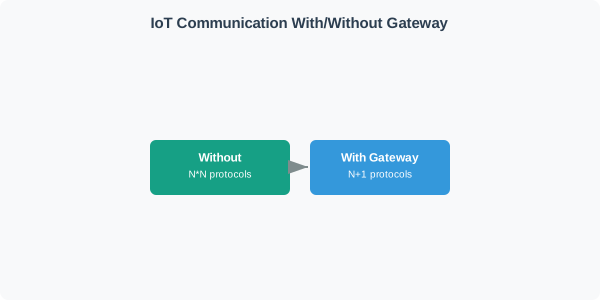
Two scenarios: devices failing to communicate without interoperability vs seamless data sharing through a gateway
Figure 8.2: IoT Device Communication With and Without Interoperability Gateway
The Four Levels of Interoperability

Think of it like communicating with someone from another country:

Level What It Means Real-World Analogy IoT Example
Technical Can connect Both have working phones Both devices on same network
Syntactic Same format Both use written letters Both devices use JSON
Semantic Same meaning Both understand “hot” means temperature Both know “temp” = temperature
Organizational Same process Both follow postal rules Both use MQTT protocol
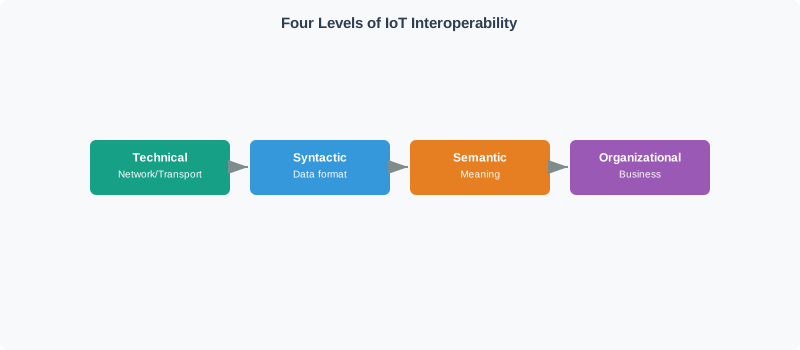
Four progressive interoperability levels: technical connectivity, syntactic format, semantic meaning, organizational process
Figure 8.3: Four Levels of IoT Interoperability from Technical to Organizational

This view shows interoperability as a series of translation steps data must pass through:

Translation pipeline showing data flowing through technical, syntactic, semantic, and organizational layers

Each interoperability layer transforms data to a higher level of abstraction, from raw bits to business-ready information.

Why Interoperability Is Hard

The IoT world has a fragmentation problem:

Challenge Example Impact
Too many protocols MQTT, CoAP, HTTP, Zigbee, Z-Wave… Devices can’t talk to each other
Vendor lock-in Philips Hue, Samsung SmartThings Buy all from one brand or nothing works
Different data formats JSON, XML, binary, proprietary Need converters everywhere
Different meanings “humidity: 50” vs “rh: 0.5” Same data, different interpretations

Real Example: Smart Home Chaos

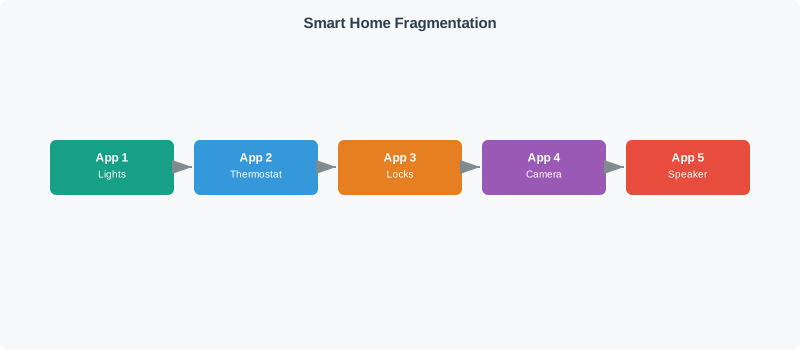
Smart home fragmentation: user managing five separate apps for lights, thermostat, doorbell, lock, and speaker
Figure 8.4: Smart Home Fragmentation with Five Apps and Incompatible Devices
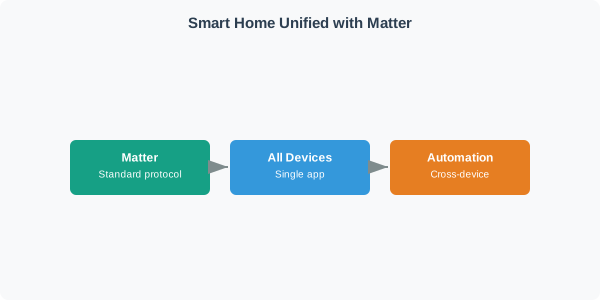
Unified smart home with Matter standard: all devices connected through one hub, enabling cross-device automation
Figure 8.5: Alternative view: With a unified interoperability standard like Matter, all devices communicate through one hub using one app. Cross-device automation becomes possible - motion sensors trigger lights, doorbells notify locks, and thermostats adjust when you leave.
The Solution: Standards and Adapters

How do we fix interoperability?

Solution What It Does Example
Standard data formats Everyone uses same structure JSON-LD, SenML
Protocol gateways Translate between protocols Zigbee-to-MQTT converter
Semantic ontologies Define shared meanings “temperature” = specific unit
Universal standards New protocols everyone adopts Matter for smart home

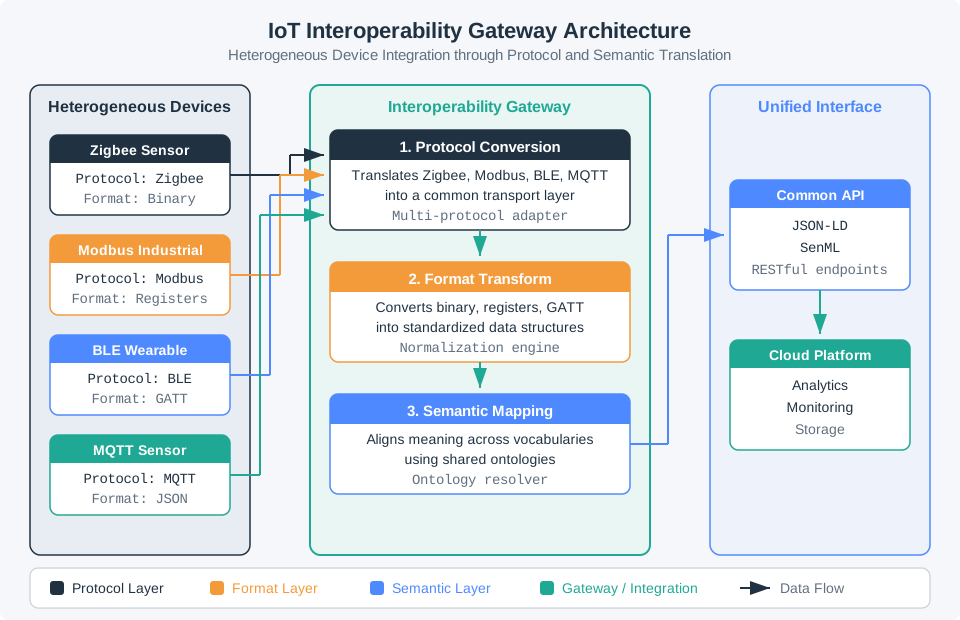
Three-stage data flow diagram showing heterogeneous device integration through interoperability gateway. Left section (Heterogeneous Devices) shows Zigbee Sensor, Modbus Industrial device, and BLE Wearable using different protocols. Middle section (Interoperability Gateway) contains three sequential processing layers: Protocol Conversion handles multiple protocol translations, Format Transform standardizes data structures, and Semantic Mapping aligns meaning across different vocabularies. Right section (Unified Interface) shows output as Common API using JSON-LD and SenML standards, feeding into Cloud Platform.

Interoperability gateway architecture showing heterogeneous devices connecting through protocol conversion, format transformation, and semantic mapping to unified cloud interface
Figure 8.6: Interoperability Gateway with Protocol and Semantic Translation Layers

The Interoperability Layer: An IoT gateway acts as a universal translator—handling protocol conversion, format transformation, and semantic mapping to present all devices through a unified interface.

8.3 Introduction

⏱️ ~5 min | Foundational | P10.C11.U01

Interoperability is the ability of different IoT systems, devices, and platforms to exchange and use information seamlessly. With billions of IoT devices from thousands of manufacturers using different protocols and data formats, interoperability is critical for creating integrated, scalable IoT ecosystems.

Key Takeaway

In one sentence: Interoperability requires alignment at all four levels - technical, syntactic, semantic, and organizational - because using the same data format means nothing if systems interpret that data differently.

Remember this: When two IoT systems fail to communicate, ask “which level is broken?” - 80% of integration failures stem from semantic misalignment (same format, different meanings), not protocol incompatibility.

Cross-Hub Connections

Explore interoperability concepts across learning resources:

  • Knowledge Map: Visualize how interoperability connects protocols, data formats, and semantic technologies
  • Simulations Hub: Try interactive protocol translation and data format conversion tools
  • Quizzes Hub: Test your understanding of semantic interoperability and integration patterns
  • Knowledge Gaps Hub: Review common misunderstandings about protocol adapters and ontology mapping
Common Misconception: “Using JSON Everywhere Solves Interoperability”

The Myth: “If all my IoT devices send JSON data, I’ve achieved interoperability. Format standardization is enough.”

The Reality: Syntactic interoperability (same format) is only ONE of four levels. You still need semantic and organizational alignment.

Real-World Example: Smart building failure with 3 vendors, all using JSON:

// Vendor A: Temperature sensor
{"temp": 72, "unit": "F", "ts": 1609459200}

// Vendor B: Environmental monitor
{"temperature": 22.2, "unit": "Celsius", "timestamp": "2021-01-01T00:00:00Z"}

// Vendor C: HVAC controller
{"t": 295.37, "u": "K", "time": "1609459200000"}

The Problem: All JSON, but systems failed to integrate because:

  1. Different field names: “temp” vs “temperature” vs “t”
  2. Different units: 72°F, 22.2°C, and 295.37K are physically equivalent temperatures, but require conversion logic
  3. Different time formats: Unix epoch vs ISO 8601 vs milliseconds
  4. No shared vocabulary: Systems couldn’t automatically recognize these as the same measurement type

Real Cost: Smart building project in Chicago (2019) spent $150,000 and 6 months building custom translation middleware for 12 device types—all using JSON but with incompatible schemas and semantics.

The Solution Hierarchy:

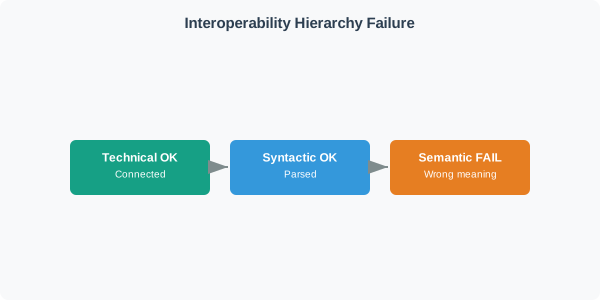
Hierarchy showing JSON syntactic layer achieved but semantic and organizational layers missing, causing integration waste
Figure 8.7: Interoperability Hierarchy Failure Without Semantic Alignment

Industry Data (IoT Analytics 2023 Survey, N=847 enterprises):

  • 64% of IoT projects cite interoperability as the #1 technical challenge
  • $127 billion annually spent on integration middleware and custom adapters
  • 38% of failed IoT deployments attributed to underestimated interoperability complexity
  • Average enterprise maintains 14 different integration adapters for IoT systems

Key Lesson: JSON solves syntax. You still need:

  • SenML (base values reduce repetition)
  • JSON-LD (@context links to shared ontologies)
  • SOSA/SSN (semantic definitions of sensor/observation concepts)
  • Protocol standards (MQTT topic naming conventions, CoAP resource structures)

Only addressing ALL four levels achieves true interoperability.

8.4 Interoperability Challenges

⏱️ ~15 min | Intermediate | P10.C11.U02

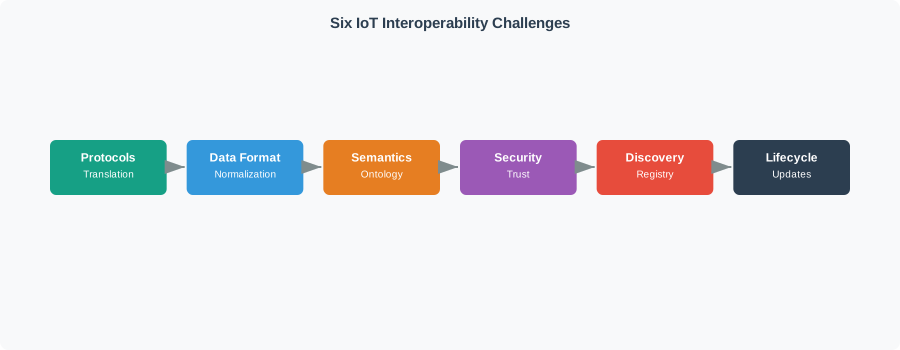
The IoT ecosystem faces six core interoperability challenges:

  • Protocol diversity: MQTT, CoAP, HTTP, proprietary protocols
  • Data format variations: JSON, XML, binary formats
  • Semantic differences: Same data, different meanings
  • Vendor lock-in: Closed ecosystems, incompatible devices
  • Legacy systems: Integration with older technologies
  • Security standards: Conflicting authentication methods
Six IoT interoperability challenges mapped to solutions: standards, gateways, ontologies, and open frameworks
Figure 8.8: Six IoT Interoperability Challenges Mapped to Solution Approaches

8.5 Alternative View: Interoperability Maturity Model

This view shows progressive maturity levels for IoT interoperability:

Interoperability maturity model showing progressive levels from ad-hoc integration to full semantic interoperability

Organizations should assess their current level and plan incremental improvements toward semantic interoperability.

This view shows the cost-flexibility spectrum of integration approaches:

Cost-flexibility spectrum from point-to-point adapters (low cost, rigid) to semantic standards (high investment, flexible)

Initial investment in semantic standards reduces long-term integration costs significantly.

8.5.1 Common Pitfalls

Pitfall: Ontology Overkill

The mistake: Implementing complex semantic web ontologies for simple IoT deployments, adding months of development time and ongoing maintenance burden for marginal interoperability gains.

Why it happens: Academic influence promotes “proper” semantic web architecture. Architects plan for hypothetical future requirements. “Best practices” documents recommend full ontology stack. Fear of rework if not done “right” from the start.

The fix: Apply progressive semantic enhancement: Level 0 uses JSON with consistent field names (good enough for 80% of projects); Level 1 adds JSON-LD with @context linking to Schema.org (adds discoverability); Level 2 uses SenML with units (standardized sensor data exchange); Level 3 implements full ontology with reasoning (only if cross-domain inference required). Start at Level 0-1 and upgrade only when you hit specific limitations.

Pitfall: Schema Drift

The mistake: Evolving data schemas without versioning, backward compatibility planning, or downstream notification, causing silent failures in analytics pipelines and dashboards.

Why it happens: Device firmware updated without coordinating with data team. No schema registry or contract testing. “Move fast” culture deprioritizes backward compatibility. Different teams own different pipeline stages.

The fix: Implement schema versioning and evolution policies. Include version in payload ("schema_version": "2.1") or endpoint (POST /api/v2/sensors/data). Apply evolution rules: additive changes only (new optional fields) = minor version; breaking changes (renames, removals, type changes) = major version with migration period. Never remove fields—deprecate for 2 releases first.

Pitfall: Gateway Single Point of Failure

The mistake: Routing all device communications through a single protocol translation gateway without redundancy, causing complete system blindness when the gateway fails.

Why it happens: Initial deployments start simple with one gateway. Budget constraints prevent redundancy investment. Gateway “just works” so reliability is assumed. No disaster recovery testing performed before production.

The fix: Deploy gateway pairs in active-passive or active-active configuration for production systems. Implement health checks with automatic failover (30-second detection, <2-minute recovery). Design devices to cache data locally during gateway outages (store-and-forward pattern). Test failover monthly—schedule planned gateway restarts to verify recovery works.

Pitfall: Ignoring Legacy Protocol Security

The mistake: Integrating legacy industrial protocols (Modbus, BACnet, older OPC) directly onto IP networks without security wrappers, exposing critical infrastructure to attacks.

Why it happens: Legacy protocols designed for isolated networks have no built-in authentication or encryption. Urgency to “just make it work” bypasses security review. IT/OT convergence happens faster than security architecture updates.

The fix: Never expose legacy protocols directly to IT networks or internet. Deploy protocol gateways that terminate legacy protocols and re-expose via secure modern APIs (HTTPS with mutual TLS). Implement network segmentation with industrial DMZ between OT and IT networks. Use VPN or encrypted tunnels for any cross-network protocol translation.

8.6 How It Works: The Four-Level Diagnostic Process

When diagnosing interoperability failures, work systematically through each level:

Step 1: Verify Technical Layer

  • Can devices ping each other? Check physical connectivity with ping or LED indicators
  • Are firewalls blocking ports? Test with telnet <ip> <port> or nc -zv <ip> <port>
  • Are protocols compatible? MQTT clients cannot directly talk to CoAP servers without a gateway
  • Passing test: Raw bytes flow between systems (even if meaningless)

Step 2: Check Syntactic Layer

  • Can systems parse each other’s messages? Try manual JSON.parse() or XML validation
  • Are schemas documented? Missing schemas mean implicit guessing of structure
  • Are data types compatible? String “123” vs integer 123 cause silent errors
  • Passing test: Messages parse without syntax errors (even if semantically wrong)

Step 3: Validate Semantic Layer

  • Do field names match? “temp” vs “temperature” vs “t” are different keys
  • Are units explicit? 72 without unit could be Fahrenheit, Celsius, or Kelvin
  • Are ontologies aligned? Link terms to shared vocabularies (JSON-LD @context)
  • Passing test: Systems interpret data identically (same meaning, same units)

Step 4: Align Organizational Layer

  • Do workflows match? System A pushes data; System B only pulls on request
  • Are security policies compatible? OAuth vs API keys vs certificates
  • Are SLAs aligned? One system expects 99.9% uptime; the other offers 95%
  • Passing test: Business processes execute end-to-end without manual intervention

This stepwise approach prevents wasting time fixing the wrong level—a common cause of failed integration projects.

8.6.1 Worked Example: Schiphol Airport Multi-Vendor BMS Integration

Scenario: Amsterdam Schiphol Airport is integrating building management systems (BMS) from three vendors across its terminal buildings. Each vendor uses different protocols, data formats, and measurement conventions. The airport needs a unified dashboard showing real-time HVAC performance across all terminals.

Given:

  • Terminal 1 (Siemens Desigo CC): BACnet/IP, temperatures in Celsius, “room_temp” field, updates every 15 seconds
  • Terminal 2 (Honeywell Niagara): Modbus TCP, temperatures as raw 16-bit ADC values (0-65535 maps to -10 to 50 C), register 40001, polled every 10 seconds
  • Terminal 3 (Johnson Controls Metasys): REST API with JSON, temperatures in Fahrenheit, “SpaceTemperature” field, push every 30 seconds
  • Total: 4,200 HVAC zones across 3 terminals
  • Requirement: Unified API delivering Celsius readings with SenML format, 30-second maximum staleness

Step 1: Diagnose interoperability levels

Level Terminal 1 (Siemens) Terminal 2 (Honeywell) Terminal 3 (JCI) Status
Technical BACnet/IP on VLAN 10 Modbus TCP on VLAN 20 HTTPS on VLAN 30 Three separate networks – need gateway
Syntactic BACnet objects 16-bit registers JSON payloads Three different data formats
Semantic “room_temp” in Celsius Raw ADC (no units) “SpaceTemperature” in Fahrenheit Different field names, different units, different meanings
Organizational Siemens maintenance team Honeywell contractor JCI cloud portal Three separate support contracts

Step 2: Design integration gateway

Translation Layer Input Output Complexity
Protocol translation BACnet/Modbus/REST Unified MQTT Medium (off-the-shelf gateways available)
Format normalization BACnet objects / registers / JSON SenML JSON-LD Medium (custom code per source)
Semantic mapping “room_temp” / register 40001 / “SpaceTemperature” {"n": "urn:dev:ow:schiphol:zone-1042:air-temperature", "v": 22.5, "u": "Cel"} High (requires unit conversion + ontology)
Unit conversion Celsius / raw ADC / Fahrenheit Celsius Low (arithmetic only)

Honeywell conversion formula: T_celsius = (raw_value / 65535) x 60 - 10

JCI conversion formula: T_celsius = (T_fahrenheit - 32) x 5 / 9

Step 3: Calculate integration cost by level

Interoperability Level Engineering Effort Recurring Cost Risk of Failure
Technical (networking) 2 weeks EUR 0/year Low (well-understood)
Syntactic (format) 3 weeks EUR 5,000/year (gateway maintenance) Low
Semantic (meaning) 8 weeks EUR 20,000/year (mapping updates when vendors change schemas) High (80% of failures)
Organizational (process) 6 weeks EUR 35,000/year (coordination across 3 vendor support contracts) Medium
Total 19 weeks EUR 60,000/year

Result: The 19-week integration project delivers a unified SenML API serving 4,200 zones from three vendors. Semantic alignment (8 weeks, 42% of effort) was the largest single cost – confirming the “80% of integration failures are semantic” rule. The EUR 60,000 annual maintenance is dominated by organizational costs (coordinating three vendor support teams), not technical issues.

Key Insight: The four interoperability levels escalate in both difficulty and cost. Technical and syntactic challenges are solved once with off-the-shelf tools. Semantic alignment requires ongoing effort because vendors change field names and units in firmware updates without notice. Organizational alignment is the most expensive long-term because it requires humans to coordinate across contractual boundaries. For Schiphol, the winning strategy was to insert a semantic normalization layer (SenML with explicit units) that isolates the unified dashboard from vendor-specific changes.

Interoperability integration complexity grows combinatorially without adapters. Calculate integration burden:

Point-to-Point Integration Cost: \(C = \frac{N(N-1)}{2}\) connections for full interoperability between \(N\) systems.

Worked example (smart building with 5 vendor systems without gateway):

  • \(N = 5\) systems (HVAC, lighting, occupancy, energy, security)
  • Direct connections required: \(C = \frac{5(5-1)}{2} = \frac{5 \times 4}{2} = 10\) point-to-point integrations
  • Each integration: 80 hours development + 20 hours/year maintenance
  • Total effort: \(10 \times 80 = 800\) hours initial, \(10 \times 20 = 200\) hours/year ongoing

With unified gateway: \(N = 5\) adapters (one per system) = 5 integrations = 400 hours initial (50% reduction), 100 hours/year ongoing (50% reduction). At 10 systems: point-to-point = 45 connections vs gateway = 10 adapters (78% reduction). Combinatorial explosion makes gateways essential at scale.

8.7 Knowledge Check

## Concept Check

8.8 Summary

  • Four interoperability levels build progressively: Technical (network connectivity), Syntactic (data format), Semantic (shared meaning), and Organizational (business process alignment). Each level depends on the foundation provided by lower levels.
  • 80% of integration failures stem from semantic misalignment, not protocol incompatibility—systems can exchange bytes perfectly but fail to integrate meaningfully when they interpret data differently.
  • Six core challenges plague IoT interoperability: protocol diversity, data format variations, semantic differences, vendor lock-in, legacy systems, and conflicting security standards.
  • Progressive approach works best: Start with consistent JSON naming (Level 0), add JSON-LD context (Level 1), use SenML for sensor data (Level 2), and implement full ontologies only when cross-domain reasoning is required (Level 3).
  • Industry impact is significant: 64% of IoT projects cite interoperability as the #1 technical challenge, with $127 billion spent annually on integration middleware and custom adapters.

“The Tower of Babel Problem!”

The Sensor Squad was visiting a smart building, but something was wrong. None of the devices could talk to each other!

“I speak Zigbee!” said Sammy the Sensor (a temperature sensor).

“I speak Wi-Fi!” said a motion detector.

“And I speak Bluetooth!” added a smart lock.

They all tried talking at once, but nobody understood anyone else. It was chaos!

“This is the interoperability problem,” Max the Microcontroller explained. “It’s like being in a room where everyone speaks a different language.”

“But wait,” Lila the LED said. “Even if we all spoke English, we’d still have problems! Sammy says ‘temp is 72’ and the motion detector says ‘temperature is 22.2.’ They MEAN the same thing but use different words and units!”

“Exactly!” Max said. “There are FOUR levels of understanding. First, we need to be able to connect – that’s called technical interoperability. Second, we need to speak the same format – that’s syntactic interoperability. Third, we need to mean the same thing – that’s semantic interoperability. And fourth, we need to follow the same rules – that’s organizational interoperability.”

Bella the Battery had an idea. “What if we build a translator? A gateway that understands ALL the languages and converts everything to one standard!”

“That’s exactly what engineers do!” Max said. “They use standards like SenML and JSON-LD. It’s like creating a universal dictionary that every device can use.”

“So interoperability is about making friends who speak different languages?” Sammy asked.

“You got it! And 80% of the time when devices can’t work together, it’s not because they can’t connect – it’s because they don’t understand each other’s MEANING!”

The Sensor Squad learned: True interoperability isn’t just about connecting devices – it’s about making sure they understand each other’s language, meaning, AND rules!
8.9 Concept Relationships

Interoperability fundamentals connect to broader IoT concepts:

The four-level model provides a diagnostic framework used across these domains.

8.10 See Also

Reference Documentation:

Industry Reports:

8.12 What’s Next

If you want to… Read this
Learn IoT interoperability standards in depth Interoperability Standards
Study how interoperability is achieved in integration Integration Patterns for IoT
Explore the broader interoperability overview Interoperability
See how gateways solve interoperability Protocol Bridging Fundamentals

Now that you understand interoperability fundamentals: