Capstone and Appendix Module Guide
More
Depth: Practitioner
Progress saves as you read. Mark sections complete as you go; your progress appears in the sidebar.
Start Here: Defend One Project Claim
This section: Start Here: Defend One Project Claim — Picture a reviewer beside your demo asking, “What should I trust after seeing this?” This guide helps you turn one useful claim into a short path through design, tests, records, and honest limits.
Picture a reviewer beside your demo asking, “What should I trust after seeing this?” This guide helps you turn one useful claim into a short path through design, tests, records, and honest limits.
Firmware means the software stored on a device. A gateway means a boundary device that joins unlike systems. A payload means the useful data inside a message. QoS means the chosen level of delivery effort and duplicate risk.
Start with one user, one setting, one device path, and one failure case. Name the proof that would support the claim and the result that would reopen it. This runway gives you the route; the project, glossary, and maths chapters keep the full engineering detail.
Do not start by listing every feature you hope to build. Write one short claim that a test can support or reject. Name who needs the result and why it helps. Draw the path from the sensor to that result. Mark each place where data, power, trust, or ownership can fail. Pick the smallest test that can expose the first weak claim.
Keep the raw record beside your conclusion. A reading, log, trace, photo, or code version shows what happened in one test. Your report explains what that record supports. It also says what remains unknown. If a reviewer cannot find the record or repeat the setup, the claim is not ready. Repair that gap before adding more parts.
Follow Blueprint Bina as one demo claim is traced to proof and honest limits.
-

A reviewer stands beside the demo.
-

What should I trust after seeing this?
-

Trace one claim through design, tests, and records.
-

Show the proof and state the honest limits.

Your guide: Sammy
“The build never follows the plan — the gap between them is where the learning lives.”
In 60 Seconds
This section: In 60 Seconds — Use this module when a prototype has to become a defended capstone project.
Use this module when a prototype has to become a defended capstone project. The route is simple: define the claim, gather evidence, use the glossary and math references when a term or calculation matters, then package the project so another reviewer can inspect the hardware, firmware, data, security, and maintenance decisions.
Start With The Reviewer’s Question
This section: Start With The Reviewer’s Question — Imagine a reviewer standing beside your demo table with one simple question: “What should I trust after seeing this?” A blinking LED, a dashboard tile, a sensor trace, or a video clip is not enough by itself.
Imagine a reviewer standing beside your demo table with one simple question: “What should I trust after seeing this?” A blinking LED, a dashboard tile, a sensor trace, or a video clip is not enough by itself. The capstone starts when the team can connect the visible behavior to a named user decision and then show the evidence that made the decision credible.
Use the route through this module like an evidence walk. The project chapter helps you decide what claim the prototype should prove. The glossary keeps words such as gateway, QoS, token, calibration, and payload from becoming vague labels. The appendix and math chapters help turn guesses about range, battery life, sampling, storage, or security into assumptions that another person can inspect.
Start small: one user, one environment, one sensor-to-dashboard path, one failure case, and one review package that admits its limits. When that route is clear, the hardware and software stop being a pile of features and become an engineering argument.
A Capstone Is A Defensible Engineering Claim
This section: A Capstone Is A Defensible Engineering Claim — A capstone project is not just a final demo.
A capstone project is not just a final demo. It is an argument that a connected system meets a useful, bounded claim under named conditions. A temperature monitor, bike tracker, irrigation controller, smart-lock prototype, or factory-dashboard mockup becomes capstone work only when the team can say what decision improves, which evidence supports the claim, and which limits still remain.
Use this module as the route map from project idea to review package. The project chapter helps plan scope, requirements, bill of materials, tests, security, power, dashboard, and final report evidence. The glossary pages keep vocabulary precise. The appendix provides quick engineering lookup. The mathematical foundations chapter supports calculations such as link budgets, sampling rates, battery life, filter behavior, probability, and cryptographic assumptions.
The first design sentence should connect purpose and proof: “For this user, in this environment, the IoT system will improve this decision, and we will prove it with these measurements.” If the sentence is vague, the project is not ready for hardware expansion.
This also keeps the capstone humane for reviewers. A reviewer should not have to reverse-engineer the team’s intent from slides, code, and a live demo. They should be able to open the report, find each claim, inspect the artifact that supports it, and understand the boundary around that artifact. A prototype can be successful and still be honest about what it does not prove: long-term enclosure durability, real-world support cost, production credential rotation, field RF conditions, or user behavior outside the test group.
The module’s job is therefore routing. When the question is “what should we build and test?”, start with the project chapter. When the question is “what exactly does this term mean?”, use the glossary. When the question is “which formula or reference value changes the decision?”, use the appendix or mathematical foundations. The route matters because the final report should read like engineering evidence, not like a collection of disconnected course topics.
| Claim Type | Evidence To Capture | Review Question | Common Gap |
|---|---|---|---|
| Sensing works | Calibration notes, raw readings, units, operating range | Does the measurement mean what the report says? | Only a polished dashboard screenshot is shown |
| Network path is reliable enough | Packet logs, latency samples, reconnect behavior, outage test | What happens when connectivity fails? | The demo assumes perfect Wi-Fi or cloud access |
| Power budget is credible | Current states, duty cycle, battery estimate, measurement method | Are the units and assumptions inspectable? | Battery life is asserted without a measured state model |
| Security and maintenance are planned | Identity model, update path, logging, rollback, support owner | Can the system be operated after the demo? | Credentials, OTA, and recovery are left until the end |
Build The Review Package While You Build The System
This section: Build The Review Package While You Build The System — A strong capstone team treats evidence as a live engineering artifact, not a final-week write-up.
A strong capstone team treats evidence as a live engineering artifact, not a final-week write-up. Keep a simple project ledger from the first prototype loop: requirement, owner, test method, artifact path, result, decision, and retest trigger. Useful artifacts include schematic revisions, firmware commits, serial logs, MQTT broker traces, CoAP request captures, BLE scanner records, current measurements, calibration tables, dashboard screenshots, accessibility notes, and threat-model decisions.
Plan evidence by claim. If the claim is “the node can run for a semester,” the project needs measured sleep, sensing, transmit, and failure-recovery states, not only a nominal battery calculation. If the claim is “the dashboard supports a safety workflow,” the project needs alert thresholds, stale-data behavior, human escalation, privacy handling, and screenshots that show the actual state transitions. If the claim is “the system is secure enough for the prototype context,” the project needs device identity, credential storage, transport protection such as TLS or DTLS where applicable, update behavior, and a clear statement of what is not protected.
Use the references only when they affect a decision. A glossary definition is useful when it separates MQTT publish-subscribe behavior from HTTP request-response behavior, or distinguishes authentication from authorization. A formula is useful when it changes a link budget, sampling interval, queue size, or battery estimate. A standards link is useful when it constrains what the prototype can honestly claim.
Before the final week, run a short evidence review with roles: one person defends the claim, one traces the artifact, and one asks what would break the conclusion. If the artifact cannot be found quickly, rename or move it. If the result cannot be reproduced, write the missing setup detail. If a claim depends on a datasheet, cloud service behavior, or protocol feature, capture the version or page used. This review usually finds weak links while there is still time to repair them.
Good capstone practice also separates “demo path” from “engineering path.” The demo path shows the happy scenario. The engineering path shows reset, reconnect, stale data, denied permissions, low battery, bad calibration, missing cloud service, and maintenance handoff. The report can then say exactly which path is demonstrated, which path is measured, and which path remains outside scope.
Evidence Has A Grain, Owner, And Failure Mode
This section: Evidence Has A Grain, Owner, And Failure Mode — Under the hood, capstone evidence fails when it is captured at the wrong grain.
Under the hood, capstone evidence fails when it is captured at the wrong grain. A single average latency hides jitter and outage behavior. A single battery-life number hides active, idle, sleep, reconnect, and fault states. A single “encrypted” label hides key storage, certificate validation, replay risk, and recovery after credential rotation. A single machine-learning accuracy score hides sampling bias, operating context, false positives, and false negatives.
Each evidence item should therefore name four things: grain, owner, method, and failure mode. Grain says whether the evidence is per packet, per reading, per device, per session, per day, or per user workflow. Owner says who maintains or repeats the test. Method says how the evidence was measured: multimeter, logic analyzer, packet capture, cloud log, test fixture, browser trace, or code review. Failure mode says what can still break the claim: stale timestamps, bad calibration, brownout resets, expired certificates, full queues, denied permissions, inaccessible UI states, or unsupported device firmware.
This is why the capstone module includes both reference material and project guidance. The final report should not merely cite concepts; it should bind them to the prototype’s evidence. A link-budget equation matters only if it explains a range decision. A glossary term matters only if it prevents a design ambiguity. A quick-reference table matters only if the project records the project-specific assumption that came from it.
The deeper engineering move is to keep raw and interpreted evidence separate. A packet capture, serial log, oscilloscope trace, current measurement, or browser trace is raw evidence. A chart, requirement status, risk rating, or design decision is interpretation. Both are useful, but they should not be collapsed into one screenshot. When interpretation changes, the raw artifact lets another reviewer check whether the claim still follows.
Evidence should also travel with a retest trigger. A new firmware library, changed enclosure, different antenna position, added sensor, revised sampling interval, credential rotation, cloud rule update, or new user workflow can invalidate an earlier result. Naming the trigger turns the capstone from a one-time submission into a maintainable engineering handoff.
Learning Objectives
This section: Learning Objectives
By the end of this module, you should be able to:
- Plan a capstone project around evidence instead of a broad demo.
- Keep project claims tied to requirements, measurements, tests, and review decisions.
- Use glossary entries as engineering boundaries, not just vocabulary.
- Apply mathematical foundations to signals, probability, cryptography, RF, power, and data analysis.
- Use quick-reference material when a project needs units, formulas, protocol comparisons, or hardware lookup.
Module Route
This section: Module Route — The capstone route starts with a project claim and ends with evidence another engineer can review.
The capstone route starts with a project claim and ends with evidence another engineer can review.
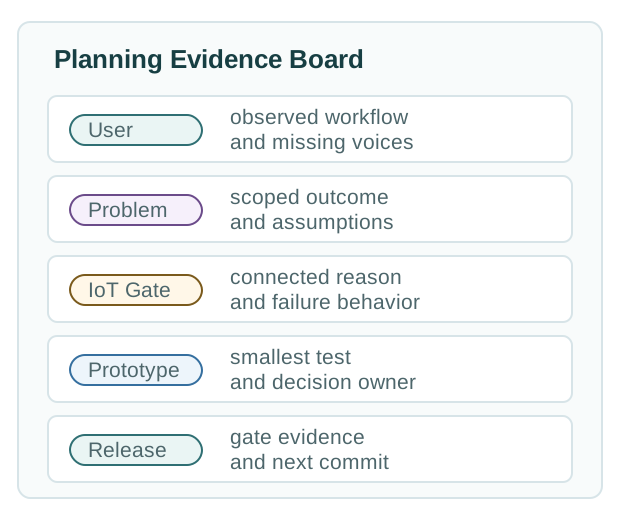
Evidence Loop
This section: Evidence Loop — Capstone quality comes from how quickly the team can connect each final claim to proof.
Capstone quality comes from how quickly the team can connect each final claim to proof.
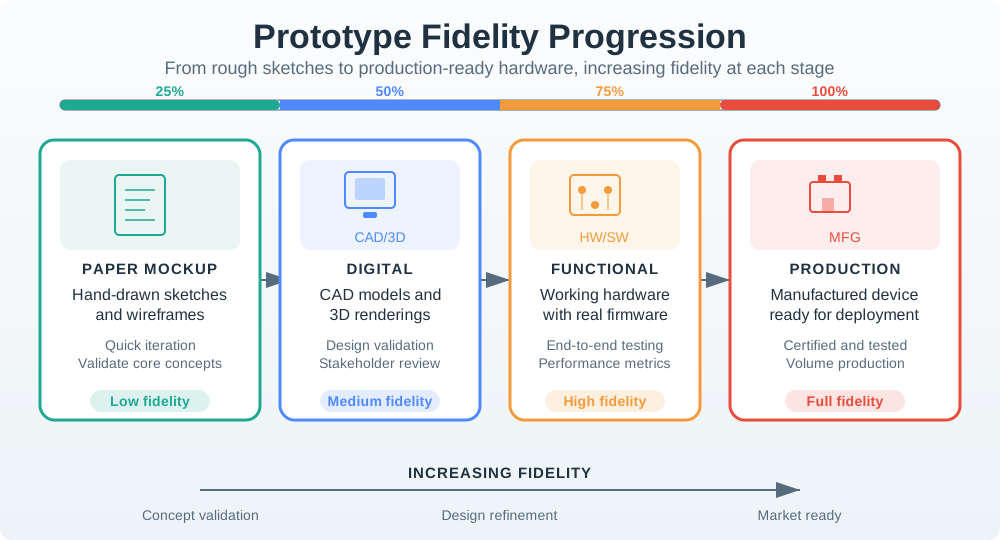
Use the smallest artifact that can answer the next decision:
- State the user, environment, and project claim.
- Identify the risky assumption behind that claim.
- Choose the smallest prototype, calculation, or reference check that can test it.
- Capture the measurement, trace, code version, schematic, screenshot, or review note.
- Decide whether the claim is supported, changed, or still open.
How It Works: Capstone Evidence Route
This section: How It Works: Capstone Evidence Route
- Frame the claim. Name the user, environment, action, success measure, and failure consequence before expanding the build.
- Map claims to artifacts. Decide which schematic, firmware commit, measurement, packet trace, screenshot, test record, or calculation can prove each claim.
- Use references at the decision point. Pull from the glossary, appendix, or mathematical foundations only when a term, formula, unit, protocol behavior, or standard changes the engineering decision.
- Review the unsupported edges. Mark what the prototype does not prove yet: field durability, real users, production security, accessibility, service cost, or long-term maintenance.
- Package for handoff. Leave the next reviewer with the claim, evidence path, result, risk, and retest trigger.
Choose Your Path
This section: Choose Your Path
Example Progression: Capstone Evidence
This section: Example Progression: Capstone Evidence
- Beginner Example: A smart-room monitor claims it can report temperature and humidity trends. The evidence packet includes the sensor model, calibration note, units, one raw-reading table, firmware commit, dashboard screenshot, and a short note about what room conditions were not tested.
- Intermediate Example: A medication-cabinet prototype claims it can detect openings and send reliable reminders. The evidence packet includes enclosure photos, switch debounce behavior, MQTT or HTTP message traces, notification screenshots, stale-data handling, battery-state measurements, and a privacy note for household data.
- Advanced Example: A small factory line dashboard claims it can support maintenance decisions. The evidence packet ties vibration or current readings to asset identity, operating state, historian records, alert thresholds, maintenance workflow, false-alarm review, rollback plan, and the owner who retests the model after equipment changes.
Try It: Draft A Capstone Evidence Packet
This section: Try It: Draft A Capstone Evidence Packet
Choose one IoT capstone idea and write a six-line evidence packet before adding features:
- Claim: the project result you want another engineer to believe.
- Evidence artifact: the measurement, trace, screenshot, calculation, schematic, or test record that can support the claim.
- Reference check: the glossary term, appendix fact, datasheet, protocol behavior, or formula that affects the claim.
- Failure case: the outage, reset, stale reading, calibration drift, denied permission, or maintenance event to test.
- Remaining limit: what the prototype still does not prove.
- Retest trigger: the hardware, firmware, workload, environment, or service change that makes the evidence stale.
Quick Check: Evidence First
This section: Quick Check: Evidence First
Check: Capstone Claim Quality
Check: Order The Evidence Route
Common Pitfalls
This section: Common Pitfalls
Avoid These Capstone Mistakes
- Treating a working demo as proof of reliability, security, power budget, or maintainability.
- Using glossary terms without naming the actual device, protocol, data, or cloud artifact involved.
- Reporting calculations without units, assumptions, measurement method, or validation conditions.
- Leaving security, OTA update, logging, rollback, and support evidence until the final week.
- Adding features after the evidence deadline instead of tightening the evidence for the claims already made.
What’s Next
This section: What’s Next
Choose the entry point that matches the question in front of you:
- Capstone Projects for project planning, implementation evidence, testing, demo, and report structure.
- IoT Glossary: A-F for terms such as actuator, AMQP, authentication, cloud, CoAP, DTLS, edge, and firewall.
- IoT Glossary: G-P for terms such as gateway, GPIO, HTTP, I2C, LoRaWAN, MQTT, payload, and publisher.
- IoT Glossary: Q-Z for terms such as QoS, TLS, telemetry, TSDB, Thread, Zigbee, Z-Wave, Wi-Fi, and 6LoWPAN.
- IoT Engineering Quick Reference for protocol tables, sensor references, formulas, pinouts, unit conversions, and standards links.
- Mathematical Foundations for IoT for link budgets, signal processing, probability, linear algebra, cryptography, and power models.
Find help
3 reviewed answers.
Where should I start in a module?
Open the module page from the sidebar to see its chapters in order. Use the module map to return to a topic you need.
Modules and pathsReviewed
What can I try when a project does not work?
Check the symptom, then work through the diagnostic steps. Keep the error message and the smallest example that reproduces it.
When you are stuckReviewed
How do interactive examples work?
Use the interactive guide to check how examples and simulations work before changing your project.
Interactive examples guideReviewed