Event-Driven Architecture
Learn about Event-Driven Architecture in IoT systems -- how devices react to real-time events using decoupled producers, brokers, and consumers for scalable and resilient IoT deployments.
Event-Driven Architecture
Learning Objectives
By the end of this topic guide, you will be able to:
- Define Event-Driven Architecture (EDA): Explain the core principles of event production, detection, and reaction in IoT systems
- Identify EDA Components: Distinguish producers, consumers, brokers, and event channels in an IoT deployment
- Compare Messaging Patterns: Differentiate between point-to-point, publish-subscribe, and event streaming approaches
- Apply Event Processing: Understand simple event processing, event filtering, and Complex Event Processing (CEP) for IoT analytics
- Select Appropriate Technologies: Choose between MQTT, Kafka, AMQP, and other event brokers based on IoT requirements
If you take away only three things from this topic:
- Events decouple producers from consumers — a temperature sensor publishes a reading without knowing (or caring) which services consume it. This decoupling lets you add new consumers (dashboard, alert service, analytics) without modifying the sensor or existing consumers.
- Brokers are the backbone — the event broker (MQTT broker, Kafka cluster, RabbitMQ) handles routing, buffering, and delivery guarantees. Choosing the right broker for your IoT scenario determines latency, throughput, reliability, and cost.
- Event-driven is not always the right choice — EDA excels for real-time reactions and fan-out scenarios, but adds complexity (eventual consistency, debugging difficulty, message ordering). Use request-response for simple query/command patterns where you need an immediate, synchronous answer.
Hey Sensor Squad! Today our four friends are building an event-driven alarm system for their school garden.
Temperature Terry is the garden’s temperature watcher. Instead of shouting the temperature every second (“72 degrees! 72 degrees! Still 72 degrees!”), Sammy only speaks up when something CHANGES: “Alert! Temperature just hit 95 degrees — the tomatoes are in danger!”
Lila the Lightbulb is the event broker — the messenger in the middle. When Sammy sends an alert, Lila does NOT just pass it to one person. She broadcasts it to EVERYONE who signed up for garden alerts. Think of her like a school PA system!
the microcontroller subscribed to temperature alerts. When he hears “95 degrees!” from Lila, he automatically turns on the garden sprinklers. He does not care WHERE the alert came from — he just reacts to the event.
the battery also subscribed, but she does something different with the SAME alert. She sends a text message to the teacher: “Garden is too hot! Sprinklers activated.” Same event, different reaction!
Why is this so cool?
- Sammy does NOT need to know who Max and Bella are (they are “decoupled”)
- If a new helper joins (say, a fan controller), they just subscribe to Lila — nobody else changes!
- Sammy saves energy by only talking when something important happens
- If Lila is busy, she remembers the message and delivers it when ready (no lost events!)
The Event-Driven Rule: Do NOT keep asking “anything happen yet?” — instead, WAIT and REACT only when something actually happens. It saves energy, reduces noise, and scales to hundreds of helpers!
The simple version: Event-Driven Architecture (EDA) is a design approach where software components communicate by producing and reacting to events — things that happen. Instead of one component directly calling another (“Hey, give me the temperature!”), a sensor simply announces “temperature changed!” and any interested service can listen and react independently.
A real-world analogy: Think about a newspaper subscription. The newspaper (producer) publishes articles without knowing exactly who reads them. Subscribers (consumers) receive the paper and each does something different — one clips coupons, another reads sports, a third checks the weather. The delivery service (broker) handles routing. No one needs to know about anyone else.
Three core components:
| Component | Role | IoT Example |
|---|---|---|
| Event Producer | Creates events when something happens | Temperature sensor detects threshold breach |
| Event Broker | Routes events to interested consumers | MQTT broker, Apache Kafka, RabbitMQ |
| Event Consumer | Reacts to events it has subscribed to | Dashboard updates, alert service triggers SMS |
When to use EDA:
- You need real-time reactions (alerts when temperature exceeds a limit)
- Multiple consumers need the same data (dashboard + analytics + logging)
- Systems should be independently deployable and scalable
- You want to add new features without changing existing code
When NOT to use EDA:
- Simple request-response queries (“What is the current temperature?”)
- When you need immediate, synchronous confirmation of an action
- Small systems with only 2-3 components that rarely change
Overview
Key Concepts: events, reactive, asynchronous, decoupling, publish-subscribe, event sourcing, Complex Event Processing
Event-Driven Architecture (EDA) is a software design paradigm in which the flow of a program is determined by events — significant changes in state such as a sensor reading crossing a threshold, a device going offline, or a user pressing a button. In IoT systems, EDA provides the foundation for building scalable, real-time, and loosely coupled systems that can process millions of sensor events per second.
The fundamental insight of EDA is temporal and spatial decoupling: event producers do not need to know which consumers exist, and consumers do not need to be online at the moment an event is produced. The event broker mediates all communication, enabling independent development, deployment, and scaling of each component.
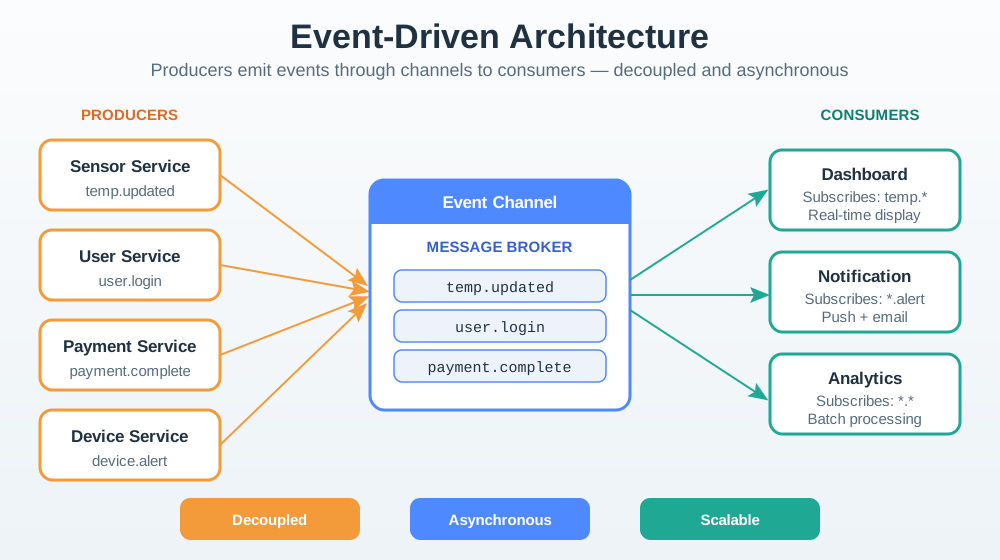
Core EDA Patterns in IoT
There are three primary messaging patterns used in event-driven IoT systems, each suited to different requirements:
Pattern Comparison
| Pattern | Delivery | Persistence | Use Case |
|---|---|---|---|
| Point-to-Point | Exactly one consumer | Until consumed | Command dispatch, task queues |
| Publish-Subscribe | All subscribers | Typically transient | Real-time alerts, fan-out |
| Event Streaming | Consumer-controlled | Long-term (days/weeks) | Analytics, audit trails, replay |
Event Processing Levels
IoT systems apply different levels of event processing depending on the complexity of the insights they need to extract:
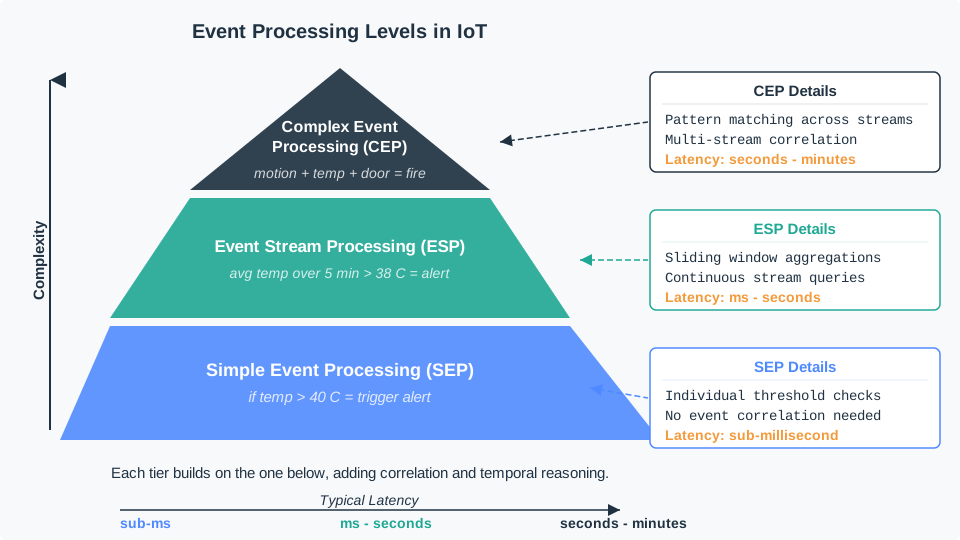
- Simple Event Processing (SEP): Each event is evaluated independently. Example: if temperature > 40C, trigger an alert. No correlation between events.
- Event Stream Processing (ESP): Continuous queries over sliding windows of events. Example: compute the average temperature over the last 5 minutes and alert if it exceeds 38C. Uses frameworks like Apache Flink or Kafka Streams.
- Complex Event Processing (CEP): Detects patterns across multiple event streams over time. Example: if motion is detected AND temperature rises AND the door has not been opened in 30 minutes, infer a potential fire. Uses pattern matching engines like Esper or Apache Siddhi.
IoT Event Broker Selection
Selecting the right event broker is one of the most consequential architectural decisions in an IoT system. The following decision tree helps guide this choice:
Broker Comparison Table
| Feature | MQTT | Apache Kafka | RabbitMQ (AMQP) |
|---|---|---|---|
| Protocol overhead | Very low (2-byte header) | Moderate | Moderate |
| Message persistence | Optional (retained messages) | Built-in (log-based) | Optional (durable queues) |
| Throughput | ~100K msg/sec | ~1M+ msg/sec | ~50K msg/sec |
| Message replay | No | Yes (offset-based) | No (consumed = gone) |
| IoT device support | Excellent (constrained devices) | Limited (heavy client) | Good (multiple protocols) |
| QoS levels | 0, 1, 2 | At-least-once (default) | At-most-once to exactly-once |
| Best for | Sensors, edge devices | Analytics pipelines | Enterprise workflows |
Worked Example: Smart Building Event Pipeline
Scenario: A commercial building has 200 temperature sensors, 50 occupancy sensors, and 30 air quality sensors. The building management system must: (a) display live readings on a dashboard, (b) trigger HVAC adjustments in real-time, (c) generate daily energy reports, and (d) detect anomalies indicating equipment failure.
Step 1: Define Event Types
| Event Type | Source | Payload Example | Frequency |
|---|---|---|---|
temperature.reading | Temp sensor | {"zone": "3F-A", "value": 23.5, "unit": "C"} | Every 60s |
occupancy.change | PIR sensor | {"zone": "3F-A", "count": 12, "status": "occupied"} | On change |
airquality.reading | AQ sensor | {"zone": "3F-A", "co2_ppm": 850, "pm25": 12} | Every 300s |
hvac.command | Control system | {"zone": "3F-A", "action": "cool", "target": 22} | On demand |
Step 2: Design the Event Flow
Sensors --> MQTT Broker --> Kafka (persistence) --> Consumers
                |                    |
                v                    v
          Live Dashboard      Stream Processing
          (WebSocket)         (Flink/Kafka Streams)
                                     |
                              +------+------+
                              |      |      |
                              v      v      v
                           HVAC   Anomaly  Daily
                           Control Detect   Report
Step 3: Select Brokers
- MQTT (Mosquitto): Edge-level broker. The 280 sensors publish via MQTT because they are constrained devices on a local network. MQTT’s small overhead (2-byte header) minimizes bandwidth usage.
- Apache Kafka: Cloud-level broker. MQTT messages are bridged into Kafka topics for persistence, replay, and stream processing. Kafka retains 7 days of events for anomaly detection model retraining.
Step 4: Calculate Event Volume
- Temperature: 200 sensors x 1 event/min = 200 events/min = 12,000 events/hour
- Occupancy: 50 sensors x ~10 changes/hour = 500 events/hour
- Air quality: 30 sensors x 12 events/hour = 360 events/hour
- Total: ~12,860 events/hour = ~308,640 events/day
At an average payload of 150 bytes, daily data volume = 308,640 x 150 = ~44 MB/day — well within MQTT and Kafka capacity.
Step 5: Implement CEP Rules
Anomaly detection rule (pseudocode):
WHEN temperature.reading.value > zone.setpoint + 5
AND  occupancy.change.count < 3
AND  hvac.command was issued > 30 minutes ago
THEN trigger "possible HVAC failure" alert
WITH severity = "high", affected_zone = event.zone
This CEP rule correlates three event streams (temperature, occupancy, HVAC commands) to detect when a zone is overheating despite low occupancy and a recent HVAC command — indicating potential equipment failure rather than simply a hot day with many people.
-
Treating every sensor reading as an event: Publishing raw sensor data at high frequency (e.g., accelerometer at 100 Hz) as discrete events overwhelms brokers and consumers. Instead, apply edge-side filtering — only publish when values change meaningfully (dead-band filtering) or summarize windows of readings.
-
Ignoring message ordering: Events may arrive out of order due to network latency, retransmissions, or parallel processing. A “door closed” event arriving before “door opened” causes incorrect state. Use sequence numbers, timestamps, and idempotent consumers to handle this.
-
Conflating events with commands: Events describe something that happened (“temperature reached 40C”). Commands describe something that should happen (“turn on cooling”). Mixing these in the same topic/queue leads to confusing ownership — who is responsible for acting? Keep event topics and command topics separate.
-
Missing dead-letter queues: When a consumer cannot process an event (malformed payload, downstream service down), the event must go somewhere. Without a dead-letter queue (DLQ), failed events are silently dropped. Always configure DLQs and monitor them.
-
Assuming exactly-once delivery is free: True exactly-once processing across distributed systems requires idempotent consumers, deduplication, and transactional producers — all of which add complexity and latency. Evaluate whether at-least-once with idempotent handlers is sufficient for your IoT use case (it usually is).
Knowledge Check
Test your understanding of Event-Driven Architecture concepts.
Learning Resources
Key chapters that expand on the concepts in this guide:
Pub/Sub and Topic Routing
Core chapter covering broker-mediated publish-subscribe delivery and topic-based routing that underpins EDA.
Communication Models for IoT
Foundational chapter comparing request-response, publish-subscribe, and push/pull patterns that underpin EDA.
SOA and Microservices for IoT
How event-driven communication connects microservices in IoT platforms, including choreography vs. orchestration.
MQTT Publish-Subscribe Basics
Deep dive into the most widely used IoT messaging protocol, covering QoS levels, topic design, and retained messages.
Summary
Event-Driven Architecture is a foundational pattern for building scalable, real-time IoT systems. The key takeaways from this topic guide are:
- Decoupling is the core benefit: Producers and consumers operate independently. Adding a new analytics service or dashboard requires zero changes to sensors or existing consumers.
- Three messaging patterns serve different needs: point-to-point for commands, publish-subscribe for real-time fan-out, and event streaming for persistent, replayable event logs.
- Event processing ranges from simple to complex: Threshold checks (SEP), windowed aggregations (ESP), and multi-stream pattern detection (CEP) form a processing hierarchy.
- Broker selection depends on your constraints: MQTT for constrained IoT devices, Kafka for high-throughput analytics pipelines, RabbitMQ for enterprise-grade routing and delivery guarantees.
- Hybrid architectures are common: Most production IoT systems combine MQTT at the edge with Kafka or similar in the cloud, bridging between them for the best of both worlds.
- Pitfalls are predictable and avoidable: Separate events from commands, implement dead-letter queues, handle out-of-order delivery, and do not flood brokers with raw high-frequency data.
What’s Next
After understanding Event-Driven Architecture, consider exploring:
- MQTT Publish-Subscribe Basics — Deep dive into the most popular IoT event protocol
- SOA and Microservices for IoT — How EDA enables microservices communication in IoT platforms
- Edge Computing — Processing events at the edge before forwarding to the cloud
- Raspberry Pi — See EDA concepts applied in a real MQTT publisher worked example