27 Lab: QoS Policy on ESP32
27.1 Start With the Receiver Proof
A QoS lab should prove what the receiver experienced, not only what the sender configured. Queue choice, shaping, retry, and expiry matter because they change the timing and completeness of the receiver record.
Start simple: define one class, send controlled traffic, observe the receiver, and record whether the policy protected the intended outcome. That proof turns a setting into an engineering decision.
27.2 Learning Objectives
By the end of this lab, you will be able to:
- Build a traffic-class record for a mixed-criticality IoT gateway scenario.
- Define service objectives that include freshness, delay, loss, duplicate, retry, and degradation behavior.
- Rehearse how queuing, shaping, rate limiting, and retry rules interact during congestion.
- Identify proof that protected traffic was actually protected at the receiver.
- Produce a QoS lab record with owner, decision, open uncertainty, and revisit trigger.
27.3 Quick Check: Receiver-Side QoS Proof
Core concept: A QoS lab should prove that the service policy behaves correctly under contention, not only that a queue algorithm can be described.
Why it matters: Many QoS failures come from mismatched policy and proof: too much traffic marked urgent, stale commands delivered reliably, retry storms that amplify congestion, or monitoring that proves the sender transmitted but not that the receiver could act.
Key takeaway: Treat every lab step as a proof question. Which class needs protection, what mechanism protects it, what tradeoff does the policy create, and what measurement proves the result?
27.4 QoS Needs Receiver Proof
QoS is a service promise under load. The promise is not “this message used a priority queue”; the promise is “this class of work still met its useful service objective while lower-priority work yielded.” In this lab, the policy is credible only when traffic classes, service objectives, contention behavior, receiver timing, degraded behavior, and ownership all line up.
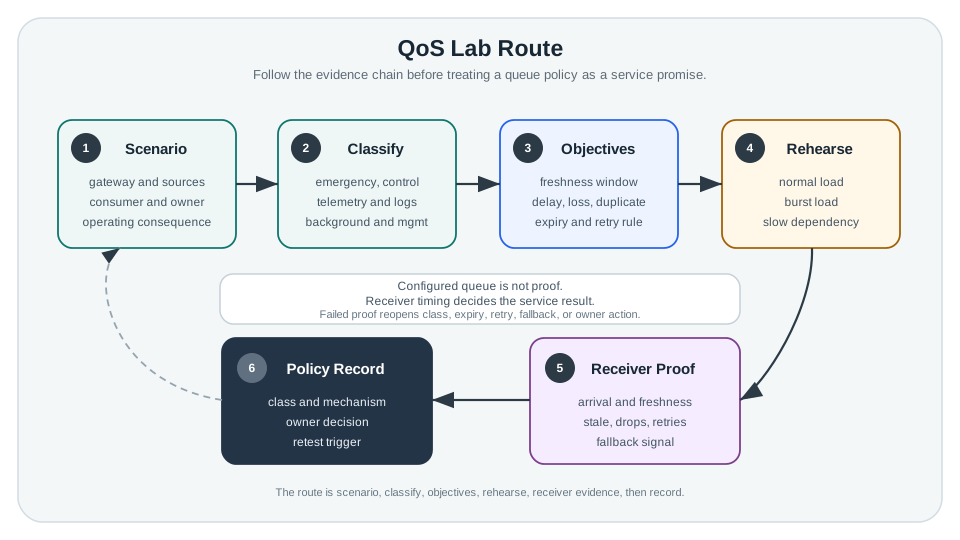
Small-screen read: The lab route is scenario, classify, objectives, rehearse, evidence, then record. Receiver evidence is the proof point that decides whether the QoS policy worked.
The most important boundary is the useful window. Emergency alerts, control commands, telemetry, diagnostics, and background transfers can all be delivered over the same gateway, but they do not have the same consequence when they arrive late. A protected class should be narrow enough to protect the work that actually changes an operating decision.
For an ESP32-class edge node or gateway, the lab should separate the service claim from the mechanism knob. A high-priority queue, a retry rule, or a rate limit is only a candidate treatment until the receiver evidence shows the intended action stayed inside its useful window. The same exercise also exposes what the system is allowed to sacrifice: background upload time, diagnostic completeness, telemetry resolution, or delayed management work.
Write the result as a chain that another operator can audit later. The record should name the traffic class, the reason it is protected, the objective that makes it useful, the load condition tested, the receiver observation, and the owner who changes the policy when the observation fails. Without that chain, the lab proves configuration effort rather than service behavior.
- Classify first: name the message type, owner, consumer, and consequence of delay before selecting a queue.
- Define the objective: write freshness, delay, loss, duplicate, retry, expiry, and degradation behavior for each class.
- Prove at the receiver: use arrival time, stale counts, drops, retries, fallback signals, and support actions to show whether the objective was met.
27.5 Build The Policy Record
Start with a traffic-class board, then turn each row into a testable record. A useful record states what the class does, why it deserves its treatment, which mechanism applies, and what observation would prove success or failure. If the team cannot name the receiver-side proof, the policy is still a hypothesis.
During the rehearsal, look for priority inflation. Teams often mark telemetry, diagnostics, and management traffic as urgent because each stream feels important to somebody. That removes the advantage from the truly time-sensitive class. The policy record should show what yields first, what is shaped, what can be summarized, what expires, and when local fallback takes over.
Use round identifiers in the lab record so evidence stays comparable. A normal-load row, a burst-load row, and a degraded-dependency row should use the same traffic-class names, objective fields, and receiver measurements. That lets the team see whether the policy merely works in the quiet case or still preserves the protected class when queue depth, retry pressure, and dependency delay rise together.
Keep the record small enough to maintain. For each traffic class, capture the objective, mechanism, expected yield behavior, receiver proof, support owner, and retest trigger. When a policy changes, update the record before running the next rehearsal; otherwise the team cannot tell whether an improvement came from a better mechanism, a narrower protected class, or a change in traffic demand.
When a row fails, record the smallest defensible correction. That may be a narrower protected class, a shorter command expiry, a telemetry summary rule, a diagnostic throttle, or a clearer operator alert. Avoid rewriting the whole policy until the failed evidence shows which assumption broke.
- Normal load: confirm that routine traffic does not consume protected capacity unnecessarily.
- Burst load: confirm that protected traffic stays useful while background or diagnostic work pauses, shapes, or drops.
- Degraded dependency: confirm that commands expire or hold instead of arriving stale, and that support owners can see the fallback condition.
27.6 Queues Move Contention
Queues, shapers, and rate limits do not create capacity. They decide which work waits, which work is slowed, and which work is rejected when demand exceeds the shared path. A priority queue can reduce delay for one class only by moving delay or loss somewhere else, so the lab has to inspect the tradeoff instead of treating the mechanism as a guarantee.
Retries need the same scrutiny. A retry can recover from a transient miss, but repeated retries during a degraded dependency can amplify congestion and make protected work worse. Expiry windows, idempotent receiver behavior, retry limits, and backoff rules keep the policy from converting delay into duplicate or stale actions.
The receiver also needs enough state to judge late or repeated work. A sequence number, command identifier, timestamp, or application-level acknowledgement can separate a useful fresh action from a stale duplicate. Transport acknowledgement alone may only prove that bytes moved across one link; the lab needs proof that the consumer accepted the right state at the right time.
Shaping and rate limiting should be checked for starvation and recovery. A token bucket, periodic upload budget, or diagnostic throttle can protect the shared path, but it can also hide growing backlog if the lab never checks queue age. The deep proof is not just “the low-priority queue dropped”; it is whether the chosen drop, delay, or summary behavior was the intended sacrifice and whether normal service recovered when contention ended.
On constrained devices, the queue policy also competes with memory, radio airtime, and local control work. A policy that holds every message for perfect delivery can exhaust the very resources needed for fresh protected traffic, so the lab should inspect bounded buffers, expiry, and discard rules together.
- Queue depth shows where contention accumulated.
- Drop and stale counts show which objective was missed.
- Fallback and support signals show whether the system has a safe action when the remote service cannot meet the objective.
27.7 Prerequisites
Use these chapters as needed:
- QoS and Service Management: traffic classes, service objectives, and policy records.
- QoS Core Mechanisms: priority queues, shaping, and rate limiting.
- QoS in Real-World Systems: domain patterns and protocol-level choices.
- Production Architecture Management: operating ownership and production proof.
27.8 Lab Scenario
A shared building gateway carries emergency alerts, access commands, operational telemetry, diagnostic logs, and background transfers. During normal operation, the gateway appears healthy. During busy periods, support records show that some protected messages arrive late, while retry traffic and diagnostics increase.
The lab question:
Can the team prove that the QoS policy protects the right traffic, degrades the right traffic, and produces enough proof for operators to act?
This lab does not require a simulator or hardware. Use the prompts to check a design, a test log, a whiteboard scenario, or a small controlled experiment.
27.9 Lab Route
Follow the route in order. Each step produces one piece of proof for the final QoS policy record.
- Set the scenario: name the gateway, traffic sources, consumers, support owner, and operating consequence for late or stale messages.
- Classify traffic: separate emergency events, control commands, operational telemetry, diagnostics, background transfers, and management traffic.
- Define objectives: write freshness, delay, loss, duplicate, expiry, retry, and degradation expectations for each class.
- Rehearse policy behavior: test how queuing, shaping, rate limits, retries, and fallback interact during normal, burst, and degraded conditions.
- Gather proof: inspect receiver-side delay, stale counts, queue depth, drops, retries, policy blocks, and support actions.
- Close the record: document decision, owner, uncertainty, and revisit trigger.
27.10 Step 1: Traffic Classification Board
Create a compact board that lists each traffic class, examples, consequence of delay, and policy owner. The point is to make over-classification visible before any mechanism is chosen.
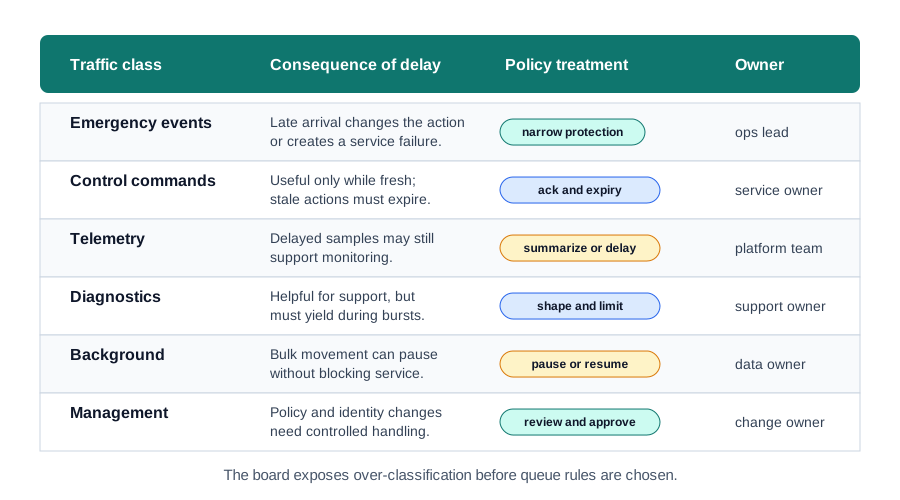
Emergency events
Messages where late arrival changes the operating consequence. These need the narrowest protected class and local fallback.
Control commands
Actions that are useful only while fresh. These need acknowledgement, expiry, duplicate handling, and command-state proof.
Operational telemetry
Measurements that can often be delayed, summarized, or sampled differently during contention.
Diagnostics and background
Support and bulk traffic that should yield to live service classes and resume when capacity returns.
Classification prompts:
- Which message types are truly protected, and why?
- Which messages can be delayed without changing the operating consequence?
- Which messages can be summarized, sampled, or dropped under load?
- Which class owns management actions such as policy changes, identity updates, or configuration pushes?
- Who approves changes to the classification map?
27.11 Step 2: Service Objective Record
For each class, write the service objective before choosing the mechanism. If the objective is vague, the lab cannot prove success.
Freshness window
How old can this message be before it should be ignored, rechecked, or treated as stale?
Delivery behavior
Is loss acceptable? Are duplicates harmless? Does the receiver need acknowledgement, idempotency, or deduplication?
Delay behavior
What delay changes the operating decision, and where should that delay be measured?
Degradation behavior
What happens when capacity is constrained: delay, summarize, drop, pause, local fallback, or support escalation?
27.12 Step 3: Queue and Shaping Rehearsal
Use a small event script to rehearse the policy. The script does not need exact timings; it needs enough structure to expose which class is protected and which class yields.
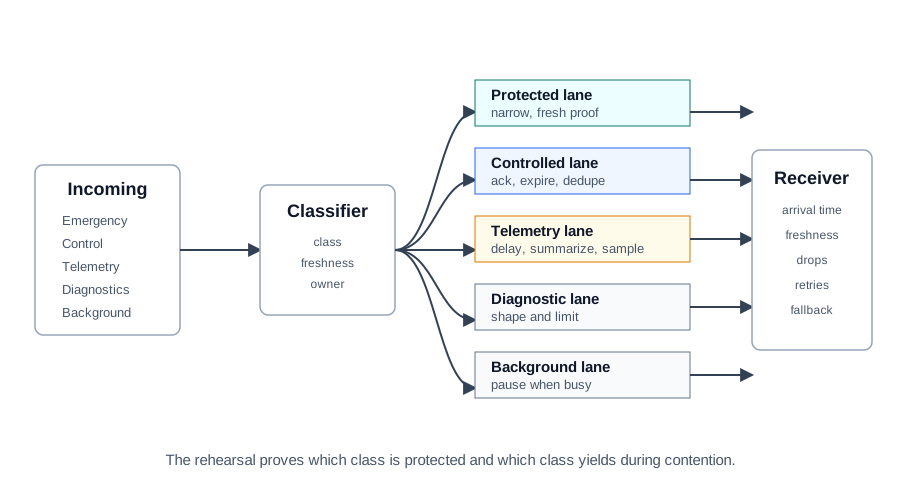
Run it: Rehearse the policy in the QoS simulator below instead of only scripting it on paper. Load a scenario that matches each round – Balanced plant for normal load, then Alarm burst or Congested gateway for burst load – and switch the policy between Strict priority, Weighted fair, Shaping, and Policing to watch which lane grows, which is shaped, and which is dropped. Step through and read the receiver outcomes so you can answer the observation questions from evidence rather than intuition.
Example rehearsal script:
Round 1: normal load
  Emergency: none
  Control: a small number of fresh commands
  Telemetry: steady measurements
  Diagnostics: low-rate logs
  Background: one transfer

Round 2: burst load
  Telemetry and diagnostics increase together.
  Protected traffic should still reach the receiver in the useful window.
  Background traffic should yield or pause.

Round 3: degraded dependency
  Receiver acknowledgement slows or becomes unavailable.
  Commands must expire or move to a hold state instead of arriving stale.
  Local fallback behavior should be visible.
Observation questions:
- Which queue grows first?
- Which class is shaped rather than dropped?
- Which class is rate-limited to protect the shared path?
- Which command expires before it can be acted on?
- Which local fallback or support action is triggered?
27.13 Step 4: Receiver-Side Proof
Sender-side logs are not enough. The receiver is where the service objective is either met or missed.
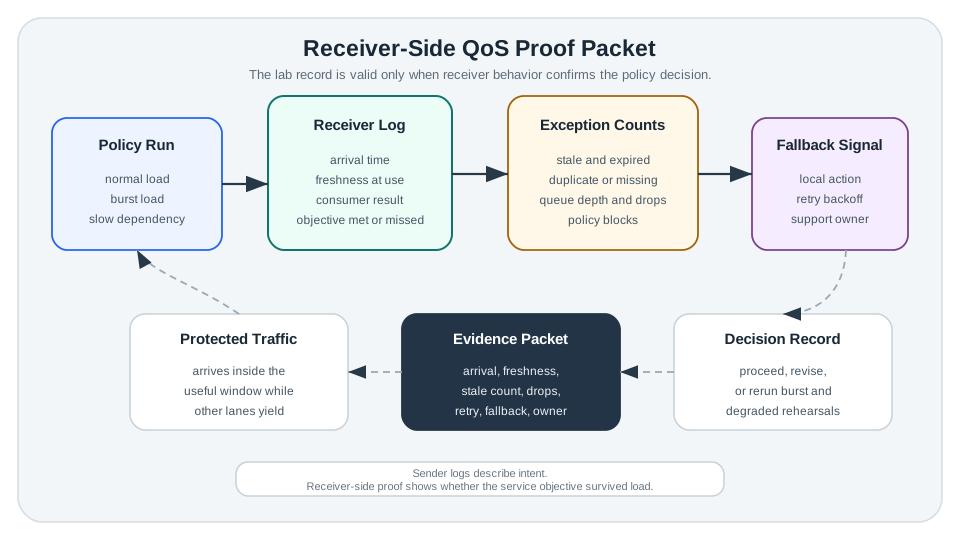
Collect proof for each class:
- Arrival time at the receiver or consumer.
- Freshness at the moment of use.
- Duplicate, missing, stale, expired, and retried messages.
- Queue depth and drops at the gateway or service boundary.
- Policy blocks or shaping decisions.
- Local fallback signals and support-owner actions.
- Notes explaining whether the proof is from normal load, burst load, or degraded operation.
The strongest lab proof links a policy decision to receiver behavior. “The queue was configured” is weak. “The protected message arrived within its useful window while telemetry was delayed and background transfer paused” is stronger.
27.14 Step 5: Degraded Behavior
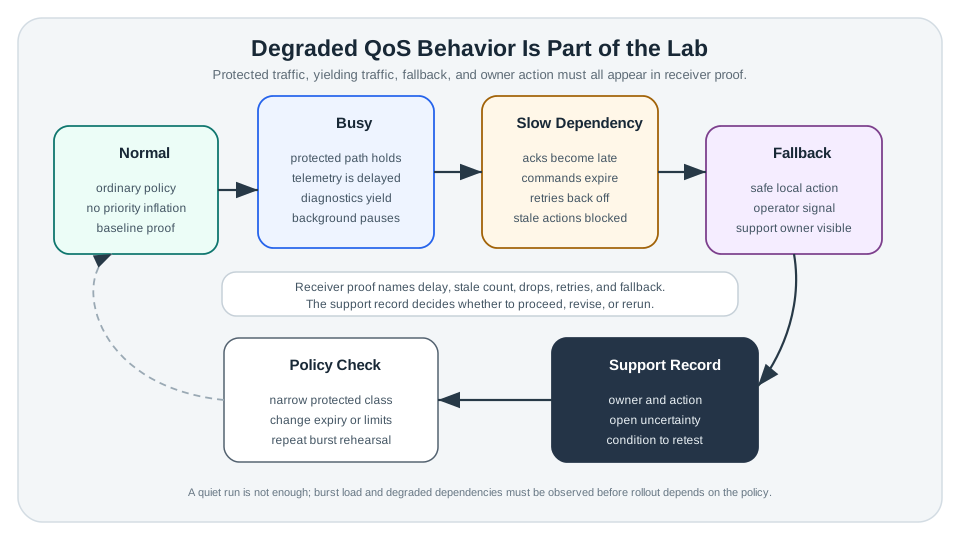
A QoS policy is most useful when the system is constrained. Define what changes before the system is overloaded.
Normal service
All classes follow the ordinary policy. Proof should show the expected distribution and no unnecessary priority use.
Busy service
Protected traffic keeps its path. Telemetry may be delayed or summarized. Diagnostics and background transfers yield.
Degraded dependency
Commands use expiry and hold checks. Local fallback handles actions that cannot wait for remote confirmation.
Policy check
Support records identify the owner, action, uncertainty, and condition that forces a policy change.
27.15 Step 6: QoS Lab Record
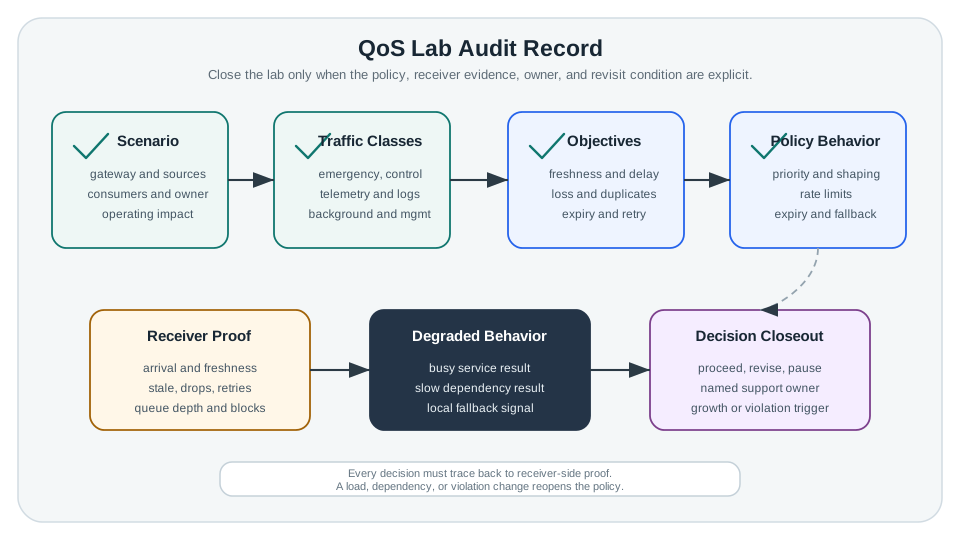
Close the lab with a record that another reader can audit.
Example record shape:
Scenario:
  Gateway, traffic sources, consumers, support owner, and operating consequence.

Traffic classes:
  Emergency, control, operational telemetry, diagnostics, background,
  and management traffic with owners.

Objectives:
  Freshness, delay, loss, duplicate, expiry, retry, and degradation behavior.

Policy behavior:
  Queue priority, shaping, rate limits, retry limits, expiry rules,
  and local fallback behavior.

Proof:
  Receiver-side timing, stale counts, queue depth, drops, retries,
  policy blocks, fallback signal, and support action.

Decision:
  Proceed, proceed with constraint, revise policy, gather more proof,
  or pause rollout.

Revisit trigger:
  Fleet growth, traffic-class change, service dependency change,
  repeated violation, or support ownership change.
27.16 Knowledge Check: QoS Lab Proof
27.17 Match: Lab Artifact to Purpose
27.18 Order: QoS Lab Workflow
27.19 Common Pitfalls
Testing only normal load
A QoS policy must be observed during bursts and degraded dependencies, not only when the gateway is quiet.
Protecting too many classes
If routine telemetry and diagnostics share the protected lane, emergency or control traffic may lose its advantage.
Ignoring stale commands
A command can be delivered reliably and still be wrong if it arrives after its useful window has passed.
Letting retries amplify load
Retries need backoff, expiry, and rate limits; otherwise a degraded dependency can create more congestion.
Stopping at sender logs
Receiver-side timing and freshness prove whether the service objective was met.
Missing ownership
Every policy violation should have an owner, action, closure signal, and revisit trigger.
27.20 See Also
- QoS and Service Management: route through traffic classes, objectives, and service records.
- QoS Core Mechanisms: queuing, shaping, and rate-limiting details.
- QoS in Real-World Systems: domain patterns and protocol-level choices.
- Production Architecture Management: production operating model and decision proof.
- SDN Fundamentals and OpenFlow: programmable service policy control.
27.21 Summary
The ESP32 QoS lab connects service-management ideas to constrained-device behavior. It asks learners to measure traffic, classify priorities, apply policy, and explain how the result would be monitored in a real deployment.
27.22 What’s Next
Continue with QoS in Real-World Systems when you need domain patterns, or return to QoS Core Mechanisms when the lab exposes a mechanism-specific gap.