Measure duty-cycled load current
Measure active, sleep and average supply current in a duty-cycled load to support the module guide's measure-first battery budget.

Predict the active and sleep supply current, then read the live scope before budgeting a cell.
Predict the reading, then compare it with the measurement.
Falstad CircuitJS
Third party ToolMeasure active, sleep and average supply current in a duty-cycled load to support the module guide's measure-first battery budget.
Open the prepared circuit.
Open this circuit in Falstad (new tab)Steps
Step 1
- Do
- Open the circuit canvas and point at the 5 V supply readout.
- You will see
- CircuitJS supply: 5 V DC. Exported active branch: 1 kΩ load plus MOSFET. Exported sleep branch: 100 kΩ across the same supply. Model inputs are synthetic, deterministic, seed 0.
- Why it matters
- A common supply makes the two branch currents comparable.
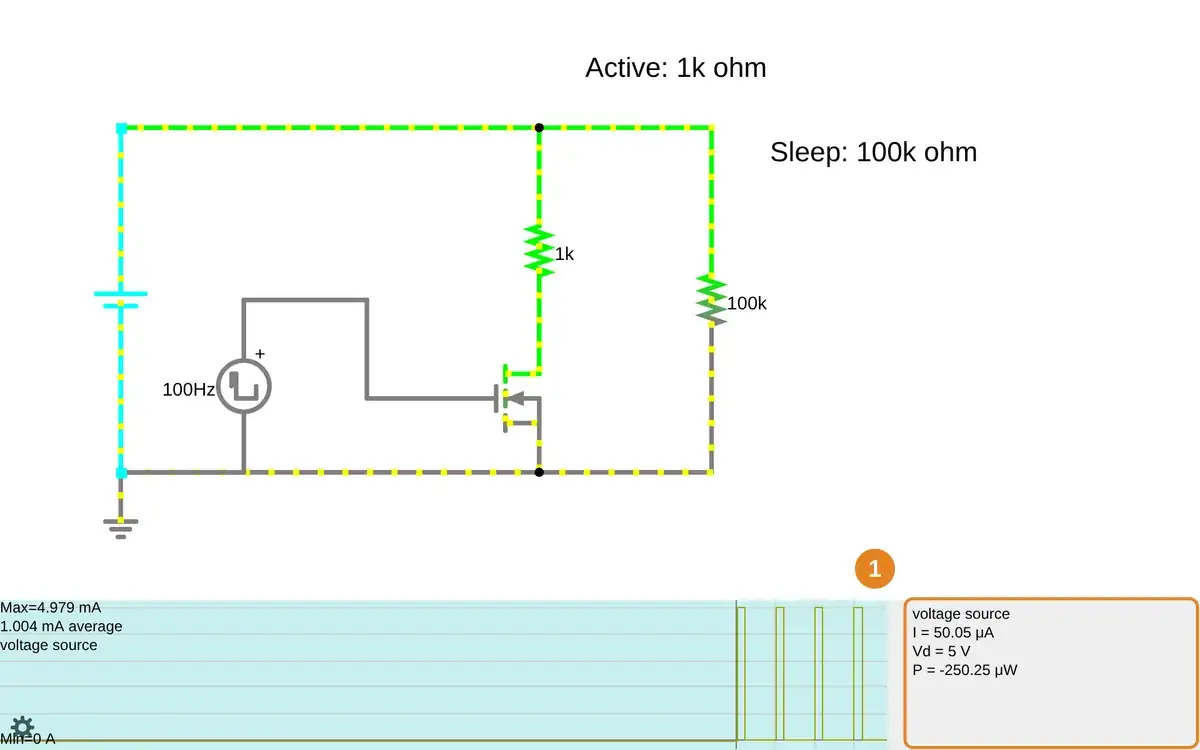
Step 1 · Falstad CircuitJS; numbered callout added to a real capture. Enlarge screenshot (new tab) Step 2
- Do
- Point at the 100 Hz drive source on the circuit canvas and inspect the scope.
- You will see
- Drive waveform: 100 Hz square wave. Netlist duty cycle: 0.20 (20%). Observed gate high: 5 V; gate low: 0 V. One 10 ms period contains about 2 ms on and 8 ms off.
- Why it matters
- The pulse width, rather than the clock rate alone, sets the average load time.
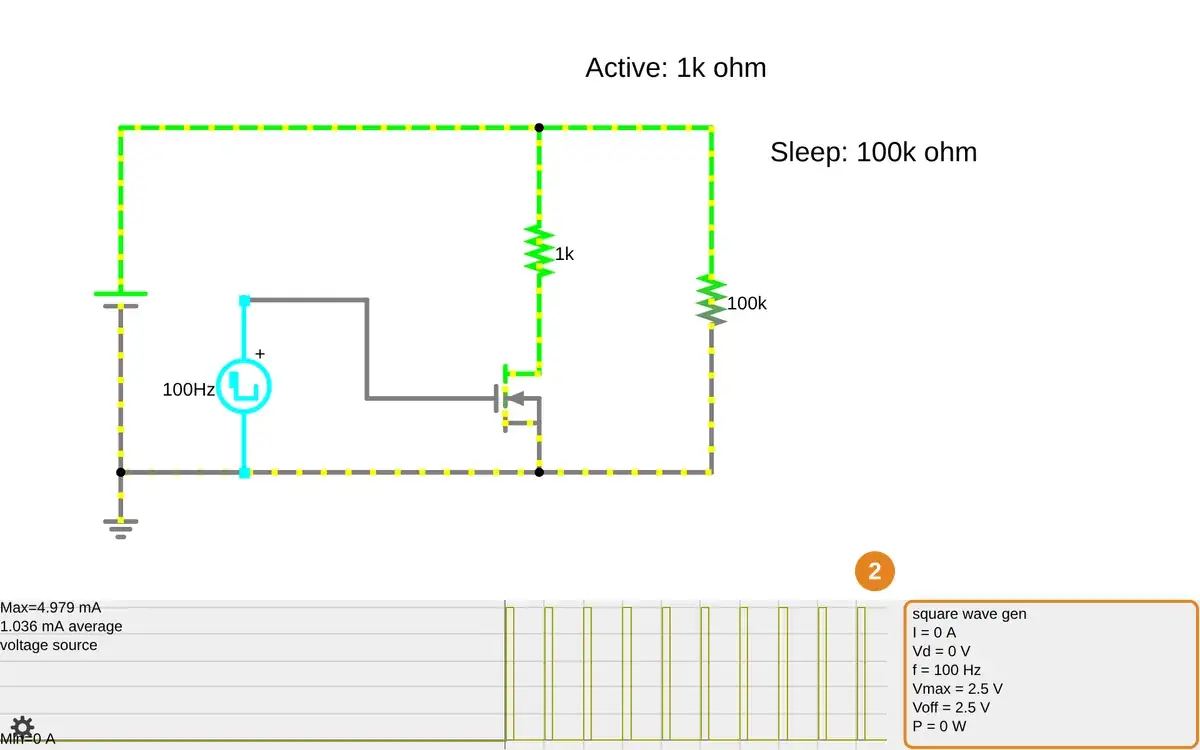
Step 2 · Falstad CircuitJS; numbered callout added to a real capture. Enlarge screenshot (new tab) Step 3
- Do
- Point at the active 1 kΩ resistor on the canvas and read current while the scope cycles.
- You will see
- CircuitJS on-state source current: 4.978865 mA. On-state load branch current: 4.928865 mA. The remaining 0.050000 mA flows through 100 kΩ. The scope reports Max=4.979 mA after repeated cycles.
- Why it matters
- The load current and sleep branch together make the active supply current.
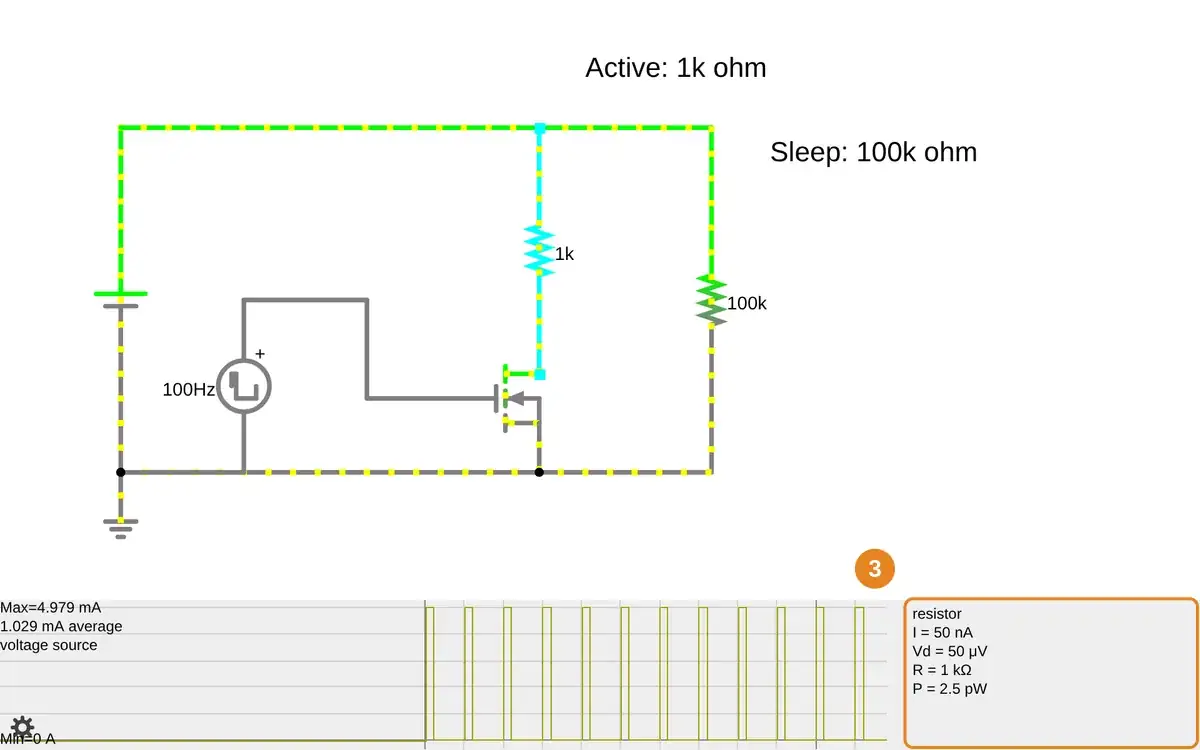
Step 3 · Falstad CircuitJS; numbered callout added to a real capture. Enlarge screenshot (new tab) Step 4
- Do
- Point at the sleep 100 kΩ resistor on the canvas and compare the scope minimum.
- You will see
- CircuitJS sleep-branch resistor current: 0.050000 mA. Off-state source current: 0.050050 mA. Off-state load leakage: 0.000050 mA. The MOSFET is off while the always-connected branch still draws current.
- Why it matters
- A switched load does not remove the current of an unswitched branch.
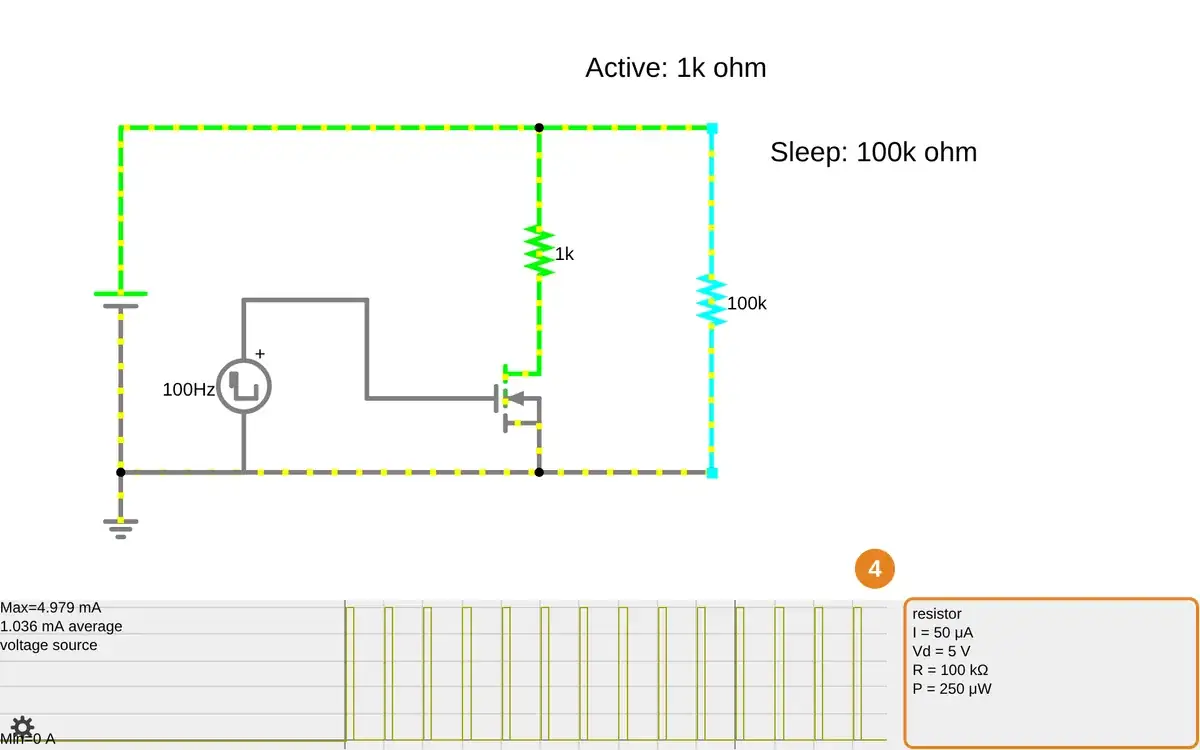
Step 4 · Falstad CircuitJS; numbered callout added to a real capture. Enlarge screenshot (new tab) Step 5
- Do
- Return to the supply readout on the canvas and read the scope average.
- You will see
- Scope Max=4.979 mA and Min≈0 mA at the displayed scale. Scope average after several periods: about 1.04 mA. API time samples: active=4.978865 mA; sleep=0.050050 mA. Weighted two-state calculation: 1.035813 mA at 20% duty.
- Why it matters
- The scope and time-weighted calculation agree to the displayed precision; the notebook can now vary duty cycle.
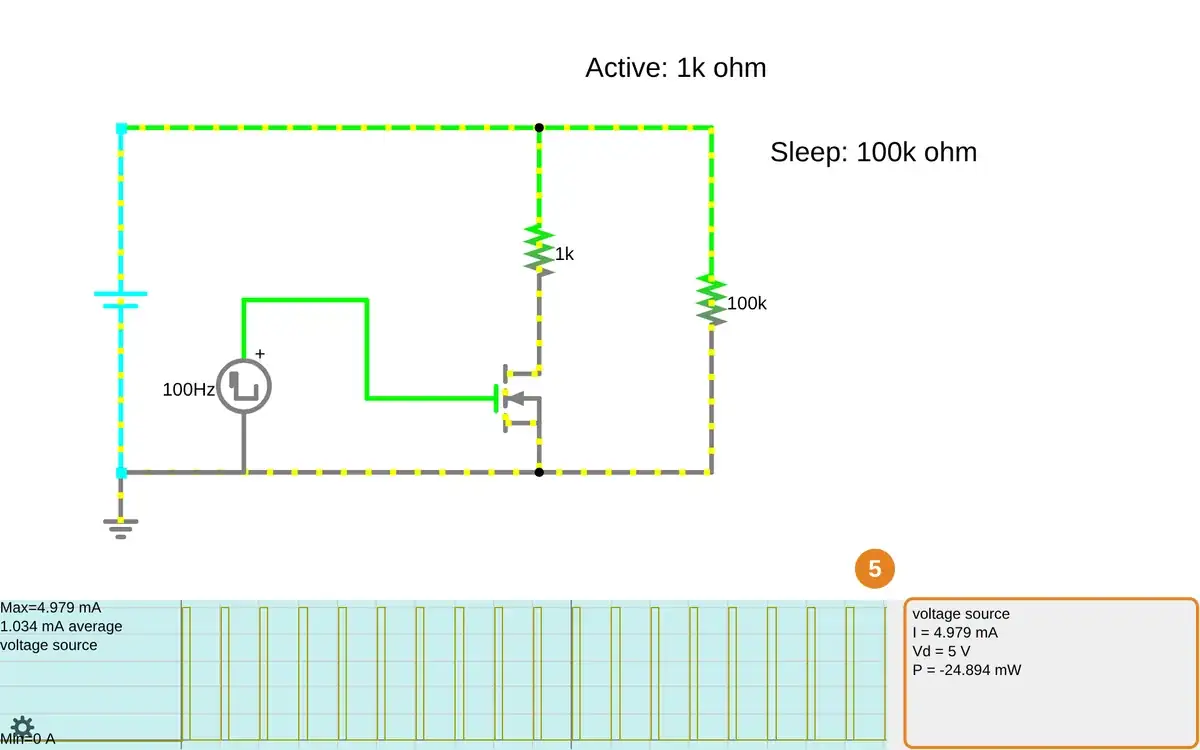
Step 5 · Falstad CircuitJS; numbered callout added to a real capture. Enlarge screenshot (new tab)
Chapter checks
These questions refer to the chapter’s examples. Use the return links to review their answers.
A battery-life calculator predicts four years, but the model uses datasheet sleep current, nominal battery capacity, and one successful radio transmission per cycle. What should the engineer do before accepting the result?
Return to the chapter’s knowledge checkBeyond a single lifetime figure, what is the most useful thing a battery-life tool provides?
Return to the chapter’s knowledge check