← Back to the chapter · Previous detail · Next detail →

Technical detail · IoT Interoperability Challenges

Trace the UMB namespace

The architecture in Figure 5 shows how a universal bridge can preserve those contracts without pretending BACnet, Zigbee, and OPC UA are the same native system.

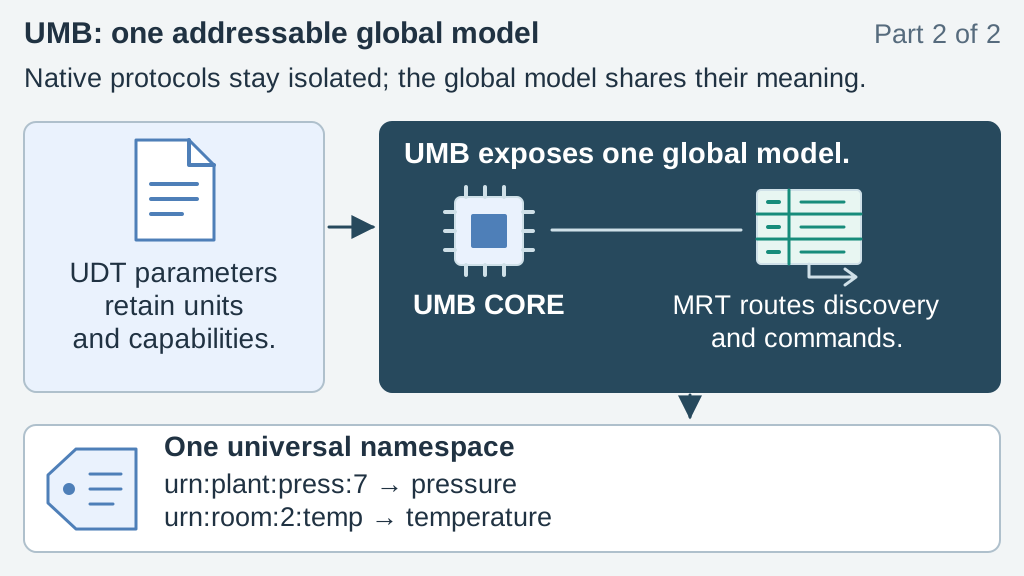
Separate UMB adaptors map BACnet objects, Zigbee clusters and OPC UA nodes into Universal Device Templates with global identifiers. Native domains retain their protocols while adaptors translate their data meaning.
A shared global model exposes native protocol data through one universal namespace, with device-template parameters retaining units and capabilities and a routing component directing discovery and commands. The model makes data addressable and shares its meaning while keeping native protocols isolated.

Compare Building BACnet with Home Zigbee and follow their separate adaptors into the shared namespace. Each adaptor translates native identity, capability, units, and route into a common record. The core uses that record to find the right domain again. The native protocols still have their own rules behind the boundary. A reviewer must check each mapping, since one common name does not by itself prove the meanings are equal.

← Back to the chapter · Previous detail · Next detail →