← Back to the chapter · Previous detail

Technical detail · IoT Interoperability Challenges

Trace a command and its return

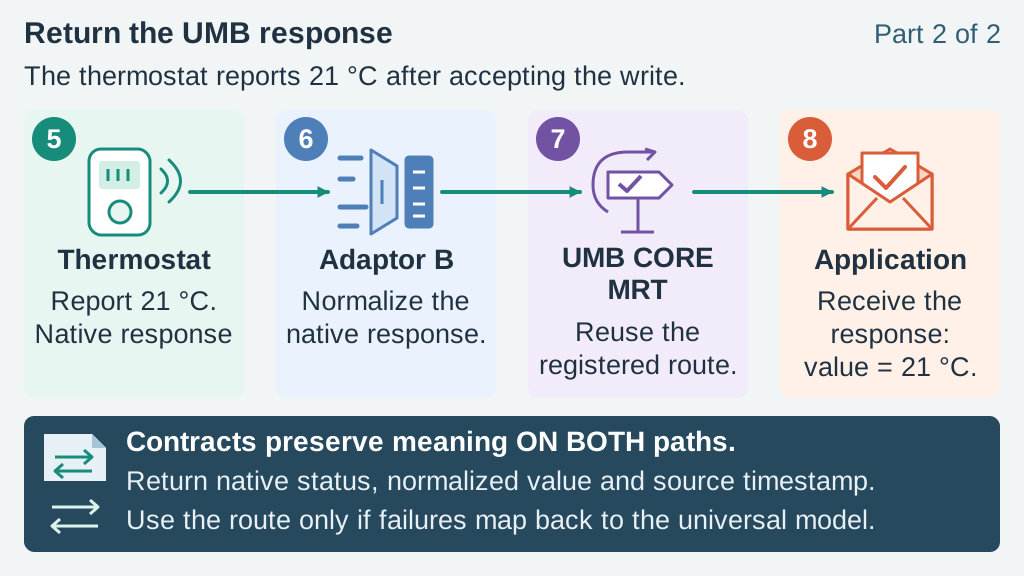
After registration, Figure 9 closes the loop by tracing translation in both directions rather than stopping at a successful lookup.

A UMB command requests 21 °C by global identifier, resolves the registered route and translates the request into a thermostat attribute write. Capability, type, range and authorization must be checked against the request contract.
A thermostat’s 21 °C response returns through the UMB adaptor and core to the application using the registered route. The response contract must preserve native status, normalized value and source timestamp, including mapped failures.

Start at Setpoint request and trace Resolve route and Translate into Thermostat. The core finds the native route, and the adaptor turns the shared request into a native write. Follow the return path to see the result mapped back to the shared contract. Record the returned status and source time as well as the value. A successful route lookup or accepted request alone does not establish that the physical setpoint changed.

← Back to the chapter · Previous detail