24 Lab: Blockchain Tamper Detection
Trace a signed IoT event from device record to ledger verification
IoT blockchain lab, hash-chain verification, gateway batching, tamper detection, ledger verification
24.1 Start With One Replayable Event
A useful blockchain lab starts before any chain is configured. It starts with one event that another party may need to replay later, such as custody, access, attestation, or a period summary.
Start simple: write the event path, the off-ledger evidence, the digest or signed record, and the verification step. The lab succeeds when the replay proves consistency, not when it merely creates a transaction.
24.2 Lab Goal
The previous chapters explained when blockchain belongs in an IoT architecture. This lab turns that decision into a verification exercise. You will trace an event through the record path, compare ledger choices, and produce a short architecture decision record.
Use this lab to answer four questions:
- Which event is durable enough to become a shared record?
- Which gateway or service signs and batches the event?
- Which ledger assumptions make the event accepted?
- Can a reviewer later reproduce the proof from the off-ledger record?
The overview depth layer shows the lab loop that ties event selection, gateway batching, ledger acceptance, tamper review, architecture decision, and design revision into one repeatable proof path.
24.3 Learning Objectives
By the end of this lab, you will be able to:
- Trace a signed IoT event from device observation to shared ledger record.
- Explain why raw telemetry stays off ledger while compact records go on ledger.
- Use hash comparison to detect whether off-ledger data changed after anchoring.
- Compare consensus assumptions without treating every ledger style as interchangeable.
- Write a concise decision record that accepts or rejects blockchain for the scenario.
24.4 Quick Check: Cold-Chain Replay Proof
Key Concepts
- Signed event: A compact record bound to an identity, timestamp source, payload fingerprint, and signature.
- Gateway batch: A group of events packaged by an edge service before ledger submission.
- Previous hash: A fingerprint from the earlier block that links accepted records into a chain.
- Candidate block: A proposed group of records waiting for validation.
- Consensus assumption: The trust model behind accepting a block, such as open participation, selected validators, or a trusted ordering cluster.
- Tamper verification: A later check that recomputes a fingerprint from stored data and compares it with the ledger record.
- Decision record: A short architecture note that records the accepted path, rejected alternatives, and records required for operation.
24.5 Ledger Proof Before Chain
A blockchain lab is useful only when the record path is precise before a block is accepted. The event must name the device or asset, the gateway that signs the package, the off-ledger data that remains available for replay, and the compact record that belongs in the shared history. Without that boundary, a ledger entry becomes an expensive log line rather than a verifiable architecture choice.
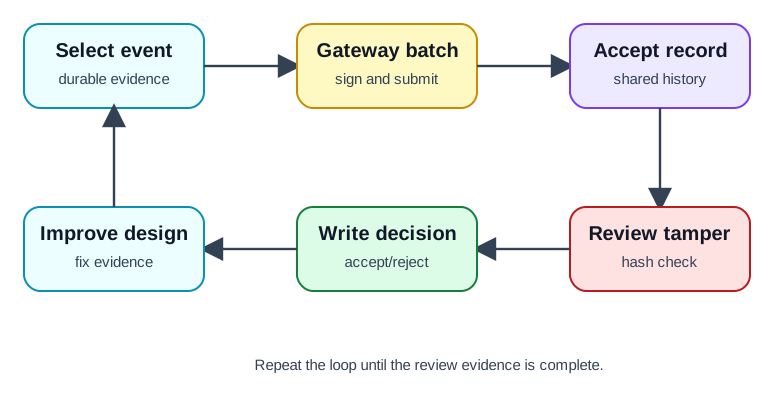
Mobile summary: The ledger proof starts with a scoped event, signer boundary, off-ledger replay path, and review decision before any block is trusted.
Use the loop as a traceability checklist. First, choose an event whose history must be shared across parties, such as a custody handoff or exception summary. Next, record the gateway responsibility: validation, batching, signing, buffering, and retry behavior. Then decide what the ledger stores, usually a compact fingerprint, event identifier, timestamp context, and accepted participant decision rather than the raw sensor stream.
The pass/fail question is simple: could a reviewer who did not watch the demo later retrieve the off-ledger record, recompute the fingerprint, verify the signer, and explain why that accepted ledger entry belongs to the scenario? If the answer is no, the lab has shown a transaction animation but not a reusable proof path.
The lab should therefore separate three claims. The device claim says what was observed. The gateway claim says who packaged and signed the event. The ledger claim says which fingerprint, timestamp, participant decision, and previous-hash link were accepted. A later reviewer needs all three claims to reproduce the proof.
- Event scope: choose a custody, attestation, summary, or exception record that several parties need to review.
- Storage boundary: keep raw readings, files, and operational logs off ledger while anchoring compact fingerprints.
- Review path: preserve the batch, fingerprint method, signature, timestamp source, and ledger reference.
24.6 Build The Replay Record
Treat the lab output as a replay record, not a platform demo. For each scenario, write the selected event, signer boundary, batch identifier, hash method, consensus style, validation result, off-ledger storage location, and retest trigger. That gives the reviewer enough evidence to distinguish a good ledger fit from normal signed audit storage.
A practical replay record should make two people reach the same result without asking the original implementer. Store the event identifier, source device or asset, gateway certificate or key identifier, batch creation time, canonical sort rule, hash algorithm, ledger transaction reference, validator or ordering service assumption, and the query used to recover the off-ledger batch. If any item is missing, write the gap as an operational risk rather than hiding it behind a successful demo screen.
Keep the record scenario-sized. A lab for one cold-chain handoff may need one exception event, one batch, one ledger transaction, and one replay query. Adding more records is useful only when it exposes a real boundary such as duplicate submission, delayed gateway upload, or key rotation.
| Artifact | Evidence to preserve | Why it matters |
|---|---|---|
| Event package | device identity, payload fingerprint, timestamp source | defines exactly what was signed |
| Gateway batch | batch id, sort rule, signature, retry state | shows who submitted the ledger material |
| Ledger record | transaction id, block reference, consensus assumption | anchors the shared history being reviewed |
| Replay query | storage path, recompute command, expected comparison | lets reviewers detect missing or changed detail |
When a mismatch appears, record the specific uncertainty instead of calling the ledger broken. The off-ledger batch may be missing, the fingerprint method may be wrong, the gateway signature may not verify, or the wrong ledger record may have been retrieved. Each case leads to a different operational response.
- Match: the recomputed fingerprint, gateway signature, timestamp source, and ledger record support the same event history.
- Missing: the ledger reference exists, but the off-ledger batch or required metadata cannot be replayed.
- Inconsistent: the recomputed fingerprint or signature does not match the accepted ledger record.
24.7 Anchors Prove Consistency
A hash-chain anchor proves that the replayed data is consistent with the accepted fingerprint. It does not prove that a sensor was calibrated, that a gateway key was protected, that validators were operated well, or that the physical event was correctly described. Those claims require identity, calibration, key-management, monitoring, and governance records outside the chain.
The fingerprint is also sensitive to representation. Two batches with the same readings can hash differently if fields are sorted differently, units are normalized differently, timestamps are rounded differently, or JSON keys are serialized in a different order. A serious lab therefore records the canonicalization rule before computing the hash. That rule is part of the proof, not an implementation detail.
The replay should also distinguish tamper evidence from ordinary correction. If a value was corrected through an approved workflow, the original batch, correction record, signer, reason, and new fingerprint should all be inspectable. If the old batch simply disappears or silently changes, the comparison reports an integrity failure instead.
Signatures narrow the boundary further. A device signature can say that a device key signed an observation package. A gateway signature can say that an edge service accepted, filtered, and batched several packages. Neither signature proves that the sensor was physically honest, that the operator followed maintenance rules, or that a later key rotation was handled safely. Those are separate assurance records that the decision record must name.
Consensus also changes the evidence boundary. A trusted ordering cluster, a permissioned consortium, and an open validator set make different assumptions about participants, finality, fault behavior, operating burden, and dispute handling. The lab decision record should name those assumptions before the ledger becomes a dependency.
- Hash links expose changed or missing stored data when the replay fingerprint no longer matches.
- Signatures bind an event package to an identity boundary, but only if keys and rotation are governed.
- Consensus records explain why the accepted block is settled enough for the scenario.
24.8 Lab Workspace
Use the transaction flow visualizer as the lab workspace. Choose a scenario, run the transaction path, and keep the lab questions focused on what becomes a shared ledger record.
24.9 Activity 1: Trace The Event Path
Start with one event that several parties may need to review later. Good lab candidates are custody handoff, gateway access audit, firmware attestation, meter period summary, or exception record. Avoid raw high-frequency readings as the ledger record.
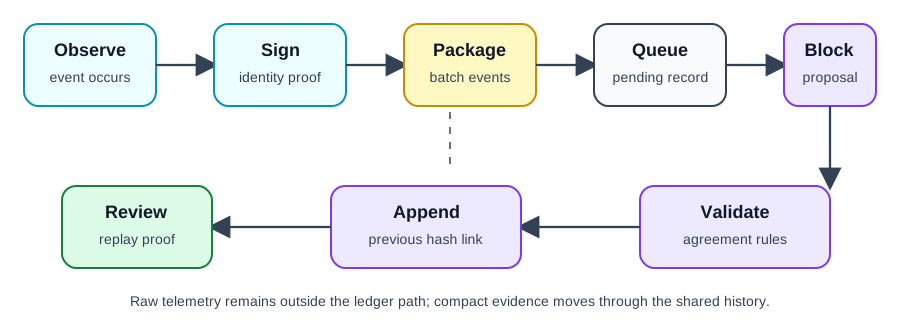
Record the event path in this order:
- Observation: What happened in the physical or operational system?
- Device identity: Which device or asset produced the observation?
- Gateway boundary: Which gateway validates and signs the event package?
- Payload fingerprint: Which compact fingerprint represents the stored detail?
- Ledger record: Which milestone or summary is written to the shared history?
- Verification query: What would a checker retrieve later to verify the record?
24.9.1 Lab Notes
For a cold-chain exception, the raw temperature stream remains in telemetry storage. The ledger record should be the exception summary, the batch fingerprint, the gateway signature, and the handoff context. For a firmware attestation, the ledger record should be the approved image fingerprint and the device identity action, not the full firmware file.
24.10 Compare Consensus Assumptions
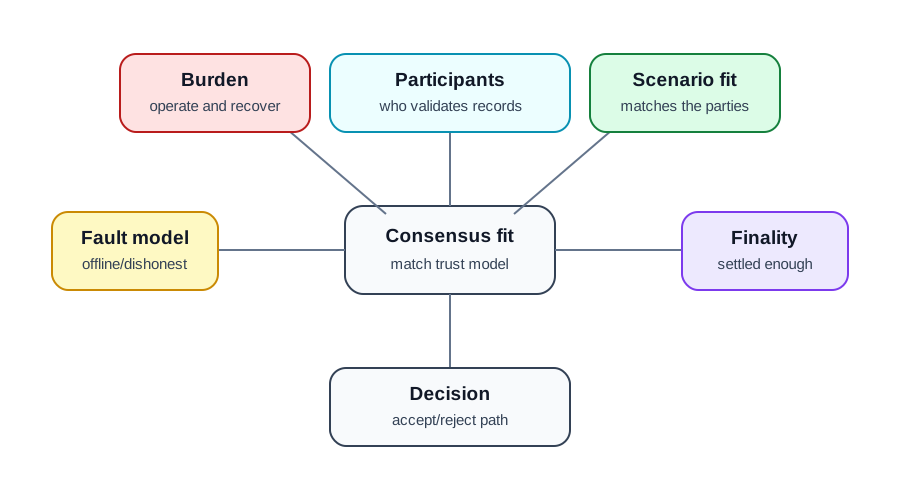
Run the visualizer with at least two consensus styles. Do not rank them by speed alone. A fast trusted ordering cluster may be fine inside one operator boundary, while a multi-party consortium needs stronger agreement among known participants.
Run it: This is the visualizer the activity refers to. Choose a consensus model (Proof of Work, Proof of Stake, PBFT, or Raft) and a scenario such as Cold Chain Alert or Firmware Attestation, Submit a transaction to watch it settle, then use Compare Consensus to run the same records under a second model. Read the difference in participants, fault tolerance, and finality against the prompts below rather than ranking by speed alone.
Compare each option using these prompts:
- Participants: Who is allowed to validate records?
- Fault model: Are validators simply unavailable, or can some behave dishonestly?
- Finality: When can the system treat the record as settled enough?
- Operating burden: Who runs validators, monitors them, and handles outage recovery?
- Fit: Does this trust model match the parties in the scenario?
24.11 Activity 3: Run A Tamper Verification
The key lab outcome is tamper detection. A ledger entry is useful only if a reviewer can replay the proof path.
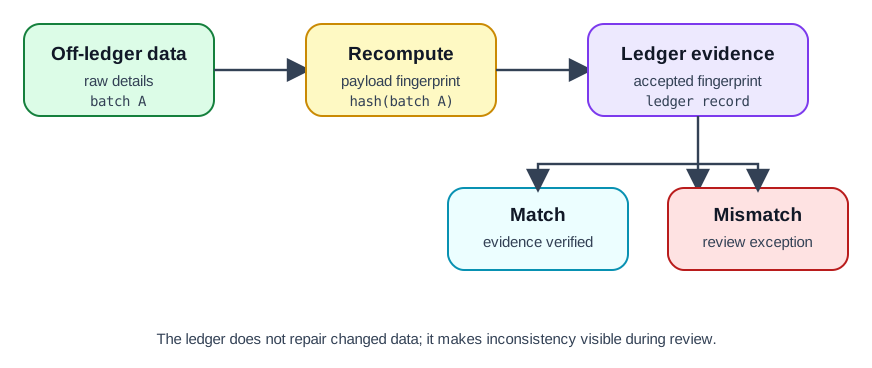
Use this verification procedure:
- Retrieve the off-ledger event batch.
- Recompute the payload fingerprint using the agreed method.
- Retrieve the ledger record for the same event or period.
- Compare the recomputed fingerprint with the ledger fingerprint.
- Verify the gateway signature and timestamp source.
- Record whether the stored data matches, is missing, or is inconsistent.
If the off-ledger batch changes after anchoring, the recomputed fingerprint changes. The ledger does not fix the data; it exposes that the stored detail no longer matches the accepted record.
24.12 Activity 4: Write The Decision Record
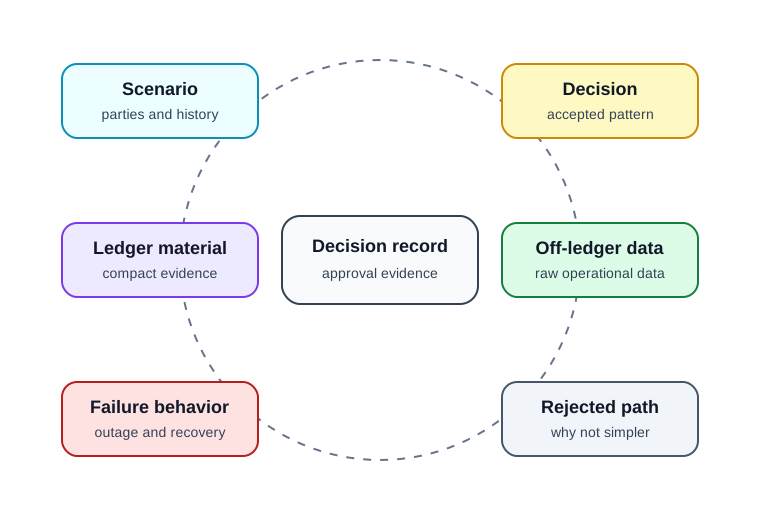
Finish the lab by writing a short decision record. Keep it specific. A good record explains the scenario, the ledger material, the off-ledger material, the identity boundary, and the rejected alternative.
Use this structure:
Scenario: Name the parties and the event history they must share.
Decision: State whether the design uses a ledger, signed audit storage, or another pattern.
Ledger material: List only compact records written to the shared history.
Off-ledger material: List raw readings, files, logs, and analytics that remain in normal storage.
Identity path: State who signs the event at each boundary.
Failure behavior: State what happens during gateway outage, duplicate submission, delayed submission, or key recovery.
Rejected alternative: Explain why direct raw telemetry on ledger, single-owner storage, or real-time ledger control was rejected.
24.13 Completion Records
Your lab is complete when you can show:
- A selected IoT event that is suitable for a shared record.
- A gateway boundary that signs and batches the event.
- A reasoned consensus choice for the scenario.
- A tamper review that explains how a changed off-ledger batch is detected.
- A decision record with accepted and rejected architecture paths.
Common Failure Patterns
A visualizer or single-node demonstration teaches hash links and record flow. Production security depends on identity provisioning, key storage, validator operation, monitoring, and recovery rules.
Raw telemetry is usually too frequent, too noisy, and too operational for ledger placement. Anchor compact fingerprints, summaries, custody events, and agreement outcomes instead.
An anchored fingerprint is not enough by itself. A reviewer also needs the off-ledger batch, the fingerprint method, timestamp source, gateway signature, and event context.
Agreement logic can automate a response after an accepted record arrives. The architecture still needs approval rules, exception handling, and recovery paths when records are missing or disputed.
24.14 Knowledge Check
24.15 Check Your Understanding
24.16 Match Lab Artifacts To Roles
24.17 Sequence The Lab Verification
24.18 Summary
This lab turns blockchain architecture into records you can verify. The useful skill is not memorizing a platform. The useful skill is tracing which IoT facts become shared records, which data stays off ledger, who signs at each boundary, how consensus assumptions match the parties, and how a later checker proves whether the ledger entry still matches. If you can produce that decision record, you can explain when blockchain belongs in an IoT design and when normal signed audit storage is the better answer.
24.19 Key Takeaway
A blockchain lab should prove the trust assumptions, transaction path, contract behavior, latency, cost, and off-chain integration before claiming IoT fit.
24.20 What’s Next
- Revisit Blockchain Fundamentals for IoT if hash links, consensus, or off-ledger anchoring are still unclear.
- Use Smart Contracts and Architectural Patterns when the next design question is automated agreement logic.
- Use Blockchain Limitations and Real-World Implementations when the next design question is scale, latency, privacy, or operating responsibility.