9 IoT Glossary: Q-R
More
Depth: Practitioner
Progress saves as you read. Mark sections complete as you go; your progress appears in the sidebar.
9.1 Overview
This section: Overview — This first reference route covers Q and R terms and keeps their definitions, examples, and cross-references together.
This first reference route covers Q and R terms and keeps their definitions, examples, and cross-references together.
This is part 1 of 2. Continue with IoT Glossary: S-Z for the second focused route.
9.2 In 60 Seconds
This section: In 60 Seconds — Picture a capstone team saying its alarm is secure, real time, and reliable.
Turn Each Term Into a Checkable Promise
Picture a capstone team saying its alarm is secure, real time, and reliable. Those words sound strong, but the reviewer still does not know who may act, how old an alert may be, what can repeat, or which record survives a fault. A useful term should open a test, not end the talk.
For each word, write the thing it owns, the evidence that proves it, and the harm it does not prevent. Tie the term to one event, person, time, unit, quality state, and system boundary. Use the full meaning on first use when a new reader may not know the short form.
Test the promise with a late alert, a duplicate, a wrong user, a lost route, an old key, and a restored data store. Ask what the term says about each result and where another control is needed. A standard name or product badge is not a field result.
Keep urgent safe action clear of vague language. If a word cannot say who acts and what happens on failure, it is not yet ready for a runbook.
This opening does not replace the detailed entries below. Practitioner turns terms into design and test records. Under the Hood examines exact mechanisms, limits, trade-offs, and the links between words that are often confused.
Use a short release check. Can a new reader say what the word owns? Can they point to proof? Can they name one risk outside it? Can they run a fault test? Can they find the owner? If any answer is no, define the term again in the project record.
This glossary section covers IoT terminology from Q through Z, with emphasis on quality of service, security, sensor data, time-series storage, wireless protocols, and additional reference terms. The most frequently reused terms in this range include QoS, TLS, Time Series, TSDB, Thread, Zigbee, Z-Wave, and 6LoWPAN.
9.3 Start With The Runtime Promise
This section: Start With The Runtime Promise — Q-Z terms often sound like guarantees, so start by naming the promise they really make.
Q-Z terms often sound like guarantees, so start by naming the promise they really make. QoS describes broker delivery behavior, not whether an actuator command is safe to repeat. TLS protects a transport session only when certificates, hostnames, clocks, keys, and trust anchors are handled correctly. A TSDB stores timestamped measurements, but it does not prove that units, retention, downsampling, or dashboard queries are fit for the incident you need to review.
Wireless terms need the same discipline. Thread, Zigbee, Z-Wave, Wi-Fi, Sigfox, and 6LoWPAN each carry assumptions about power, topology, range, gateway roles, channel planning, and recovery. The term is a starting point, not a field result.
Use this section to turn vocabulary into runbook checks. Ask what state the term owns, what evidence proves it, and what failure remains outside the promise.
9.4 Learning Objectives
This section: Learning Objectives
After reviewing this section, you will be able to:
- Define key IoT terms from Q to Z with technical precision.
- Evaluate quality of service levels and their trade-offs for different IoT scenarios.
- Differentiate wireless protocols such as Zigbee, Z-Wave, Thread, Wi-Fi, Sigfox, and 6LoWPAN by topology, power, range, and data rate.
- Select appropriate database technologies for time-series IoT data based on write rate, retention, aggregation, and query patterns.
9.5 Q-Z Terms Name Run-Time Promises
This section: Q-Z Terms Name Run-Time Promises — The Q-Z range is where vocabulary becomes operations.
The Q-Z range is where vocabulary becomes operations. QoS, retry, routing, schema, telemetry, TLS, token, topic, TSDB, Thread, Wi-Fi, Zigbee, Z-Wave, and 6LoWPAN name promises that are tested after deployment, not just during design. They decide whether a message can be duplicated, whether a certificate is trusted, whether a timestamp is meaningful, whether a query can reconstruct an incident, and whether a low-power network still works after interference or route changes.
Read each term by asking what run-time state it owns. MQTT QoS owns broker delivery behavior, not database writes or actuator safety. TLS owns transport authentication, confidentiality, and integrity only when certificate validation, hostnames, clocks, key storage, and trust anchors are correct. A topic owns broker routing, but it does not define tenant authorization, schema compatibility, or dashboard freshness. A TSDB owns timestamped storage and time-window queries, but retention, downsampling, backup, and cardinality control are still design choices.
Wireless terms carry similar operational boundaries. Thread and 6LoWPAN make IPv6 practical on constrained IEEE 802.15.4 networks, but border-router behavior, fragmentation, routing, and sleepy-device assumptions still matter. Zigbee and Z-Wave can reduce endpoint power, but coordinator, certification, regional band, channel, and mesh-health evidence decide whether the deployment is credible. Wi-Fi provides high throughput and IP familiarity, but power draw and congestion can dominate battery or reliability claims.
| Run-Time Promise | Terms To Bind | Evidence To Inspect | Risk If Vague |
|---|---|---|---|
| Delivery | QoS, retry, subscriber, subscription, topic, wildcard | PUBLISH/PUBACK trace, retry policy, topic ACL, duplicate test | A duplicate or misrouted command changes physical state |
| Trust | TLS, token, certificate, HTTPS, OAuth | Certificate chain, hostname check, token scope, expiry test | Encrypted traffic is mistaken for authorized traffic |
| History | Telemetry, timestamp, time series, TSDB, TimescaleDB | Schema version, unit, retention policy, downsampling query | Incident review cannot reconstruct the original signal |
| Connectivity | Thread, Zigbee, Z-Wave, Wi-Fi, Sigfox, 6LoWPAN | Channel, role, gateway/border router, link quality, route table | Range or power claims ignore topology and recovery behavior |
Use Q-Z terms as operational proof points: identify the promise, the artifact, and the failure that the term does not automatically prevent.
9.6 Turn Terms Into Runbook Checks
This section: Turn Terms Into Runbook Checks — For a project or capstone review, translate each Q-Z term into a runbook check.
For a project or capstone review, translate each Q-Z term into a runbook check. A QoS claim should say which MQTT QoS level is used, why that level fits the data or command, what duplicate behavior was tested, and where idempotency is enforced. QoS 0 may be acceptable for high-rate telemetry where the next sample replaces a missed one. QoS 1 may be appropriate for important telemetry when consumers deduplicate by timestamp, sequence number, or message id. QoS 2 may be useful in broker delivery paths, but it still does not prove that an actuator command is safe to repeat physically.
Security terms need observable negative tests. TLS evidence should include certificate-chain validation, hostname behavior, supported protocol version, clock tolerance, and how keys or trust stores rotate. Token evidence should include scope, expiry, refresh behavior, and the API or broker rule that enforces authorization. A practical review should deliberately test an expired token, wrong hostname, revoked credential, or unauthorized topic so the term is not only asserted on the happy path.
Time-series and telemetry terms need data-life-cycle evidence. Record sensor id, unit, timestamp source, schema version, quality flag, and retention class in at least one sample row. For InfluxDB, TimescaleDB, Prometheus, QuestDB, or another TSDB-like store, write down the expected write rate, cardinality drivers, compression or downsampling policy, query windows, backup and restore expectation, and the person or team that can operate it. A dashboard screenshot is not enough if the underlying query hides missing data or stale aggregation.
Wireless terms need deployment evidence rather than generic protocol descriptions. For Thread, record the border router, mesh role, channel, route health, and whether sleepy end devices meet latency needs. For Zigbee, record coordinator state, channel selection, joining policy, and interference assumptions. For Z-Wave, record the regional band and inclusion/exclusion workflow. For 6LoWPAN, record IPv6 header compression, fragmentation risk, MTU, routing interaction, and what happens when one fragment is lost. The review should end with a specific next check, not a broad claim that the network is low power.
The compact format is term, owner, evidence, and recovery. “TLS” becomes “gateway process owns TLS validation; proof is a successful valid-chain connection and failed wrong-hostname test; recovery is certificate rotation through the documented trust-store update path.” That format turns vocabulary into something an operator could use during an outage.
9.7 Guarantees Stop At Layer Boundaries
This section: Guarantees Stop At Layer Boundaries — Under the hood, Q-Z terms often fail when a guarantee is stretched beyond its layer.
Under the hood, Q-Z terms often fail when a guarantee is stretched beyond its layer. MQTT QoS 1 confirms a broker delivery handshake, but a subscriber may still process the same payload twice. MQTT QoS 2 narrows a duplicate path inside MQTT, but it does not prove that storage, alerts, or physical actuators are exactly once. A retained message can be useful for last-known state and dangerous when old state appears current after a reboot. Wildcard subscriptions can simplify monitoring and accidentally cross tenant, device, or command namespaces.
TLS and token terms stop at their own boundaries too. TLS can authenticate the endpoint and protect bytes in transit, but it cannot decide whether a device is allowed to publish to a topic unless an authorization layer checks that policy. A token may authorize an API call, but it does not prove sensor calibration, payload truth, or device possession unless it is combined with device identity. Bad clocks can break certificate validity and token expiry checks, so time synchronization becomes part of security evidence.
Data terms hide another boundary. A timestamp may be generated by the sensor, gateway, broker, ingestion service, database, or dashboard. Each choice changes ordering and incident reconstruction. Schema validation can reject malformed data, but it cannot prove units, calibration, or semantic truth. Downsampling can make long-term dashboards efficient while deleting spikes that matter for safety, warranty, or maintenance. TSDB compression and retention policies therefore belong in the engineering argument, not in a footnote.
Wireless and adaptation terms hide state that is easy to miss. Thread and Zigbee meshes depend on router roles, neighbor tables, link quality, and channel planning. Z-Wave behavior depends on regional frequencies, inclusion security, and network healing. 6LoWPAN compresses IPv6 headers and fragments packets across small IEEE 802.15.4 frames; losing one fragment can lose the whole IPv6 packet. Wi-Fi has familiar IP behavior but higher idle listening costs and shared-channel contention. Sigfox and other narrowband options constrain payload size, downlink, and regional service availability.
A rigorous Q-Z explanation names both the useful guarantee and the stop sign. QoS helps broker delivery but stops before application idempotency. TLS protects transport but stops before authorization and operations. TSDB stores time-indexed rows but stops before proof that the signal was sampled correctly. Thread or Zigbee helps low-power mesh behavior but stops before evidence that the actual deployment has healthy routes. That stop-sign discipline is what turns vocabulary into dependable design review.
9.8 Deep Dive: Q-Z Terms Define Operational Boundaries
This section: Deep Dive: Q-Z Terms Define Operational Boundaries — Read Figure 9.1 from QoS 0 to QoS 2, tracking how acknowledgements, duplicate handling, protocol state, and message exchanges increase.
Terms from Q through Z describe what happens after a device starts operating: delivery semantics, retry behavior, routing, sampling, schema evolution, serialization, telemetry, security, time-series storage, wireless behavior, and low-power IP networking. Read Figure 9.1 from QoS 0 through QoS 2 while tracking acknowledgement, duplicate risk, state, and overhead.
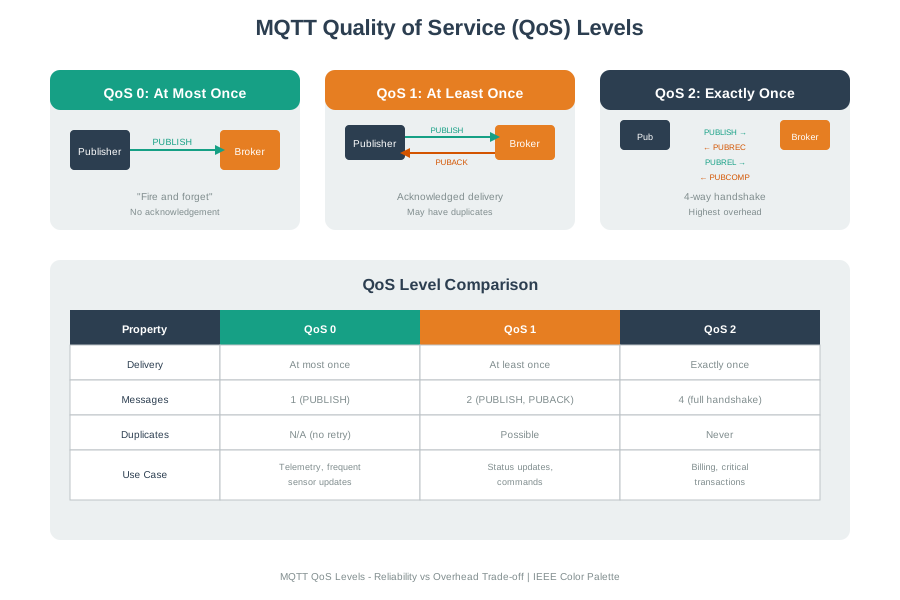
Read Figure 9.1 from QoS 0 to QoS 2, tracking how acknowledgements, duplicate handling, protocol state, and message exchanges increase. The diagram stops at broker delivery, so use each term to name a boundary that can be tested. QoS is not a universal reliability switch; timestamps still control ordering and retention, while wireless choices still carry topology, channel, power, certification, gateway, and regional constraints.
In Figure 9.1, qoS 0 minimizes exchange state but can lose a publication, QoS 1 adds acknowledgement while permitting duplicates, and QoS 2 adds a longer handshake to control duplicate delivery at the broker boundary. None proves the full business outcome. A QoS 1 duplicate can be harmless telemetry with timestamp-and-sequence deduplication and dangerous for a non-idempotent actuator command. The same stop-sign logic applies to the other Q-Z terms: each names one owned promise and leaves downstream checks visible.
For a capstone explanation, avoid saying that a system is “real time,” “secure,” “reliable,” or “low power” without the Q-Z term that makes the claim inspectable. Real-time may mean an alert deadline, a control-loop budget, or dashboard freshness. Secure may mean TLS certificate validation, token scope, key storage, or message authorization. Low power may mean radio duty cycle, sleepy end-device behavior, sampling interval, routing role, or retransmission cost.
| Boundary | Terms That Make It Inspectable |
|---|---|
| Reliability | QoS, retry, routing, subscriber, subscription, topic, wildcard, and real-time terms explain what can be lost, duplicated, delayed, filtered, or misrouted. |
| Data | Sampling, schema, serialization, telemetry, time series, timestamp, TSDB, and TimescaleDB terms explain what is measured, encoded, stored, compacted, and queried. |
| Connectivity | Thread, Wi-Fi, Zigbee, Z-Wave, Sigfox, cellular IoT, frequency, and 6LoWPAN terms explain how packets move through constrained or managed networks. |
9.8.1 Connect the Term to a Measurable Check
Before using a Q-Z term in a project review, connect it to evidence from the system. QoS should point to MQTT packet flow, duplicate handling, and command idempotency. Retry should point to backoff settings and maximum attempts. Schema should point to JSON Schema, Protobuf, Avro, or database migrations. TLS should point to certificate validation, cipher policy, and token handling.
For wireless and storage terms, record the constraint that changes the design. Zigbee, Thread, and Wi-Fi share the 2.4 GHz band in many deployments but use different channel plans and mesh/star behavior. Z-Wave uses sub-GHz regional bands and certification constraints. TSDB selection depends on write rate, retention, downsampling, compression, query shape, and operational familiarity.
For a QoS or retry claim, capture both the protocol trace and the application rule. Record the MQTT client id, clean-start/session setting, topic, QoS level, retained flag, packet identifiers, PUBACK/PUBREC/PUBREL/PUBCOMP evidence where relevant, retry interval, and the consumer rule that prevents duplicate side effects. For a command path, add the command id, expected state transition, acknowledgement source, timeout, and rollback or manual-review path.
For data terms, keep the evidence tied to the field contract. A telemetry row should show sensor id, units, timestamp source, schema version, quality flag, and retention class. A TSDB or TimescaleDB decision should include write rate, cardinality, compression/downsampling plan, query windows, backup/restore expectations, and the team that can operate the database. For TLS and Token, record certificate chain validation, hostname behavior, clock tolerance, key rotation, scope, expiry, and where authorization is enforced.
For wireless terms, record the deployment constraint rather than only the protocol name. A Thread or Zigbee statement should include channel, PAN or fabric identity as appropriate, router/end-device role, gateway or border-router dependency, link-quality evidence, and interference assumptions. A 6LoWPAN statement should include the adaptation boundary: IPv6 header compression, fragmentation risk, MTU, routing interaction, and what happens when a fragment is lost.
- Choose the observable. Example: MQTT PUBLISH/PUBACK logs, a TLS certificate chain, a Zigbee channel scan, a Thread border-router route, or a TSDB retention policy.
- Name the term and layer. Example: QoS at the MQTT layer, timestamp at the data model layer, or 6LoWPAN at the adaptation layer.
- Write the failure mode. Example: duplicate command, rejected token, stale aggregation, channel interference, malformed payload, or dropped fragmented packet.
9.8.2 Late-Alphabet Terms Decide Operations
Many Q-Z terms are operational contracts. MQTT QoS 1 can redeliver a message, so consumers still need deduplication or idempotent state changes. QoS 2 narrows one MQTT duplicate-delivery path, but it does not make a physical actuator command safe by itself. TLS protects transport only when certificates, hostnames, time, keys, and trust stores are correct.
Time-series terms carry similar boundaries. Sampling rate changes what a sensor can represent. Schema changes what a downstream service can trust. Retention policy changes what an incident review can reconstruct. Downsampling changes which anomalies survive long-term storage.
The hidden technical detail is usually state ownership. A broker owns session state, inflight packet identifiers, retained messages, subscriptions, and wildcard matching. Firmware owns local sampling, UART or SPI timing, retry queues, and command execution. A gateway or border router owns protocol adaptation, Thread-to-IP forwarding, Zigbee coordinator state, Z-Wave regional behavior, or 6LoWPAN compression and fragmentation. A data platform owns timestamp normalization, schema compatibility, retention, rollups, and alert queries.
Because those owners differ, one Q-Z fix can create another Q-Z failure. Raising MQTT QoS can increase radio wake time and duplicate-handling requirements. Extending TSDB retention can increase storage cost while still losing high-frequency anomalies if downsampling is too aggressive. Tightening TLS or token lifetime can break devices with bad clocks or unreachable renewal paths. Moving from Wi-Fi to Thread or Zigbee can reduce power, but it introduces mesh-health, border-router, coordinator, channel, and certification constraints.
A rigorous capstone treats late-alphabet vocabulary as a runbook checklist: what state exists, where it is stored, how it expires, who can rotate it, how duplicates are detected, how failures are retried, and which evidence would prove the system behaved correctly after an outage or upgrade.
For capstone work, use Q-Z terms to assign operational responsibility: which firmware task, broker, route, gateway, database, dashboard, alert rule, certificate store, or support process owns the next check?
9.9 How It Works: Use Q-Z Terms in a Review
This section: How It Works: Use Q-Z Terms in a Review — Beginner Example: A room sensor publishes temperature to floor/3/room/12/temperature with QoS 0, includes an ISO 8601 timestamp, and stores readings in a TSDB.
- Start with one operational claim: “the command is reliable,” “the network is low power,” “the dashboard shows history,” or “the API is secure.”
- Replace the claim with exact terms: MQTT QoS 1 plus idempotency, Thread mesh plus border router, TSDB retention plus downsampling, or HTTPS with TLS certificate validation and scoped tokens.
- Add the check that would prove or disprove it: packet capture, duplicate-command test, channel survey, route table, schema validation, retention policy, or expired-token test.
Beginner Example: A room sensor publishes temperature to floor/3/room/12/temperature with QoS 0, includes an ISO 8601 timestamp, and stores readings in a TSDB. The important terms are topic, QoS, timestamp, time series, and TSDB.
Intermediate Example: A smart-building gateway receives Zigbee sensor reports, forwards MQTT telemetry over TLS, and stores hourly aggregates in TimescaleDB. The important terms are Zigbee, routing, telemetry, TLS, schema, sampling, aggregation, and retention.
Advanced Example: A low-power asset tracker uses 6LoWPAN over IEEE 802.15.4, forwards data through a Thread border router, retries only idempotent updates, and rejects expired OAuth tokens at the API. The important question is which layer owns delivery, identity, replay protection, fragmentation, and historical evidence.
9.10 Key Concepts
This section: Key Concepts — QoS (Quality of Service): MQTT delivery semantics that trade reliability, duplicate handling, latency, network overhead, and power use.
QoS (Quality of Service): MQTT delivery semantics that trade reliability, duplicate handling, latency, network overhead, and power use. TLS (Transport Layer Security): The cryptographic protocol that provides authentication, confidentiality, and integrity for IoT communications. Time Series: Sensor or event data indexed by timestamp so trends, anomalies, and historical aggregates can be queried. TSDB (Time Series Database): A database optimized for high-rate timestamped writes, time-window queries, compression, and retention policies. Thread: An IPv6-based low-power mesh protocol for home and building IoT devices. UART: A simple point-to-point serial interface used to connect microcontrollers to sensors, GPS modules, and modems. Zigbee and Z-Wave: Low-power mesh protocols commonly used in home automation and building control.
9.11 For Beginners: Using This Glossary
This section: For Beginners: Using This Glossary — This section is a quick reference for important IoT words from Q to Z.
This section is a quick reference for important IoT words from Q to Z. Use it when a chapter, project brief, or diagram mentions a term such as “QoS,” “TSDB,” “TLS,” “Thread,” or “Zigbee” and you need the definition, plain-language explanation, common mistakes, and related terms in one place.
This is part 3 of the IoT Glossary, covering terms Q-Z. See also:
Glossary A-F - start of the glossary sequence and quick navigation Glossary A-F - ACL through Frame Glossary G-P - Gateway through Publisher
Reference usability can be estimated by lookup coverage:
where is resolved lookups and is total lookups.
Worked example: If learners perform 220 glossary lookups and 198 are resolved without leaving the section, usability is . Improving cross-references and examples should push this ratio higher.
9.12 Q
This section: Q
9.12.1 QoS (Quality of Service)
Definition: A set of mechanisms that control network resources and delivery characteristics, particularly message delivery semantics such as at-most-once, at-least-once, and exactly-once within a defined protocol boundary.
In simple terms: Delivery choices - like choosing between regular mail, tracked delivery, or registered mail depending on how important your package is and what extra handling you can afford.
Common confusions:
- MQTT QoS (0, 1, 2) refers to message delivery, not network performance
- Higher QoS means more overhead and latency
Related terms: At-most-once, At-least-once, Exactly-once, Acknowledgment
Synonyms: delivery quality, service level
9.13 R
This section: R
9.13.1 REST (Representational State Transfer)
Definition: An architectural style for web services using HTTP methods (GET, POST, PUT, DELETE) to perform CRUD operations on resources, emphasizing stateless communication and uniform interfaces.
In simple terms: Web API design principles - a common way to build APIs where URLs represent things (resources) and HTTP methods represent actions (get, create, update, delete).
Common confusions:
- REST vs. RESTful - REST is the style, RESTful describes APIs following REST principles
- Not all HTTP APIs are RESTful (many only use POST)
Related terms: API, HTTP, Microservices
Synonyms: REST API, RESTful API
9.13.2 Retry
Definition: The practice of automatically re-attempting a failed operation, typically with backoff strategies and maximum attempt limits to handle transient failures gracefully.
In simple terms: “Try again” - when something fails, automatically attempt it again (perhaps after waiting) because many failures are temporary and succeed on retry.
Common confusions:
- Retries without backoff can overwhelm systems (thundering herd)
- Not all operations should be retried (only transient failures)
Related terms: Backoff, Idempotency, Circuit Breaker
Synonyms: retry mechanism, automatic retry
9.13.3 Routing
Definition: The process of selecting paths in a network for traffic to flow, using algorithms and routing tables to determine the best path for data to reach its destination.
In simple terms: Finding the best route - like a GPS navigating traffic, routers determine the best path for data to travel from source to destination through the network.
Common confusions:
- Routing vs. switching - routing works between networks (Layer 3), switching works within networks (Layer 2)
- Static vs. dynamic routing have different use cases
Related terms: Mesh, Gateway, Packet
Synonyms: packet routing, path selection
9.14 Continue to Part 2
This section: Continue to Part 2 — Continue with IoT Glossary: S-Z.
Continue with IoT Glossary: S-Z.
Find help
3 reviewed answers.
Where should I start in a module?
Open the module page from the sidebar to see its chapters in order. Use the module map to return to a topic you need.
Modules and pathsReviewed
What can I try when a project does not work?
Check the symptom, then work through the diagnostic steps. Keep the error message and the smallest example that reproduces it.
When you are stuckReviewed
How do interactive examples work?
Use the interactive guide to check how examples and simulations work before changing your project.
Interactive examples guideReviewed