Traffic and Tunneling Review
Traffic and Tunneling Review
Traffic and Tunneling Review
Legacy protocol tunneling can be useful, but it is not automatically a good fit. The review should test how a tunneled flow behaves when payload size, retry behavior, gateway translation, and diagnostics matter.
Inspect Figure 1 and ask where a valid wireless message can still fail while crossing into a legacy industrial endpoint.
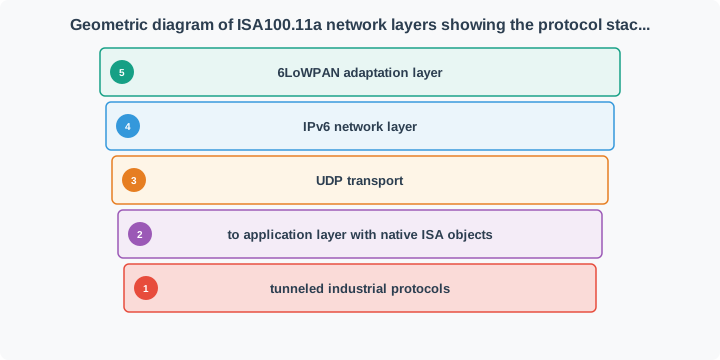
Follow Figure 1 from the traffic purpose to the radio path. A command, alarm, log, or history record passes through UDP, IPv6, and 6LoWPAN. The gateway then maps the tunnelled industry protocol for the old endpoint. That edge owns more than byte form. Its error map and time rules can change the meaning seen by the app. A good packet trace proves only that the data reached the gateway. The lab must also force a map fault and check the result shown to the app.
Payload shape Record whether the flow is a command, status update, alarm, diagnostic request, maintenance action, or history upload.
Frame behavior Record whether the flow fits the expected frame behavior or requires fragmentation, retries, or buffering.
Gateway ownership Record who owns translation rules, error mapping, timestamp handling, and application-system troubleshooting.
Fallback behavior Record what operators see when the legacy endpoint, wireless path, or gateway translation fails.
Avoid treating a single successful tunneled message as a release result. Repeat the review with realistic response payloads, diagnostic payloads, route changes, and a gateway restart or replacement event.