Review Platform Transition Signals
Review Platform Transition Signals
Transition Timing
Early platforms are flexible because they are easy to change. Later platforms are useful because they remove ambiguity. Move forward when the current platform is no longer answering the real question.
Figure 1 shows when a platform stops answering the next design question.
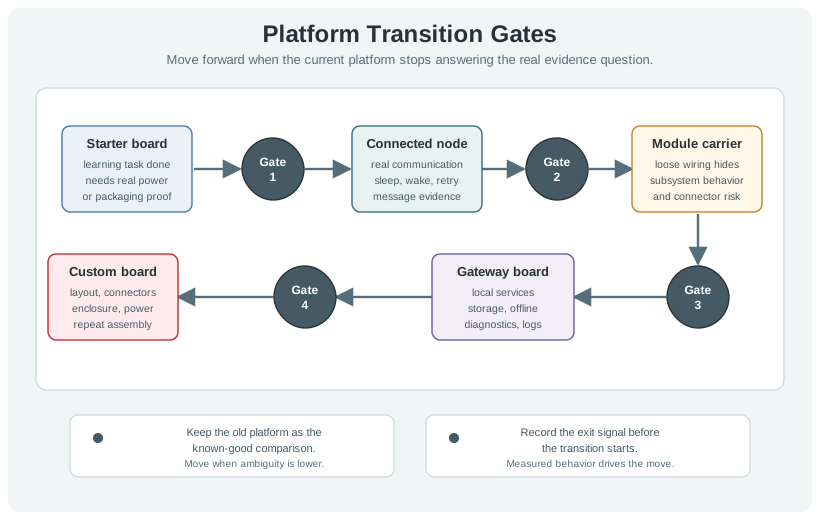
The starter board is useful until the learning task is done and power or packaging becomes the issue. A connected node can expose real communication, sleep, wake, retry, and message evidence. A module carrier then tests subsystem wiring and connector risks that a bench build can hide; a custom board checks the final power, placement, and service paths. Each gate asks what evidence is still missing, not how polished the current demonstration looks. Move forward when the next form can expose that missing behavior, and repeat the earlier claim on the new build.
Use these transition signals:
Do not discard an early platform immediately. Keep it as a known-good comparison while the next platform is being brought up.