Write the Platform Handoff Record
Write the Platform Handoff Record
Worked Scenario: Cold Storage Monitor
A team is building a cold storage monitor for small facilities. The device must read several sensors, report events to a nearby gateway, keep working during short network outages, and fit inside a small enclosure with external probes.
Platform Path
The team starts with sensor checks, then tests radio and gateway behavior. A carrier and custom board add proof of wiring, fit, and power paths.
Platform Review Record
The record ties the chosen node and gateway to the network-loss question. It also keeps the next gate and rejected option visible.
prototype=cold-storage-monitor
stage=functional-prototype
current_question=can sensor nodes report events through a local gateway during intermittent network loss?
chosen_platform_form=connected-controller-node plus gateway-board
why_node=local sensing, low-energy state measurement, event retry, and warning output
why_gateway=local buffering, reconnect behavior, status display, and service logs
rejected_option=single gateway-only design because it cannot prove distributed probe placement
next_transition=module carrier for connectors, test points, and enclosure fit
Platform Handoff Record
When a platform is selected, leave a record that future reviewers can challenge. Platform decisions often become hard to revisit after firmware, wiring, and test fixtures accumulate around them.
Figure 1 keeps the cold-storage platform choice tied to network-loss evidence.
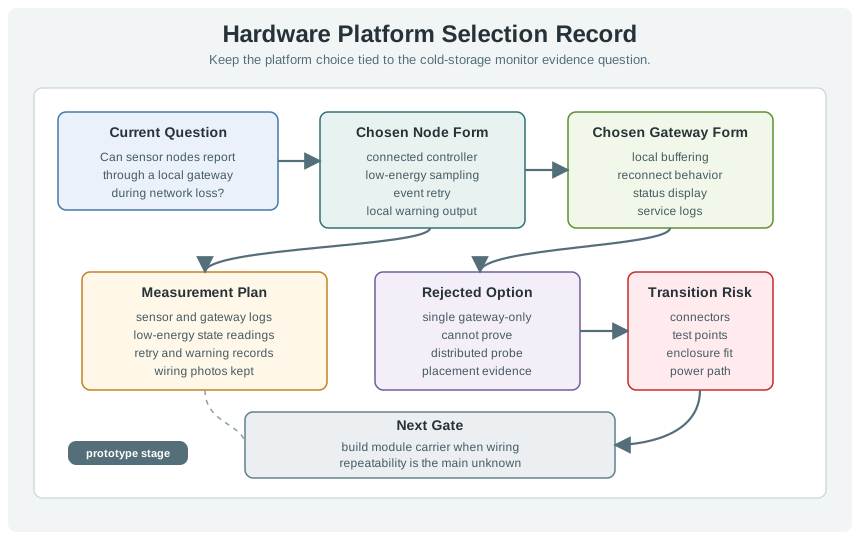
The current question asks whether sensor nodes can report through a local gateway during network loss. The node form therefore needs low-energy sampling, event retry, and a local warning output. The gateway needs buffering, reconnection behavior, status, and a service log. A single successful transmission is not enough to answer the question. Record the selected forms, the measurements made during a disconnection, and the behavior observed after recovery. The handoff then names unresolved power and service risks so a later board or gateway choice can retest them rather than inheriting an unqualified pass.
Record:
Technical boundaries. The cold-storage exercise selects connected-controller nodes and a gateway board to investigate event reporting during intermittent network loss, assuming distributed probes, retries, warnings, and local buffering are needed. A single successful transmission cannot answer that question, and the selection does not establish carrier-board readiness until connectors, test points, and enclosure fit pass the next gate.