Use the Platform Selection Funnel
Use the Platform Selection Funnel
Platform Forms and What They Prove
Each platform form answers a different class of question. Treat the form as a stage-gate choice.
Figure 1 starts platform selection with the next gap in the evidence.
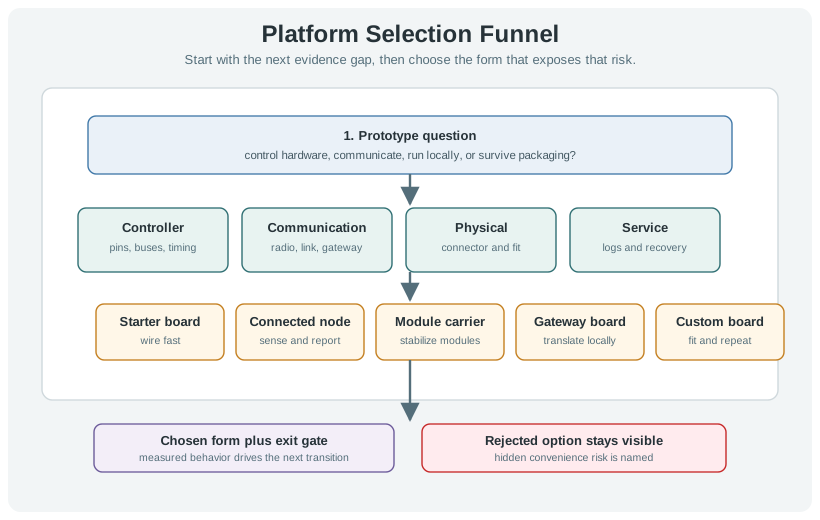
The funnel starts with a question, then tests the constraints before a form is chosen. For the cold-room monitor, the first question is whether events survive a gateway outage. Choose a connected node and gateway, block their link, and record queued events and recovery. The decision record also names a rejected option and the next gate. If the next question concerns cable strain inside the enclosure, the outage result cannot answer it. Test the intended connector on a carrier and keep that result with the build.
In the cold-room example, the team can use the funnel twice: first to test an outage with the node and gateway, then to test the cable and enclosure on a carrier. Record why each form was chosen and what its test still leaves open.
Avoid False Comparisons
Deterministic I/O means input and output operations with predictable timing. Comparing platforms by a single feature is usually misleading. A board with more processing headroom may be weaker for battery sleep. A board with fast software iteration may be weaker for deterministic I/O. A board with convenient connectors may be too large for the intended enclosure.