Predict the Secure Handoff

Predict the Secure Handoff

animation
cryptography
security

Required diagrams: communication boundaries, protocol fit, and firmware verification.

Protect a Pump Command and Its Update

A pump gets a START command today and new firmware next month. Follow the command through the gateway in Figure 5. Ask where the link ends and who can read the command. Then use Figure 6 to choose protection for that path. For the update, follow Figure 7 from the release signature to the pump’s check before it runs the new code.

Predict the Secure Handoff

For each handoff, decide what the control proves before reading the check. A protected link and an approved update answer different questions.

  • Predict: Transport encryption ends at a gateway that forwards plain pump commands. Is the device-side handoff still confidential? Check: No. Secure communication must cover every boundary where the command needs protection.
  • Predict: The firmware download uses an encrypted channel but the pump never verifies a release signature. Can the pump prove who authorised the image? Check: No. Channel protection and firmware authenticity answer different questions.
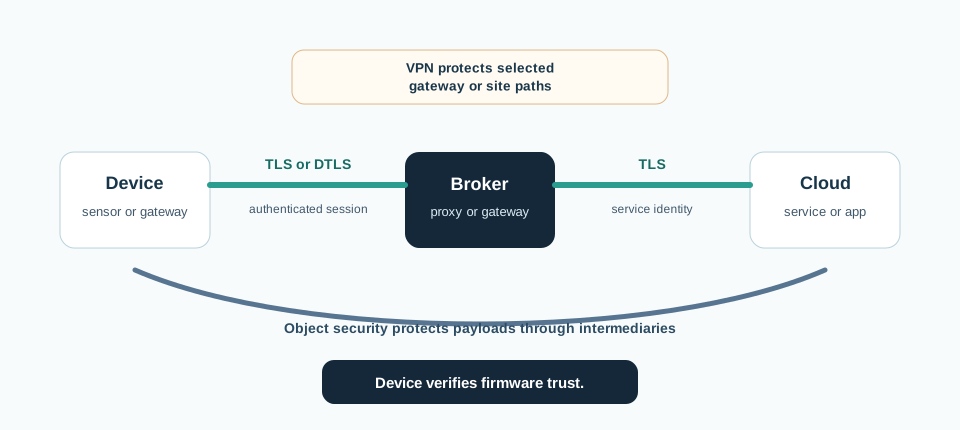
Secure IoT boundary map contrasting one-hop session security, end-to-end object security through intermediaries, network tunnels for gateway paths, and signed firmware trust.
Figure 5. Session protection ends at each connection endpoint, while object protection follows the message through intermediaries. A tunnel protects a network path, and signed firmware is verified on the device.
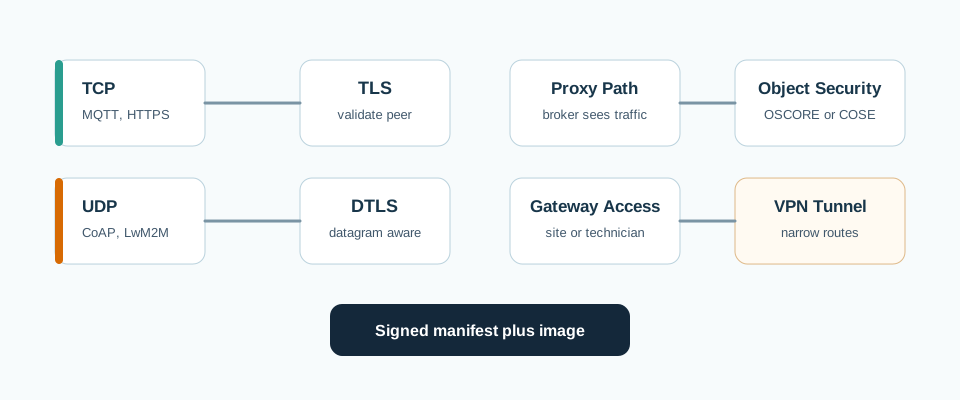
Protocol fit diagram mapping TCP sessions to TLS, UDP sessions to DTLS, broker and proxy paths to object security, gateway and site paths to VPN tunnels, and firmware packages to signed manifests verified on the device.
Figure 6. TCP sessions use TLS and UDP sessions use DTLS. Object security protects messages through intermediaries, tunnels protect gateway paths, and signed manifests authorize firmware on the device.
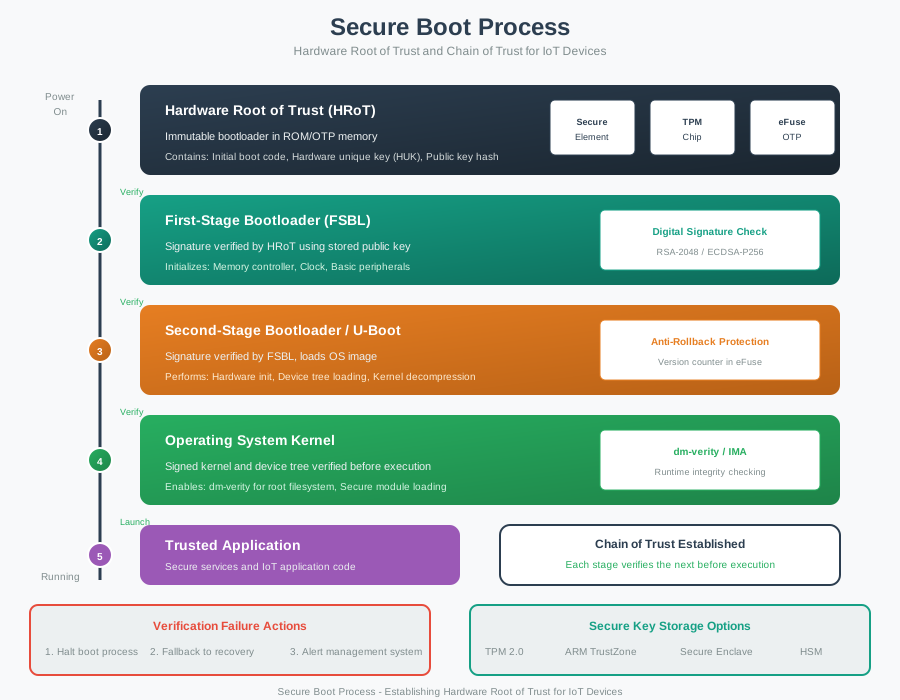
An immutable hardware root verifies the first bootloader, which verifies the next stage and signed kernel, with signature checks and anti-rollback version policy.
Figure 7. The immutable hardware root verifies the first bootloader, which verifies later boot stages and the signed kernel. Signature checks and anti-rollback policy apply along the chain.

Return to the chapter

Back to the chapter