Compare star and mesh delivery during node failure
Explain independent packet forwarding and diagnose loss by comparing target-node delivery and RPL route recovery after the same simulated node fails in a star and mesh.

Trace the next hop and the packet receipt before calling a route recovered.
Predict the reading, then compare it with the measurement.
Contiki-NG Cooja
Third party ToolExplain independent packet forwarding and diagnose loss by comparing target-node delivery and RPL route recovery after the same simulated node fails in a star and mesh.
Download the complete lab packet and follow README.md to run it in the free simulator.
Download the setup and run guideGet the lab files
Download the complete packet for the simulation and its firmware, or download individual files for inspection. README.md gives the setup and run commands.
Steps
Step 1
- Do
- In the Cooja Network window, open mesh.csc in Cooja and pause near 89 s. Trace target mote 5’s arrow through its relay to root 1.
- You will see
- Seed 1 uses 50 m UDGM range and interference. At 85.065 s target 5 reports preferred parent 3 and Rank 422. The GUI arrow shows 5→3→1. Root 1 receives application traffic before the fault.
- Why it matters
- The before-state route identifies which dependency node 3 removal will break.
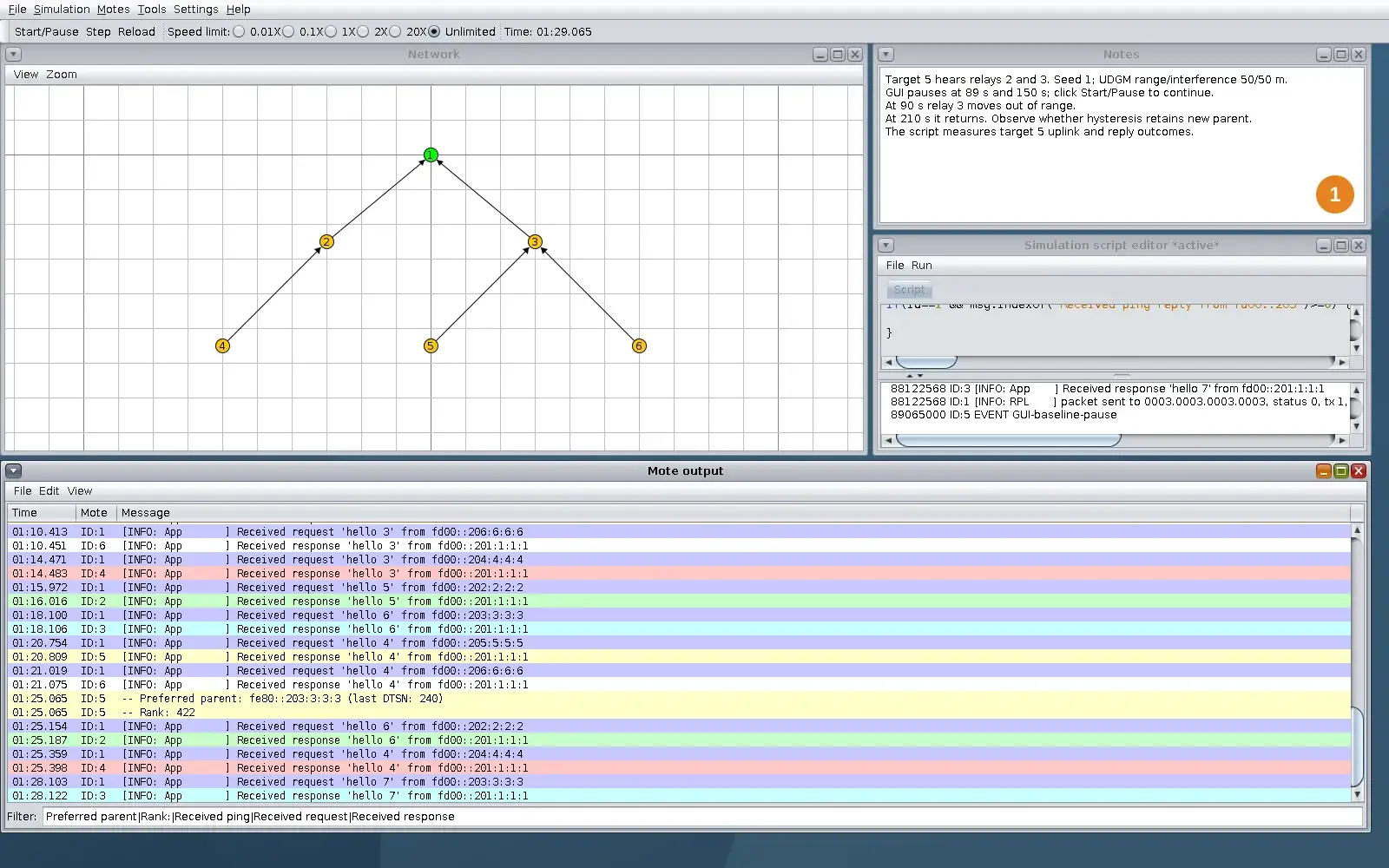
Step 1 · Contiki-NG Cooja; numbered callout added to a real capture. Enlarge screenshot (new tab) Step 2
- Do
- In the Cooja Network window, click Start/Pause once. At the pause near 150 s, inspect node 3’s absence and target 5’s new route.
- You will see
- The ScriptRunner moves node 3 to (300,300) at 90.065 s. At the second pause target 5’s arrow points to node 2, then root 1. The headless log records the first new-parent event at 100.760728 s.
- Why it matters
- A changed path explains why a delivered packet can resume after a relay moves out of radio range.
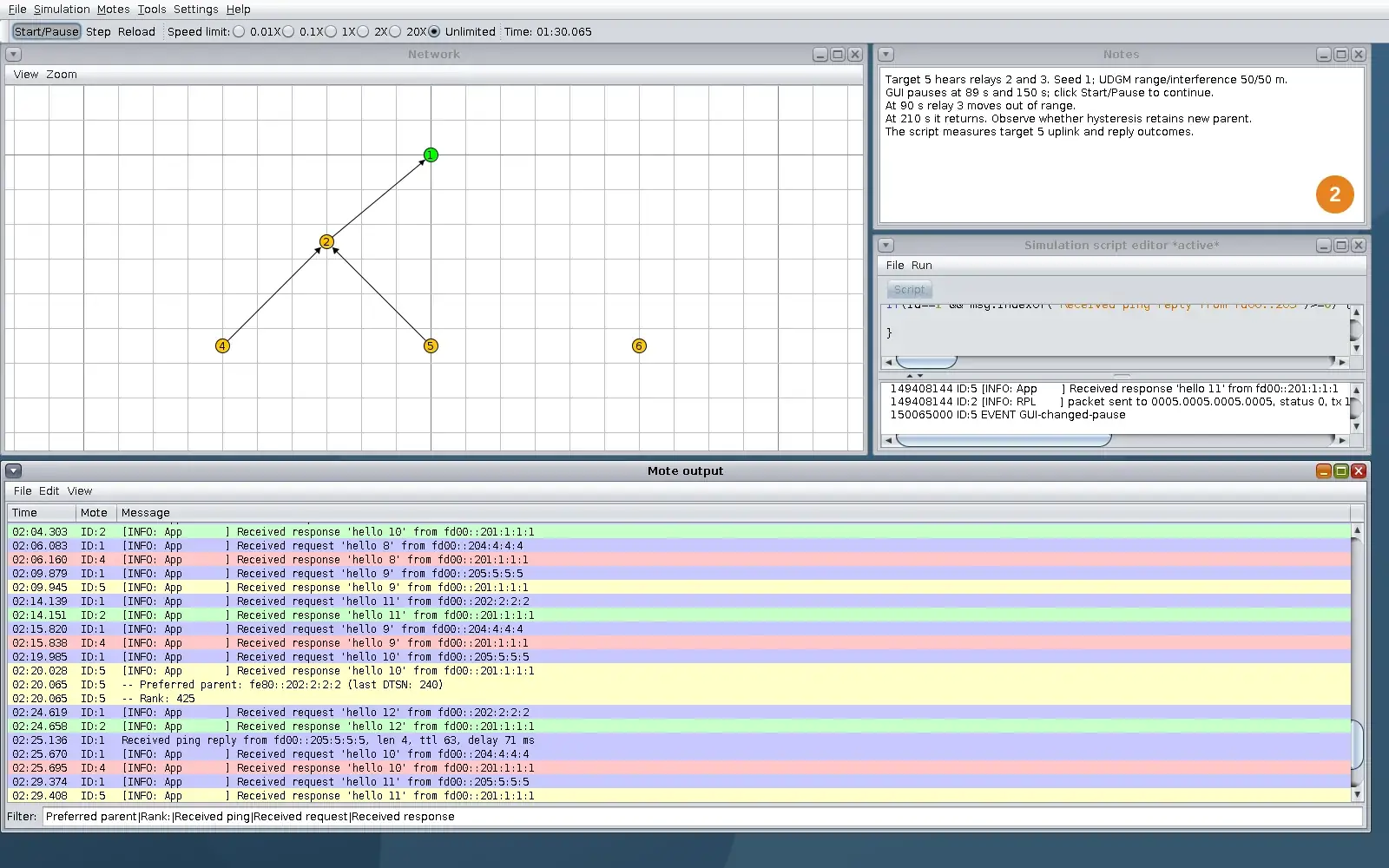
Step 2 · Contiki-NG Cooja; numbered callout added to a real capture. Enlarge screenshot (new tab) Step 3
- Do
- Filter Mote output for Preferred parent|Rank. Compare the two snapshots, then check mesh-headless.log for the target fault-window counters.
- You will see
- At 85.065 s target 5 reports parent 3, Rank 422. At 140.065 s it reports parent 2, Rank 425. The log counts 12 target requests sent and 10 received by root during the 90.065–210.065 s fault window.
- Why it matters
- Parent change and application delivery are separate measurements: 10.695728 s to new parent, 20.579856 s to first observed root receipt.
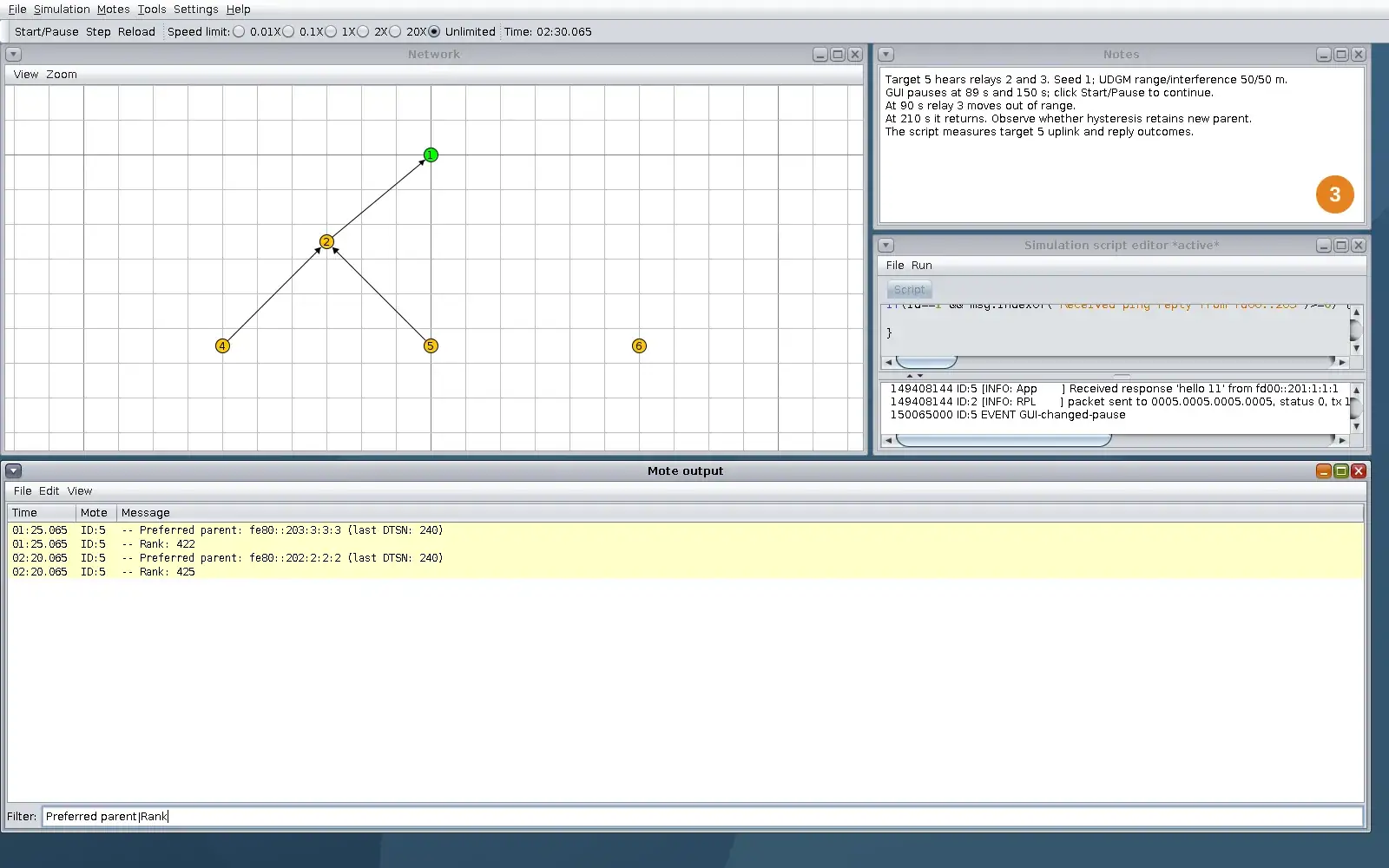
Step 3 · Contiki-NG Cooja; numbered callout added to a real capture. Enlarge screenshot (new tab) Step 4
- Do
- In the Cooja Network window, open star.csc, let it pause near 89 s, and trace target 5’s direct arrow to root 1.
- You will see
- The same six mote positions and seed use 120 m UDGM range and interference. At 85.065 s target 5 reports parent 1 and Rank 296. It sends to root 1 directly, with no node-3 dependency.
- Why it matters
- The star route establishes a before-state for the same node-3 failure.
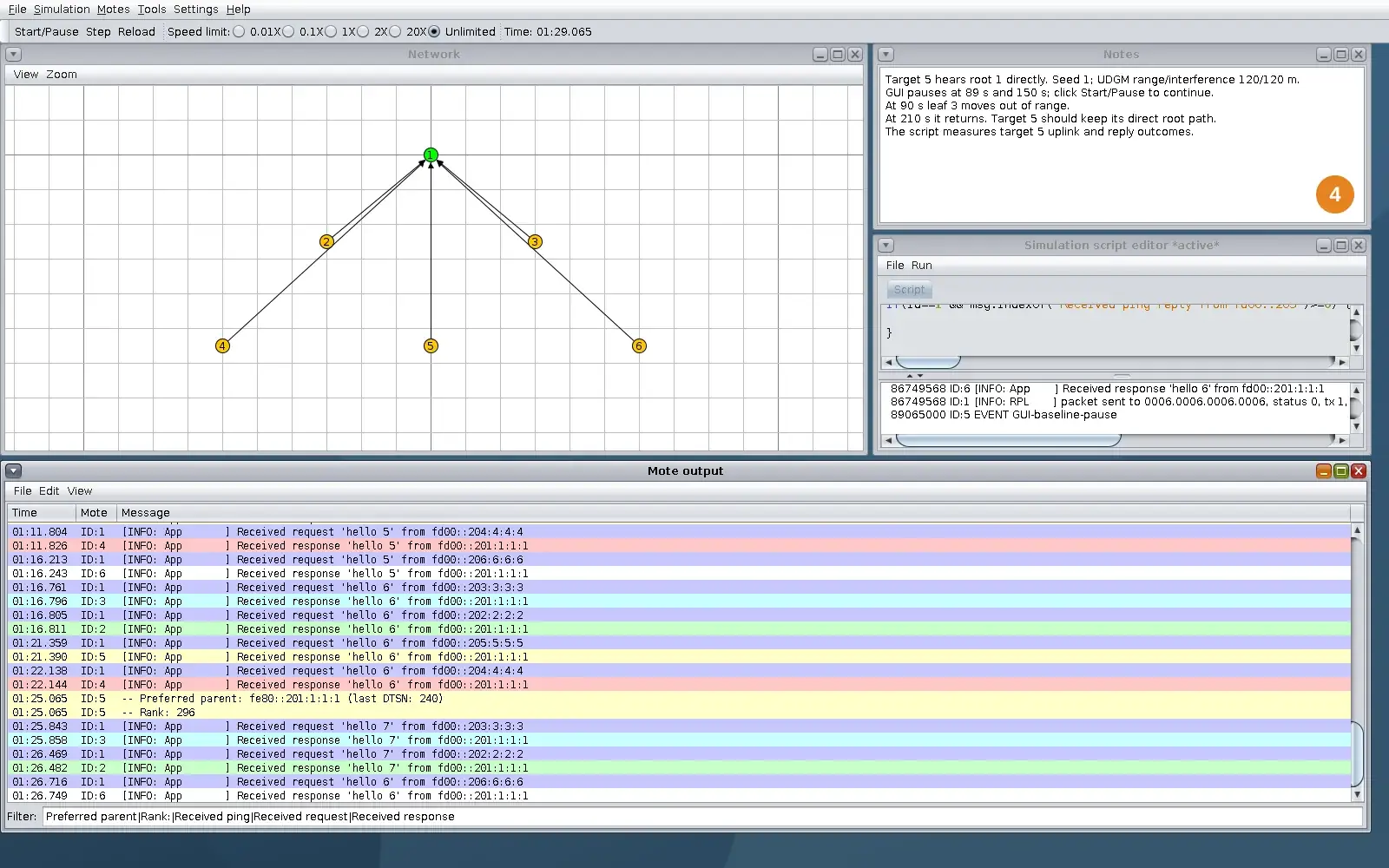
Step 4 · Contiki-NG Cooja; numbered callout added to a real capture. Enlarge screenshot (new tab) Step 5
- Do
- In the Cooja Network window, click Start/Pause once. At the next pause, inspect target 5’s path and the post-fault application rows.
- You will see
- Node 3 moves out of range at 90.065 s, while target 5 keeps its direct root path. The first scheduled target request after the fault reaches root at 92.147568 s. Star-headless.log counts 12 of 12 target requests delivered during the fault window.
- Why it matters
- Target 5 needed no route recovery in this star because the removed node was a leaf, not its root.
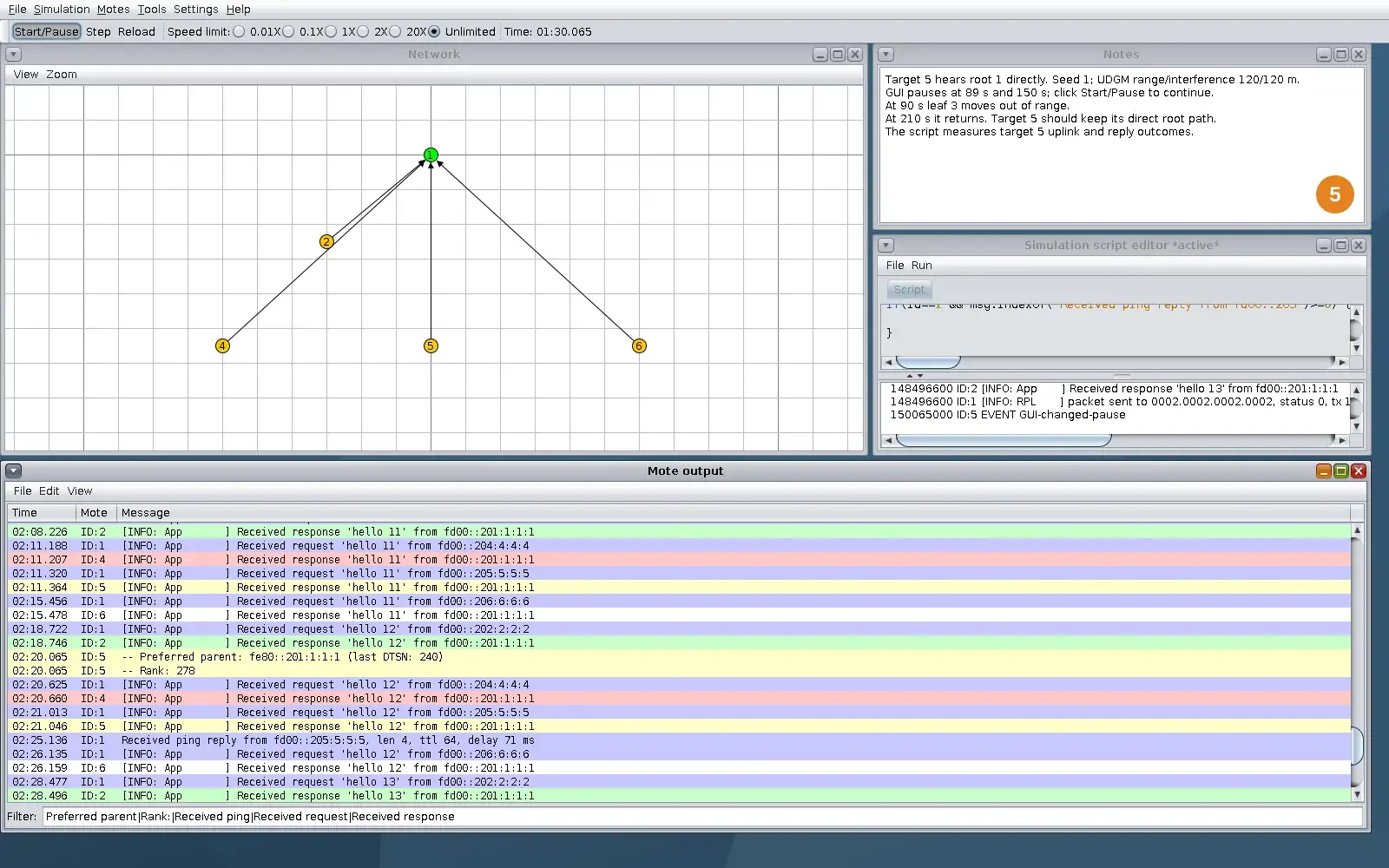
Step 5 · Contiki-NG Cooja; numbered callout added to a real capture. Enlarge screenshot (new tab) Step 6
- Do
- Filter the star Mote output for Preferred parent|Rank. Compare it with the mesh snapshots and both headless summaries.
- You will see
- Star target 5 reports parent 1 at both 85.065 and 140.065 s, with Rank 296 then 278. It delivered 12/12 fault-window requests; mesh delivered 10/12. Mesh first recovered root receipt was 110.644856 s; star had no route break to recover.
- Why it matters
- The comparison is about this chosen leaf or relay failure; radio ranges differ and whole-network traffic totals are not a controlled reliability estimate.
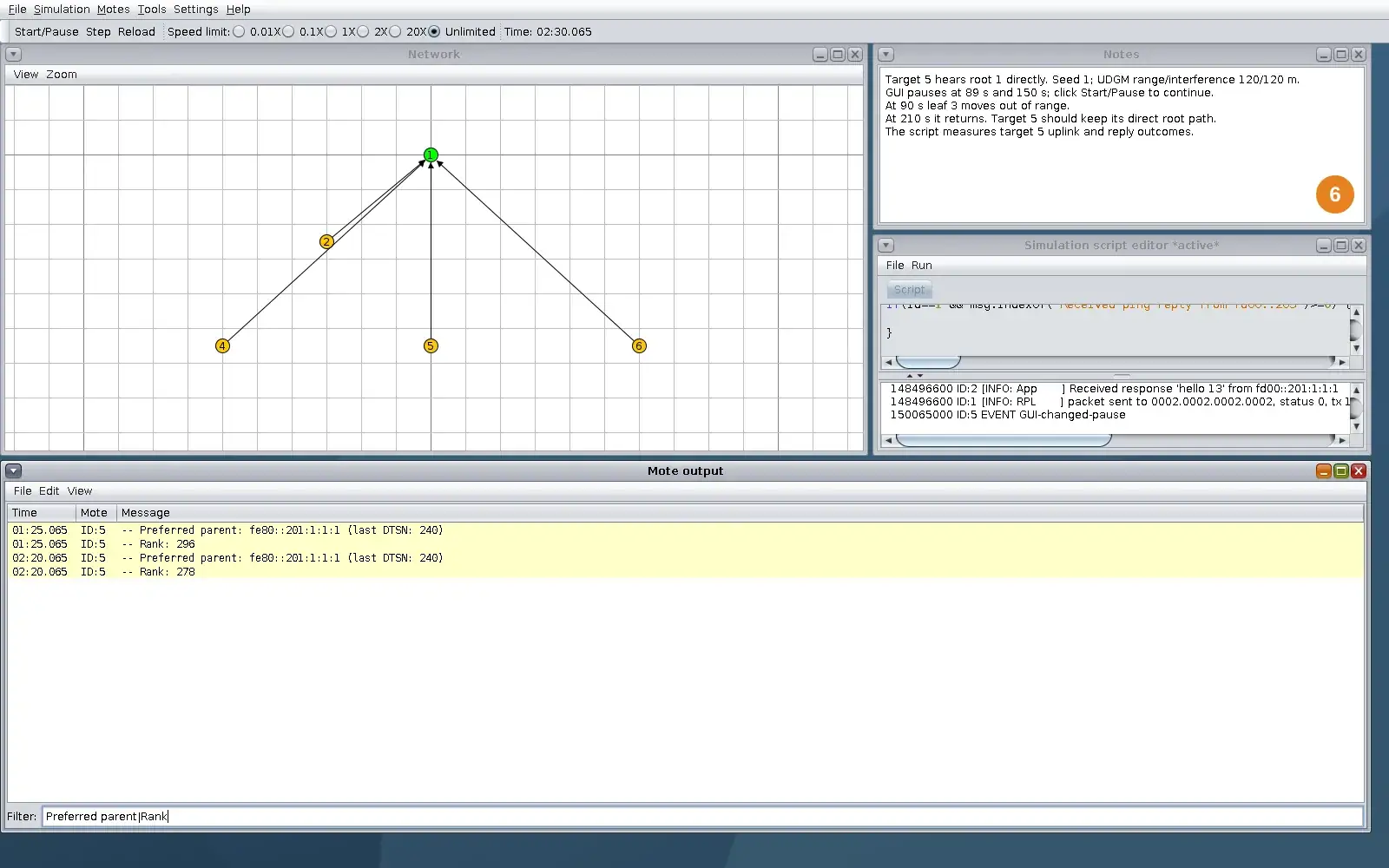
Step 6 · Contiki-NG Cooja; numbered callout added to a real capture. Enlarge screenshot (new tab)
Chapter checks
These questions refer to the chapter’s examples. Use the return links to review their answers.
A building gateway carries camera packets, thermostat readings, and control acknowledgements over the same uplink. Which packet switching idea makes that sharing possible?
Return to the chapter’s knowledge checkA factory dashboard reports that command messages arrive with uneven delay during a camera upload, even though the uplink has enough nominal bandwidth. What should you inspect first?
Return to the chapter’s knowledge check