 Radio Remi guides
A field team has a real problem to settle: Why can one Zigbee role drain a coin cell in 9.17 hours? They must decide what happens before they change sleepy-device poll interval on the device. Predict the direction first.
See the relationship first
Set the input, use the rule, then read the result and its unit.
The audit later on checks more than one number. Here, the added model uses the baseline named below and holds every other chapter value fixed. That sentence bridges the fixtures, so the numbers do not change without a reason.
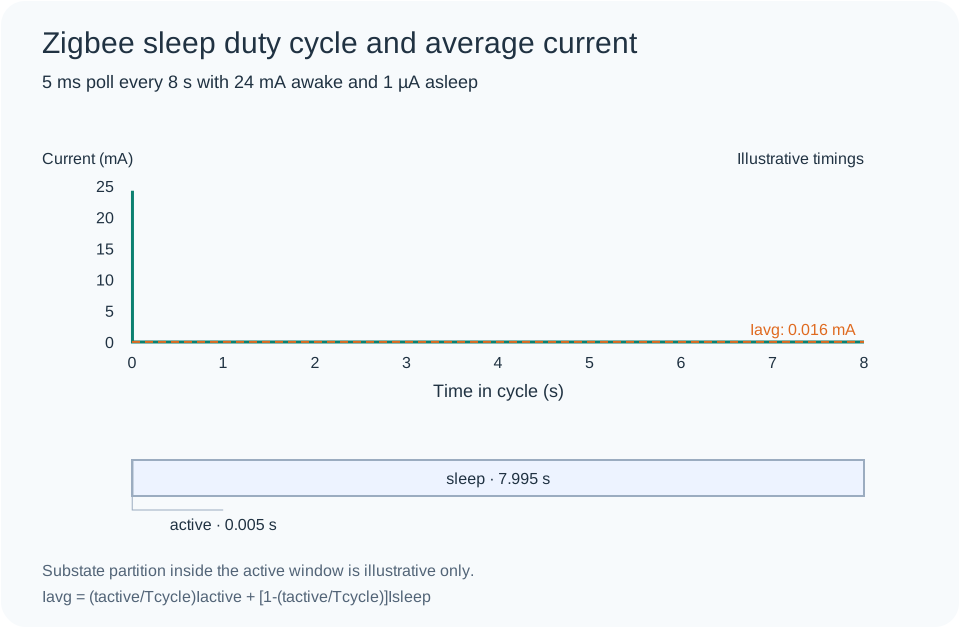
Derive the baseline in four moves
- 1
Name the input. The chapter baseline for sleepy-device poll interval is 8.
- 2
Name the rule. Iavg=(tactive/Tcycle)Iactive+[1-(tactive/Tcycle)]Isleep
- 3
Put in the chapter value. Set sleepy-device poll interval to 8. The page rule gives active duty as 0.063%.
- 4
Read the result. Keep % next to the value. Use it only within the limits on this page.
Predict, then change sleepy-device poll interval
Try Predict what happens to active duty. Move one control, calculate, then check your idea.
Observe Lengthening the poll interval shrinks the active fraction. The router cannot take that saving because listening is its network job. Reset to 8 and compare active duty.
Explain Only sleepy-device poll interval moves here. The other chapter values stay fixed.
Check yourself
What should you do before you trust the result?
What does this small model leave out?
1. Start with what the radio does
A router must listen almost continuously so it can relay arriving frames. A sleepy end device wakes for a short poll, then returns to microamp sleep. The role changes the fraction of time spent at the 24 mA current.
2. Name every algebra move
Make a fractionduty=tactive/Tcycle.
Weight each currentIavg=duty Iactive+(1−duty)Isleep.
Discount the cellCusable=C0(1−k)t(1−δ).
Divide charge by currentruntime=Cusable/Iavg.
3. Keep units compatible
Convert 1 µA to 0.001 mA before adding it to 24 mA. Since mAh divided by mA gives hours, 172 mAh / 0.0160 mA produces about 10,800 hours.
4. Try one controlled change
TryChange only the sleepy device's poll interval. The radio currents, 5 ms active window, cell, derating, and self-discharge stay fixed.
ObserveAt 8 s, duty is 0.0625%, average current is 0.0160 mA, usable charge is 172 mAh, and the sleepy estimate is about 10,800 hours or 1.23 years. The raw router limit is only 9.17 hours.
ExplainLengthening the poll interval shrinks the active fraction. The router cannot take that saving because listening is its network job.
This is a first-order charge budget, not a battery qualification.
- Radio and cell
- 24 mA and 220 mAh are catalog-typical teaching values
- Pulse delivery
- Internal resistance and brownout are not modelled here
- Network traffic
- Retries, sensing, processing, and reporting add charge
Measure the full current trace and validate the cell across temperature and age.
5. Reproduce the chapter numbers
duty=0.005/8=0.000625. Iavg=0.000625(24)+0.999375(0.001)=0.0160 mA. Cusable=220(0.99)²(0.80)=172 mAh. Runtime=172/0.0160=10,800 h=1.23 years. The un-derated always-on comparison is 220/24=9.17 h, making the displayed role comparison about 1,180×.
6. Carry the evidence forward
Record role, poll interval, wake duration, measured active and sleep current, payload rate, retry rate, cell chemistry, derating, temperature range, brownout threshold, and the retest trigger for a firmware or route change.
7. Check yourself
Why must 1 µA become 0.001 mA?
Why is 1.23 years not a promise?
Why can the router not simply sleep for 8 seconds?
The calculation proves that an always-listening role is incompatible with this coin-cell example. It does not predict a deployed lifetime.
- 9.17 hours
- Raw 220 mAh / 24 mA limiting comparison
- 1.23 years
- Sleepy charge-only estimate after stated allowances
- 1,180×
- Comparison using the chapter's differently bounded worked cases
Approve the role only after current-trace, pulse, temperature, and network-behavior tests.