 Phoebe guides
A field team has a real problem to settle: From Frequency to Wavelength and Antenna Length They must decide what happens before they change carrier frequency on the device. Predict the direction first.
See the relationship first
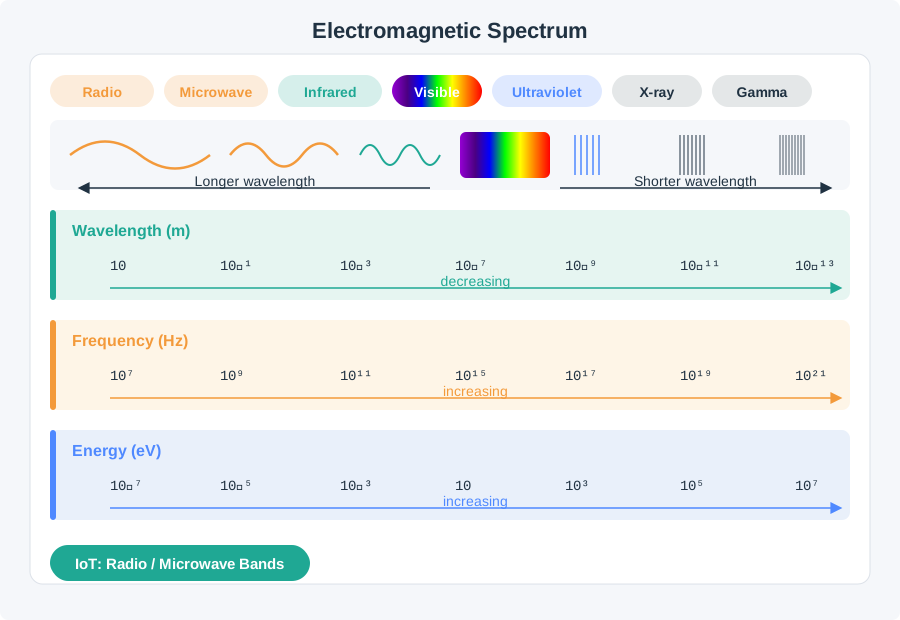
The chapter figure below shows: Frequency and wavelength move in opposite directions across the electromagnetic spectrum; IoT radios sit in the long-wavelength radio and microwave bands.
The audit later on checks more than one number. Here, the added model uses the baseline named below and holds every other chapter value fixed. That sentence bridges the fixtures, so the numbers do not change without a reason.
Derive the baseline in four moves
- 1
Name the input. The chapter baseline for carrier frequency is 2400.
- 2
Name the rule. λ = c/f; L_1/4 = λ/4; penalty_dB = 20 log10(f/900 MHz)
- 3
Put in the chapter value. Set carrier frequency to 2400. The page rule gives quarter-wave scale as 3.13 cm.
- 4
Read the result. Keep cm next to the value. Use it only within the limits on this page.
Predict, then change carrier frequency
Try Predict what happens to quarter-wave scale. Move one control, calculate, then check your idea.
Observe The widget evaluates λ = c/f, L_1/4 = λ/4, and 20 log10(f/900 MHz), exactly the three derivation lines above. Reset to 2400 and compare quarter-wave scale.
Explain Only carrier frequency moves here. The other chapter values stay fixed.
Check yourself
What should you do before you trust the result?
What does this small model leave out?
1. Begin with the physical story
Frequency counts wave cycles each second. Wavelength measures how far one cycle travels. Because every radio wave in air travels at almost the same speed, fitting more cycles into one second makes each cycle shorter.
2. Put names and units on the maths
Keep the units beside every number. They are an error detector: only like units can be added or subtracted.
| Symbol | Meaning | Unit |
|---|---|---|
| c | wave speed in air, 3.00 × 10^8 | m/s |
| f | cycles each second | Hz |
| λ | distance travelled in one cycle | m |
| L_1/4 | one quarter of a wavelength | m |
3. Derive it with every move named
Write one-cycle timeFrequency f cycles/s means one cycle lasts 1/f s.
Multiply speed by timeλ = c × (1/f) = c/f.
Take one quarterA quarter-wave scale is L_1/4 = λ/4.
Compare same-distance lossFSPL contains f², so its dB change is 10 log10[(f₂/f₁)²] = 20 log10(f₂/f₁).
4. Reproduce the chapter's numbers
The 2.4 GHz penalty relative to 900 MHz is 8.52 dB; 5 GHz relative to 900 MHz is 14.9 dB. The 900 MHz quarter-wave is 2.67× the 2.4 GHz quarter-wave.
5. Try the formula
TrySlide from 900 MHz toward 5 GHz and compare wavelength, quarter-wave scale, and the clean-air loss penalty.
ObserveObserve that wavelength and antenna scale shrink as frequency rises, while the same-distance loss penalty grows.
ExplainThe widget evaluates λ = c/f, L_1/4 = λ/4, and 20 log10(f/900 MHz), exactly the three derivation lines above.
This small widget varies one named input and holds the chapter constants fixed.
- The honesty boundary below names what it does not model
- Needs separate evidence
Use field evidence or a deeper model before release.
6. What the result buys you
Lower frequency is not automatically “better,” and higher frequency is not automatically “faster.” The equations expose two starting trade-offs: longer antennas and lower clean-air loss at the lower band, versus smaller antenna scale and potentially wider channels at higher bands. Walls, diffraction, detuning, bandwidth rules, regional limits, and measured delivery remain deployment evidence.
7. Check yourself
Try each question before revealing the answer.
1. What is λ at 2.4 GHz?
Answer: 3.00×10^8 / 2.40×10^9 = 0.125 m.
2. Why is the quarter-wave 3.12 cm?
Answer: 0.125 m / 4 = 0.03125 m = 3.12 cm.
3. How much more FSPL does 5 GHz have than 900 MHz at the same distance?
Answer: 20 log10(5000/900) = 14.9 dB.
These are the chapter inputs, worked results, and named teaching assumptions.
- The speed 3.00 × 10^8 m/s
- Time, interval, or service-life value
- 900 MHz
- Frequency, sample rate, or event rate
- 2.4 GHz
- Frequency, sample rate, or event rate
- 5 GHz cases come from the chapter
- Frequency, sample rate, or event rate
Quarter-wave is an antenna scale, not a finished antenna design. The clean-air penalty holds distance and antenna assumptions fixed; real antennas, walls, bodies, scattering, regulation, channel width, and multipath belong in the chapter's Under the Hood and field tests.