 Phoebe guides this bridge
See the relationship before changing it
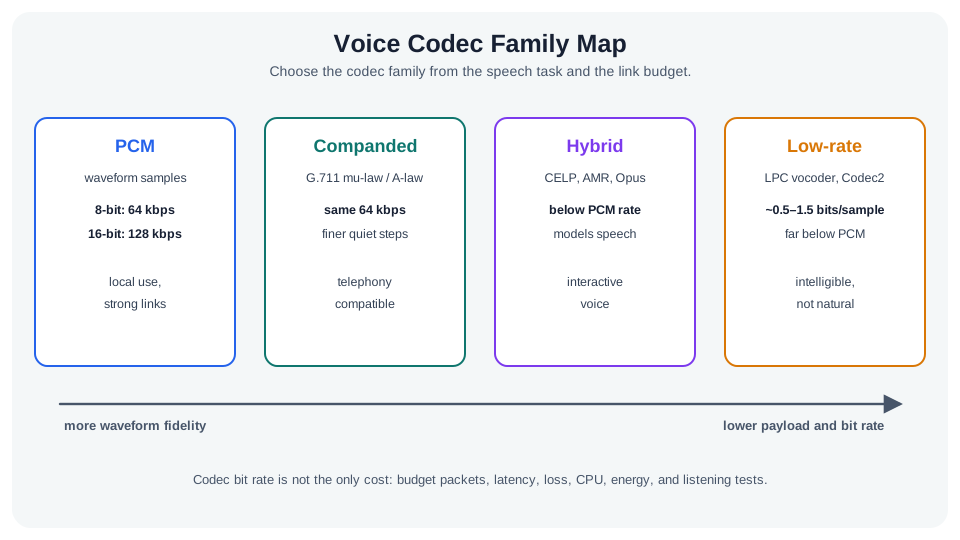
The chapter figure below shows: Codec choice moves along a payload/fidelity axis, but every option still needs packet, latency, loss, CPU, energy, and listening validation.
The retained audit below checks several chapter fixtures. This model keeps those stated values fixed and changes only voice quantizer resolution, so the numeric fixture does not switch without explanation.
Derive the baseline in four named moves
- 1
Name the input. The chapter baseline is 8 bits.
- 2
Name the relationship. quiet-speech step = 2,000 mV / 2^bits
- 3
Substitute with units. 2,000 / 2^8 = 7.813 mV
- 4
Read the result. Keep the unit beside the value. Use it only inside the technical boundary on this page.
Predict, then change voice quantizer resolution
Try Predict the direction of quiet-speech step = 2,000 mV / 2^bits. Test another voice quantizer resolution, then compare ideal amplitude step.
Observe Extra bits reduce ideal quantization steps before microphone noise is counted. Reset voice quantizer resolution to 8 and compare ideal amplitude step.
Explain More quantizer bits divide the same voice-signal voltage span into exponentially more levels, so each added bit halves the ideal amplitude step.
Check yourself
What should you do before trusting a moved-control result?
What does this small model leave out?
1. Separate time from amplitude
Sample rate says how often voltage is read. Bit depth says how many amplitude codes can store each reading. An 8 kHz, 8-bit stream takes 8000 readings each second and gives each reading one of 256 levels.
Phoebe: More readings do not make the amplitude ruler finer; more bits do not make the clock faster.
2. Find the 4 kHz content ceiling
Substitute the chapter ratefmax = 8000/2 Hz.
Dividefmax = 4000 Hz = 4 kHz.
This is the ideal Nyquist ceiling, not a promise of flat microphone or codec response to 4 kHz.
3. Build the linear quantization floor
Uniform rounding error from step size q lies between −q/2 and +q/2. Its RMS value is q/√12. For a full-scale sine, that produces the familiar ideal estimate:
Substitute 8 bits6.02(8)+1.76.
Multiply48.16+1.76.
Add49.92 dB ≈ 49.9 dB.
4. Compare the chapter’s 16-bit figure
Substitute 16 bits6.02(16)+1.76.
Multiply and add96.32+1.76 = 98.08 dB ≈ 98.1 dB.
Compare98.1−49.9 = 48.2 dB more ideal full-scale SNR, while the chapter’s bit rate rises from 64 kbps to 128 kbps.
5. Move the talker 40 dB below full scale
The linear quantizer’s absolute step stays fixed. A signal L dB below full scale loses L dB of SNR.
Use the 8-bit baselineSNR(40) = 49.9 − 40.
SubtractSNR(40) = 9.9 dB.
Change the ruler, not the wire widthμ-law and A-law compress large amplitudes before 8-bit quantization and expand them after decoding, creating finer effective steps near quiet speech while still carrying 8 bits at 64 kbps.
6. Check yourself
1. What content ceiling follows from 8 kHz sampling?
4000 Hz, or 4 kHz.
2. What ideal full-scale SNR follows from 8 bits?
6.02(8)+1.76 = 49.9 dB.
3. Why doesn’t companding need a ninth wire bit?
It redistributes effective quantization resolution toward quiet amplitudes before the same 8-bit code is sent.
7. Honesty boundary
The amplitude-step calculation fixes a 2000 mV span, and the ideal signal-to-noise estimate assumes a uniform quantiser, a full-scale sine, and uncorrelated rounding noise. Microphones, gain control, codecs, packet loss, and perception add limits, while a voice 40 dB below full scale is only an illustrative case.
- 6.02N+1.76 result assumes an ideal uniform quantizer
- Ideal uniform-quantiser signal-to-noise formula
- a full-scale sine
- Assumed input waveform at full amplitude
- uncorrelated rounding noise
- Assumed uncorrelated quantisation error
- Real microphones
- Unmodelled microphone response and noise
- gain control
- Unmodelled automatic amplification effects
- codecs
- Unmodelled speech encoding effects
- packet loss
- Unmodelled missing audio packets
- hearing perception set additional limits
- Perceived speech quality needs separate evaluation
- “40 dB below full scale” is a realistic illustrative case named by the chapter
- Illustrative quiet-speech level relative to full scale
- not a universal quiet-talker level
- Illustrative level does not represent every quiet talker
Go deeper in From Samples to a Speech Model for predictive codecs and perceptual trade-offs.