 Pete guides
A field team faces an unresolved physical question: How does a 154 dB budget become only 2 dB at 8 km? They must answer it before changing lpwan field distance on the real device. Predict the direction first.
See the relationship before changing it
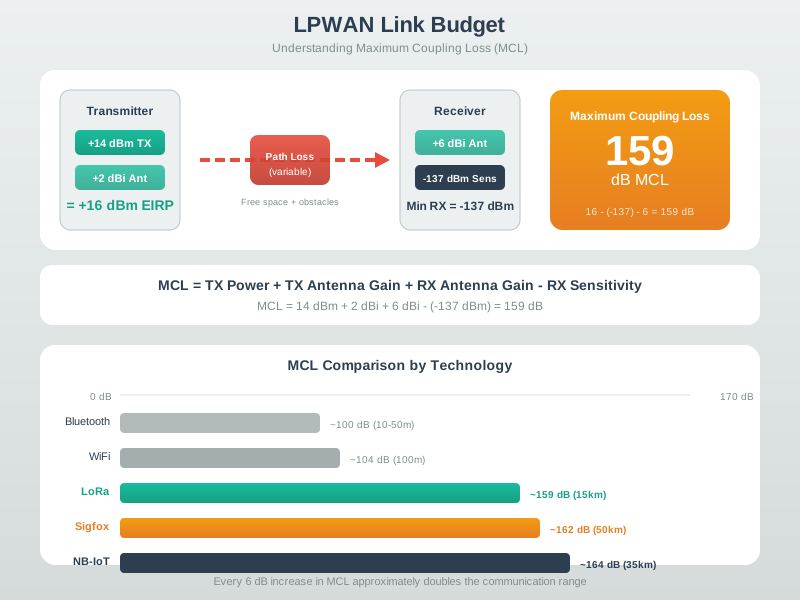
The chapter figure below shows: Long range is earned through link budget, antenna placement, path loss, gateway density, and margin, not through a data-sheet range number alone.
The retained audit below checks several chapter fixtures. This added model holds every other chapter fixture fixed, so the numeric fixture does not switch without explanation.
Derive the baseline in four named moves
- 1
Name the input. The chapter baseline for lpwan field distance is 3000.
- 2
Name the relationship. B=14+3-(-137)=154 dB; M=154-[PL1m+27log10(d)]-15
- 3
Substitute the chapter fixture. Set lpwan field distance to 3000. The page ledger gives path loss as 125.55 dB.
- 4
Read the result. Keep dB beside the value. Use it only inside the technical boundary on this page.
Predict, then change lpwan field distance
Try Predict the direction of Path loss. Move one control, calculate, then check your prediction.
Observe Predict an increase in path loss as the input increases over this range. Reset to the chapter baseline and compare.
Explain Only lpwan field distance moves here. The other chapter fixtures remain fixed.
Source: content/networking-core/network-physical-lpwan-cellular.qmd — Phoebe's Field Notes: Where The Soil-Moisture Sensor's Link Budget Comes From. Use the chapter equation and fixed ledger above; only the named input varies.
Check yourself
What should you do before trusting a moved-control result?
What does this small model leave out?
1. A link budget is only capacity to lose
Transmit power, receive antenna gain, and receiver sensitivity say how much total path loss the radio pair can tolerate. Distance and environment then spend that budget.
2. Grow path loss from a 1 m anchor
Find wavelengthλ=c/f.
Anchor at 1 mPL1m=20log10(4π/λ).
Grow through the sitePL(d)=PL1m+10nlog10(d/1 m).
3. Pay obstruction before calling it margin
Here sensitivity is negative, so subtracting it increases the tolerable loss. The 15 dB obstruction allowance is then paid before any headroom is claimed.
4. Try the field distance
TryMove the soil sensor from 1 km to 10 km. The radio mode and obstruction allowance stay fixed.
ObserveAt 3 km, path loss is about 125.6 dB and 13.4 dB remains after obstruction. At 8 km, only about 2 dB remains. SF12's example charge is roughly 32× SF7's.
ExplainDistance spends margin logarithmically, and deeper coverage spends airtime. A paper-positive link can still be operationally fragile.
The field calculation changes distance while keeping the example band, radio settings, path-loss exponent of 2.7, and 15 dB obstruction allowance fixed. It does not model terrain, rapid fading, interference, duty-cycle rules, packet format, gateway diversity, downlink windows, retries, or battery chemistry.
- terrain profiles
- Needs separate evidence
- fast fading
- Needs separate evidence
- interference
- Needs separate evidence
- duty-cycle rules
- Needs separate evidence
- packet format
- Needs separate evidence
- gateway diversity
- Needs separate evidence
- downlink windows
- Needs separate evidence
- retries
- Needs separate evidence
- battery chemistry
- Needs separate evidence
Use field evidence or a deeper model before release.
5. Reproduce the chapter values
At 915 MHz, λ≈0.328 m and PL1m≈31.7 dB. The radio budget is 14+3−(−137)=154 dB. At 3,000 m, PL≈125.6 dB and margin is 154−125.6−15=13.4 dB. At 8,000 m, PL≈137.1 dB and margin is about 1.95 dB.
6. Prove the installed service
Record site coordinates and height, antenna and enclosure, radio mode, measured RSSI/SNR and packet success, retry and join behavior, receive windows, current trace, payload cadence, seasonal conditions, gateway or operator ownership, and fallback.
7. Check yourself
Why is 154 dB not the field margin?
Does a 1.95 dB paper margin approve 8 km?
Why mention SF12 charge on a distance page?
The field calculation changes distance while keeping the example band, radio settings, path-loss exponent of 2.7, and 15 dB obstruction allowance fixed. It does not model terrain, rapid fading, interference, duty-cycle rules, packet format, gateway diversity, downlink windows, retries, or battery chemistry.
- The four-readings-per-day context
- Soil-sensor reporting schedule
- 915 MHz
- Illustrative uplink carrier frequency
- 0.328 m
- Wavelength at illustrative carrier frequency
- 14 dBm
- Transmitter output power
- 3 dBi
- Receive-antenna gain
- −137 dBm
- Receiver sensitivity threshold
- 154 dB
- Maximum path-loss budget before other losses
- n=2.7
- Assumed field path-loss exponent
- 15 dB
- Additional obstruction-loss allowance
- 3 km
- First sensor-to-gateway distance
- 125.6 dB
- Path loss at first distance
- 13.4 dB
- Margin after obstruction at first distance
- 8 km
- Longer comparison distance
- 137.1 dB
- Path loss at longer distance
- 1.95 dB
- Margin after obstruction at longer distance
- 0.00096 mAh
- Example spreading-factor-seven packet charge
- 0.0306 mAh
- Example spreading-factor-twelve packet charge
- roughly 32×
- Spreading-factor-twelve to spreading-factor-seven charge ratio
They are not a vendor or site guarantee.