 Pete guides
A field team faces an unresolved physical question: Where does a 13 dB release margin actually come from? They must answer it before changing site loss in decibels on the real device. Predict the direction first.
See the relationship before changing it
The chapter figure below shows: The calculation is additive in dB units: add gains, subtract losses, then compare the result with receiver sensitivity.
The retained audit below checks several chapter fixtures. This added model holds every other chapter fixture fixed, so the numeric fixture does not switch without explanation.
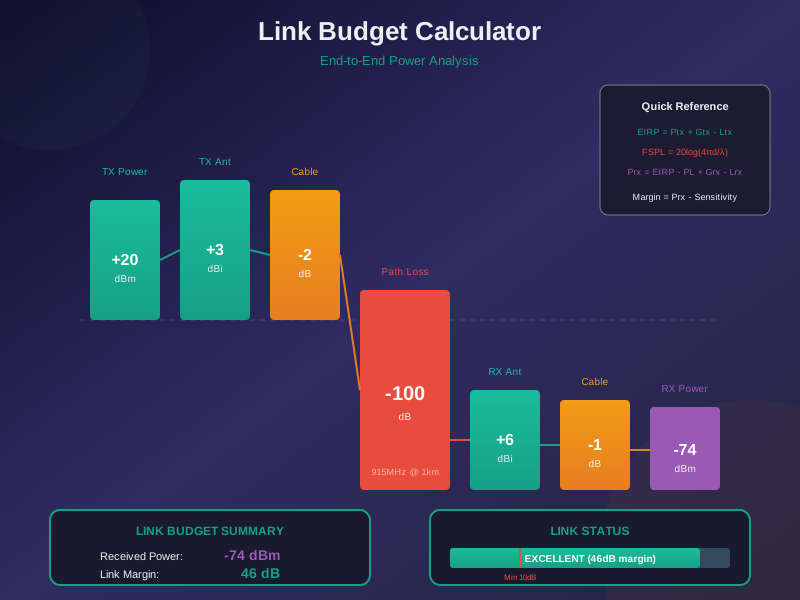
Derive the baseline in four named moves
- 1
Name the input. The chapter baseline for site loss in decibels is 15.
- 2
Name the relationship. Pr=14+2-96-Lsite; Mrelease=Pr-(-118)-10
- 3
Substitute the chapter fixture. Set site loss in decibels to 15. The page ledger gives nominal margin as 23.00 dB.
- 4
Read the result. Keep dB beside the value. Use it only inside the technical boundary on this page.
Predict, then change site loss in decibels
Try Predict the direction of nominal margin. Move one control, calculate, then check your prediction.
Observe Each extra decibel of site loss removes one decibel from both margins. The linear power ratio changes by about 1.26 for each decibel. Reset the control to 15 and compare nominal margin.
Explain Only site loss in decibels moves here. The other chapter fixtures remain fixed.
Check yourself
What should you do before trusting a moved-control result?
What does this small model leave out?
1. Turn the radio path into a ledger
Mara, the field engineer, knows that a gateway is the radio collector she must reach from a sensor over the hill.
Radio power is written in decibel-milliwatts, or dBm. A gain or loss is written in decibels, or dB. Power is a level. Gain and loss change that level.
Why we do this: A signed ledger shows where signal strength is gained or spent.
Add each gain. Subtract each loss. Then compare the power that arrives with the receiver's limit.
2. Build the two margins
Mara draws one line from the gateway, over the hill, to the sensor.
She calls transmit power Pt, antenna gain G, path loss Lpath, and hill or site loss Lsite.
Predict received powerWhy: First find the power that reaches the sensor.Pr=Pt+G−Lpath−Lsite.
She calls the arriving power Pr. She calls the receiver limit its sensitivity.
Find nominal marginWhy: This shows the gap between arriving power and the receiver limit.Mnom=Pr−Sensitivity. Subtracting a negative limit adds headroom.
She calls that first gap the nominal margin, Mnom. The team also promises to keep a reserve for change.
Pay the reserveWhy: A release must keep the promised buffer unused.Mrelease=Mnom−Mreserve.
The promised buffer is Mreserve. The gap left after paying it is the release margin, Mrelease.
3. Keep the limit and promise apart
At the release review, Mara must show both the receiver limit and the team's promise.
The transmit antenna gain is now written as Gt. The receiver sensitivity is written as Srx. The reserve is written as R.
Why we do this: Separate names stop a receiver limit from being mistaken for spare margin.
Sensitivity belongs to the receiver mode. Reserve is the team's buffer for fading, installation change, foliage, and measurement error.
4. Try a worse hill
Mara asks what happens when wet leaves and a new shed make the hill path worse.
The changing hill cost is the site loss, written Lsite.
Why we do this: Changing one loss shows exactly how much margin that change spends.
TryMove only the site loss. Watch both margins fall while the promised reserve stays fixed.
ObserveAt 15 dB site loss, received power is −95 dBm. Nominal margin is 23 dB. The 10 dB reserve leaves 13 dB for release.
ExplainEach extra decibel of site loss removes one decibel from both margins. The linear power ratio changes by about 1.26 for each decibel.
The signed dB arithmetic is exact for the stated power ratios.
- Antenna pattern
- Must be measured on the installed path
- Polarization
- Must match the real antenna positions
- Receiver mode
- Must match the released radio settings
- Interference
- Needs site and channel evidence
- Fading distribution
- Needs repeated samples, not one reading
- Packet target
- Needs a stated delivery goal
- Spatial variation
- Needs checks across the claimed area
Use field evidence or a deeper model before release.
5. Walk through the chapter case
Mara now reads the full hill ledger aloud so the review team can check every sign.
Arriving powerWhy: Add the launch gain and pay both path losses.14+2−96−15=−95 dBm.
Nominal headroomWhy: Compare arriving power with the receiver limit.−95−(−118)=23 dB.
Release headroomWhy: Keep the promised 10 dB reserve untouched.23−10=13 dB.
That final gap is about 20× in linear power. The release record should stay in the signed dB ledger so each gain and loss remains visible.
6. Prove the installed path
Before she signs the promise, Mara walks the hill and tests the real gateway and sensor.
Why we do this: A desk ledger checks the plan; field records check the claim.
Record the radio mode, power, antenna, polarization, cable loss, connector loss, site model, receiver limit, and reserve rule. Add signal and noise readings, packet success, test locations, and every event that triggers a new check.
7. Check the promise
Mara gives the release reviewer three quick checks before the link is approved.
Why does subtracting −118 increase margin?
Is 23 dB the release margin?
Does a positive desk margin prove coverage?
These values reproduce the chapter's link-budget ledger.
- 14 dBm
- Gateway transmit power
- 2 dB
- Transmit antenna gain
- 96 dB
- Base path loss
- 15 dB
- Hill and site loss
- −95 dBm
- Power that reaches the sensor
- −118 dBm
- Receiver sensitivity
- 10 dB
- Promised release reserve
- 23 dB
- Nominal margin before reserve
- 13 dB
- Release margin after reserve
This illustrative ledger is not a universal coverage promise.