 Battery Bruno guides
A field team faces an unresolved physical question: How large must the store be when the harvester goes quiet? They must answer it before changing dark interval on the real device. Predict the direction first.
See the relationship before changing it
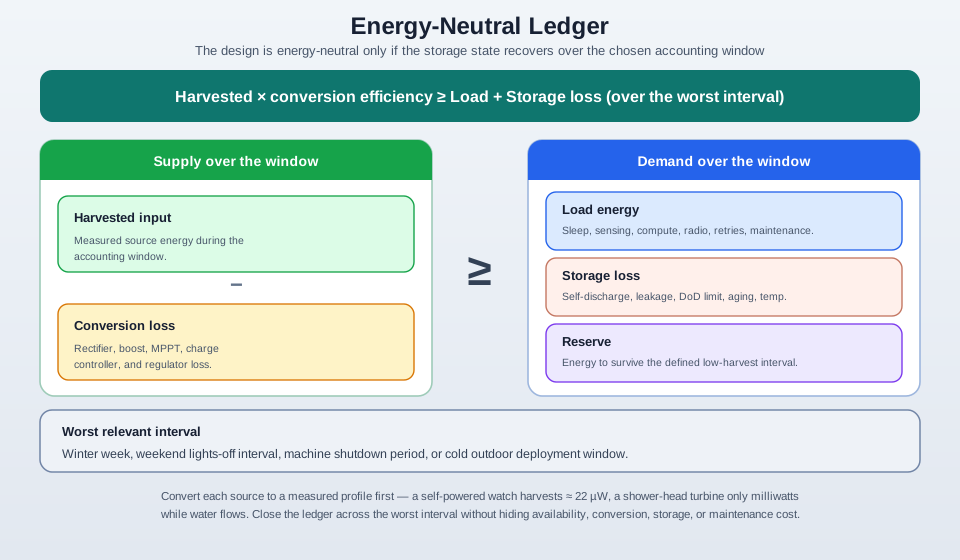
The chapter figure below shows: Energy-neutral ledger: harvested energy times conversion efficiency must be at least the load energy plus storage loss over the worst interval, with a reserve to survive the low-harvest window.
The retained audit below checks several chapter fixtures. This added model holds every other chapter fixture fixed, so the numeric fixture does not switch without explanation.
Derive the baseline in four named moves
- 1
Name the input. The chapter baseline for dark interval is 7.
- 2
Name the relationship. Eday≈6.70 mWh Edark=6.70x7=46.9 mWh Estore=46.9/(0.80x0.70)=83.8 mWh Pwinter=6.70/(2x0.80)=4.19 mW Aindoor=12.0/0.0700=171 cm²
- 3
Substitute the chapter fixture. Set dark interval to 7. The page ledger gives dark load as 46.90 mWh.
- 4
Read the result. Keep mWh beside the value. Use it only inside the technical boundary on this page.
Predict, then change dark interval
Try Predict the direction of dark load. Move one control, calculate, then check your prediction.
Observe The buffer answers 'how long without input?' The panel answers 'how fast must normal input refill the day?' A viable design needs both answers. Reset the control to 7 and compare dark load.
Explain Only dark interval moves here. The other chapter fixtures remain fixed.
Check yourself
What should you do before trusting a moved-control result?
What does this small model leave out?
1. Start with the physical story
A harvester produces power only under its source conditions. The node spends energy every day. Multiply daily load by the number of low-harvest days to find energy that must come from storage. Then divide by the usable depth and reserve fractions because the whole nameplate store is not available.
2. Name every algebra move
Add state chargeSleep, sensing, and radio total 2.02 mAh/day.
Convert charge to energyAt 3.3 V, 2.02 mAh is 6.67 mWh/day.
Cover the dark intervalEdark=Eday×dark days.
Allow depth and reserveEstore=Edark/(usable depth×available reserve share).
Find winter source powerP=Eday/(harvest hours×charger efficiency).
Scale collector areaArea=daily load/(energy collected per cm² per day).
3. Reproduce the chapter case
Edark=6.70×7=46.9 mWh
Estore=46.9/(0.80×0.70)=83.8 mWh
Pwinter=6.70/(2×0.80)=4.19 mW
Aindoor=12.0/0.0700=171 cm²
One outdoor square centimetre produces 21.0 mWh/day under the stated peak-sun case. Indoors it produces only 0.0700 mWh/day, so a continuous 0.5 mW load needs about 171 cm² before storage losses.
4. Try one real input
TryMove the control and predict which outputs should change before reading them.
ObserveEvery added dark day increases load and required storage in a straight line. Winter panel power and the indoor-area comparison stay fixed because they describe one normal day's load.
ExplainThe buffer answers 'how long without input?' The panel answers 'how fast must normal input refill the day?' A viable design needs both answers.
This is a small formula ledger, not a complete source qualification.
- Weather and light
- Real source conditions vary by site, season, orientation, and dirt.
- Storage losses
- Leakage, aging, temperature, and charge-rate limits need measurements.
- Source electronics
- MPPT and converter quiescent current are not in the simple ledger.
Correct, not complete: the balance sizes an illustrative energy window; it does not guarantee energy neutrality at a real site.
5. Use the result in the design
Measure the worst-season source, converter efficiency, real load trace, storage usable depth, leakage, and dark interval. Size from the worst credible window, not peak sunlight.
6. Record the evidence state
Keep irradiance or source condition, collector area, source voltage-current curve, charger efficiency, storage chemistry, usable depth, reserve, leakage, and load trace.
7. Check yourself
Why divide by 0.8×0.7?
Why is indoor area so much larger?
Does 4.19 mW size the whole panel?
The arithmetic uses the chapter's named or clearly labelled catalog-typical inputs.
- Weather and light
- Real source conditions vary by site, season, orientation, and dirt.
- Storage losses
- Leakage, aging, temperature, and charge-rate limits need measurements.
- Source electronics
- MPPT and converter quiescent current are not in the simple ledger.
Correct, not complete: the balance sizes an illustrative energy window; it does not guarantee energy neutrality at a real site.