 Blueprint Bina guides
A field team faces an unresolved physical question: How can one retry erase an 18-month battery claim? They must answer it before changing retries on the real device. Predict the direction first.
See the relationship before changing it
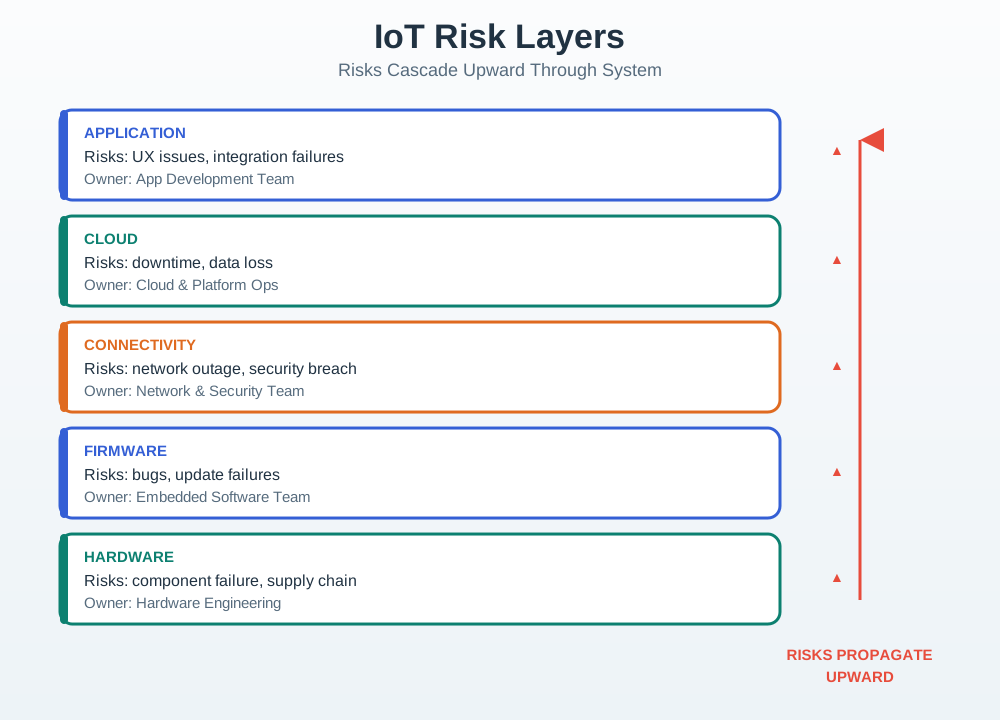
The chapter figure below shows: A concrete IoT defect can cross several layers, so the sprint must preserve evidence at each boundary to locate the source.
The retained audit below checks several chapter fixtures. This added model holds every other chapter fixture fixed, so the numeric fixture does not switch without explanation.
Derive the baseline in four named moves
- 1
Name the input. The chapter baseline for retries is 1.
- 2
Name the relationship. E=3.000x3.0=9.00 Wh; Ibudget=3000/13140=228 uA Baseline d=0.001; Iavg≈200 uA; life≈20.6 months One retry d=0.002; Iavg≈380 uA; life≈10.8 months Fresh-pack sag=54 mV; aged-pack sag=162 mV
- 3
Substitute the chapter fixture. Set retries to 1. The page ledger gives actual life as 10.8 months.
- 4
Read the result. Keep months beside the value. Use it only inside the technical boundary on this page.
Predict, then change retries
Try Predict the direction of actual life. Move one control, calculate, then check your prediction.
Observe Predict a decrease in actual life as the input increases over this range. Reset to the chapter baseline and compare.
Explain Only retries moves here. The other chapter fixtures remain fixed.
Source: content/design-methodology/design-thinking-agile-risk.qmd — Phoebe's Field Notes: Why a Retry Storm Erases the Battery Budget. Use the chapter equation and fixed ledger above; only the named input varies.
Check yourself
What should you do before trusting a moved-control result?
What does this small model leave out?
1. Average a repeating current shape
A sleeping node spends most time at low current and brief periods at high current. Duty cycle is the fraction of each interval spent transmitting. Retries lengthen that high-current fraction.
2. Name every algebra move
Attach voltageE=QV.
Set the target budgetIbudget=Q/ttarget.
Find duty cycled=TTX(1+retries)/Tinterval.
Weight the currentsIavg=Isleep(1−d)+ITXd.
Divide capacity by drawtlife=Q/Iavg.
Check pulse sagΔV=IRint.
3. Reproduce baseline and one retry
Baseline d=0.001; Iavg≈200 µA; life≈20.6 months
One retry d=0.002; Iavg≈380 µA; life≈10.8 months
Fresh-pack sag=54 mV; aged-pack sag=162 mV
The risk is not merely “battery life.” It is whether observed retry rate and pulse voltage keep the measured average below the 228 µA target budget.
4. Try retries per uplink
TryAdd retries while interval, burst length, and currents stay fixed.
ObserveOne retry almost doubles the average current because the transmit pulse dominates the sleep current.
ExplainRetries spend the same high-current burst again; capacity is then divided by a larger average draw.
This is a periodic average-current ledger, not a battery discharge simulation.
- Retries
- Real retry counts vary with link, protocol, timing, and backoff
- Current
- Boot, sensing, receive windows, compute, leakage, and updates are omitted
- Capacity
- Temperature, aging, self-discharge, cutoff, and pulse-rate effects reduce usable charge
Gate the risk with packet counters, current traces, cold/aged pulse tests, and the deployed retry policy.
5. Turn the model into a risk trigger
State the maximum retry percentile and average-current ceiling that preserve 18 months. Assign an owner and a mitigation if either signal crosses the gate.
6. Keep the risk evidence current
Record firmware, interval, payload, radio settings, current trace, retry distribution, cell condition, test environment, and the decision date.
7. Check yourself
Why is the 18-month budget about 228 µA?
Why does one retry hurt so much?
Does 10.8 months predict field life exactly?
The arithmetic reproduces the chapter's 2×AA, ESP32-S3 teaching case.
- 20.6 months
- Baseline periodic average before unmodeled loads and derating
- 10.8 months
- One retry on every uplink, not a measured distribution
- 162 mV
- Catalog-typical aged-resistance pulse estimate
Correct, not complete: this retry ledger does not qualify an 18-month service claim.