 UX Uma guides
A field team faces an unresolved physical question: How can a 19-year charge budget still brown out? They must answer it before changing cell resistance on the real device. Predict the direction first.
See the relationship before changing it
Set the input, apply the rule, then read the result with its unit.
The retained audit below checks several chapter fixtures. This added model holds every other chapter fixture fixed, so the numeric fixture does not switch without explanation.
Derive the baseline in four named moves
- 1
Name the input. The chapter baseline for cell resistance is 200.
- 2
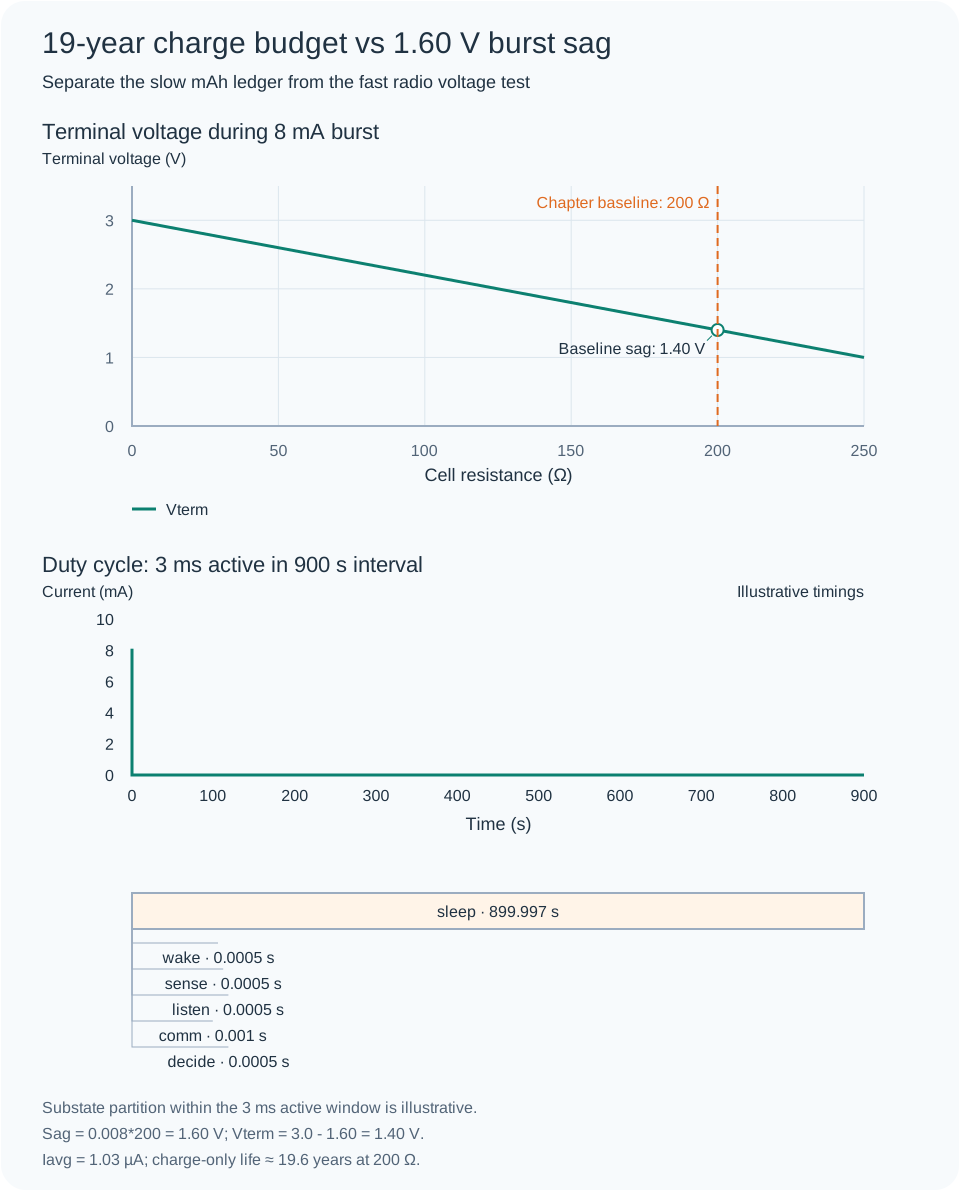
Name the relationship. Qusable = 0.8x220 = 176 mAh; E = 0.528 Wh d = 0.003/900 = 3.33x10⁻⁶ Iavg = 1.03 uA; charge-only life ≈ 19.6 years at 200 ohm: sag = 0.008x200 = 1.60 V; Vterm = 1.40 V
- 3
Substitute the chapter fixture. Set cell resistance to 200. The page ledger gives radio voltage as 1.40 V.
- 4
Read the result. Keep V beside the value. Use it only inside the technical boundary on this page.
Predict, then change cell resistance
Try Predict the direction of radio voltage. Move one control, calculate, then check your prediction.
Observe Predict a decrease in radio voltage as the input increases over this range. Reset to the chapter baseline and compare.
Explain Only cell resistance moves here. The other chapter fixtures remain fixed.
Source: content/ux-connected-products/connected-devices-fundamentals.qmd — Phoebe's Field Notes: Why the Coin Cell Dies Before Its mAh Run Out. Use the chapter equation and fixed ledger above; only the named input varies.
Check yourself
What should you do before trusting a moved-control result?
What does this small model leave out?
1. Separate two ways a battery fails
A charge budget asks how long average current can continue. A voltage-sag test asks whether the source can supply one short radio burst now. A worn coin cell can pass the first calculation and fail the second.
2. Name every algebra move
Derate chargeQusable=fQnominal.
Find duty cycled=Tactive/Tinterval.
Weight currentsIavg=Isleep(1−d)+Iactive d.
Subtract burst dropVterm=Voc−IRint.
3. Reproduce the beacon ledger
d = 0.003/900 = 3.33×10⁻⁶
Iavg = 1.03 µA; charge-only life ≈ 19.6 years
at 200 Ω: sag = 0.008×200 = 1.60 V; Vterm = 1.40 V
The two-year average-current budget is 176 mAh ÷ 17,520 h = 10.0 µA, so charge alone looks comfortable.
4. Try the cell resistance
TryAge the cell by increasing internal resistance while leaving its charge ledger unchanged.
ObserveLifetime stays fixed because average current is fixed, while burst voltage collapses as resistance rises.
ExplainThat is why installed antenna loss, retries, and peak current can end service long before the mAh estimate.
The cell is represented by a fixed open-circuit voltage and one resistance.
- Cell
- Real voltage and resistance vary with temperature, age, and pulse history
- Radio
- Startup, receive windows, retries, and updates add current
- Life
- Self-discharge and cutoff voltage reduce usable service
Measure the complete installed current trace and minimum radio voltage.
5. Test the worst moment
Repeat the longest radio action at cold temperature, low state of charge, poor link quality, and after aging. Watch supply voltage and reset state, not only an average-current meter.
6. Record the device state
Store cell type, lot, age, temperature, resistance, current trace, antenna installation, retries, brownout threshold, recovery behavior, firmware, and the change condition for replacement.
7. Check yourself
Why does charge predict 19.6 years?
Why can the same cell brown out?
Does adding mAh fix voltage sag?
The 15-minute and two-year product claim comes from the chapter; the CR2032 and radio values are stated typical assumptions.
- 220 mAh at 3.0 V
- Coin-cell teaching case
- 8 mA for 3 ms
- BLE burst assumption
- 10 Ω to 200 Ω
- Fresh-to-aged resistance illustration
Correct, not complete: this two-state ledger does not qualify a battery-powered connected product.