UART Frame Timing: Framing, Bit Periods, and Byte Throughput
UART Frame Timing: Framing, Bit Periods, and Byte Throughput
Ada re-derives the chapter’s UART byte rates, bit periods, and timing margin straight from the frame shape
 ADA · CALCULATION AUDIT
UART Frame Timing: Framing, Bit Periods, and Byte Throughput
A UART baud rate is a physics budget for sampling time. The chapter already gives the frame shape and the two example baud rates, so the byte-rate and timing-margin claims can be checked without inventing any new measurements.
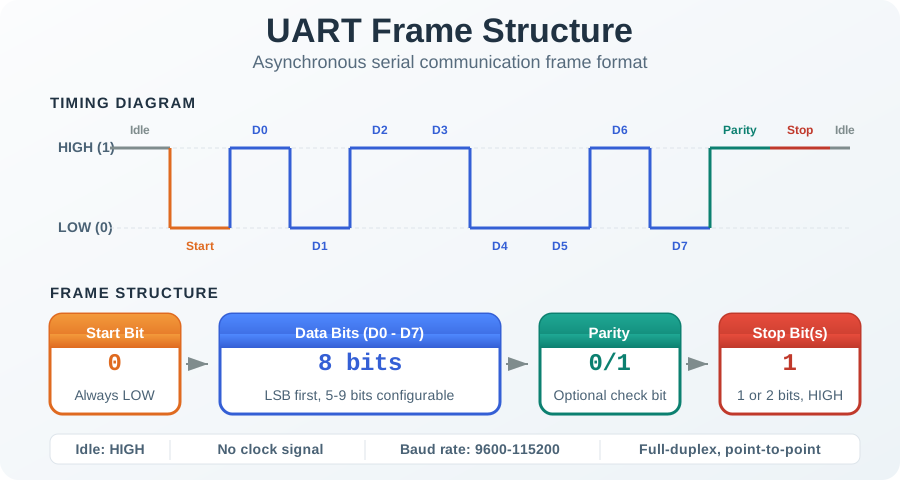
A UART link runs an 8N1 frame — one start bit, eight data bits, one stop bit — and the chapter clocks it at both 9600 and 115200 baud, where timing error between transmitter and receiver accumulates across the frame because there is no shared clock. At 9600 baud that is about 960 data bytes per second; at 115200 baud it is about 11,520 bytes per second, though electrical and timing margin grow more sensitive to cable and oscillator quality. This audit asks the question those two rates invite: how much of the bit-time sampling window does the faster link actually give up compared with the slower one?
Companion to the chapter UART and RS-232 Protocols — every number here comes from that chapter.
See the relationship before changing it
The chapter figure below shows: A receiver synchronizes on the start bit, samples the data bits by timing, optionally checks parity, then waits for the stop bit.
The retained audit below checks several chapter fixtures. This model keeps those stated values fixed and changes only uart baud rate, so the numeric fixture does not switch without explanation.
Derive the baseline in four named moves
- 1
Name the input. The chapter baseline is 9600 baud.
- 2
Name the relationship. payload rate = baud / 10 bit-times per byte
- 3
Substitute with units. 9,600 / 10 = 960 bytes/s
- 4
Read the result. Keep the unit beside the value. Use it only inside the technical boundary on this page.
Predict, then change uart baud rate
Try Predict the direction of payload rate = baud / 10 bit-times per byte. Test another uart baud rate, then compare 8n1 payload rate.
Observe A higher baud rate moves more 8N1 bytes each second but leaves less time for each sampled bit. Reset uart baud rate to 9600 and compare 8n1 payload rate.
Explain Eight data bits plus start and stop bits make ten transmitted bits per byte, so raising baud rate increases useful byte throughput proportionally.
Check yourself
What should you do before trusting a moved-control result?
What does this small model leave out?
Build an 8N1 frame as 1 start + 8 data + 1 stop bit, then calculate byte rate and bit period at 9600 and 115200 baud.
Throughput rises from 960 to 11520 bytes/s, but the sampling window contracts from 104.17 µs to 8.68 µs per bit—a 12× reduction.
Framing spends ten serial bit times for each eight-bit payload byte, and higher baud compresses every timing margin in direct inverse proportion.
Frame Length, Byte Rate, and Bit Period
| Check | Arithmetic | Result |
|---|---|---|
| 9600 baud byte rate | 9600 bit/s / 10 bit/byte |
960 byte/s before protocol overhead. |
| 9600 baud bit period | 1 / 9600 s = 0.00010417 s |
104.17 us per bit. |
| 115200 baud byte rate | 115200 bit/s / 10 bit/byte |
11,520 byte/s before protocol overhead. |
| 115200 baud bit period | 1 / 115200 s = 0.0000086806 s |
8.68 us per bit. |
| Timing-margin comparison | 104.17 us / 8.68 us = 12.0 |
The faster link has one twelfth the bit-time window of the 9600 baud link. |
The bounded conclusion is the same as the diagnostic advice above: the arithmetic supports the stated 960 and 11,520 byte/s figures, and it explains why 115200 baud exposes clock, edge, cable, and grounding problems that 9600 baud may hide.
Every number above is taken from the chapter’s own UART timing example and re-derived step by step.
Technical boundaries: This ideal continuous-frame calculation excludes parity and extra stop bits, idle gaps, protocol headers, oscillator mismatch, receiver oversampling, cable capacitance, RS-232 driver slew, noise, and retransmission.