The Burst-Capacity Ledger: Bytes, Rates, Airtime, and Retry Load
The Burst-Capacity Ledger: Bytes, Rates, Airtime, and Retry Load
Ada carries the chapter’s device ledger through overhead, outage timing, raw airtime, and retry load
 ADA · CALCULATION AUDIT
The Burst-Capacity Ledger: Bytes, Rates, Airtime, and Retry Load
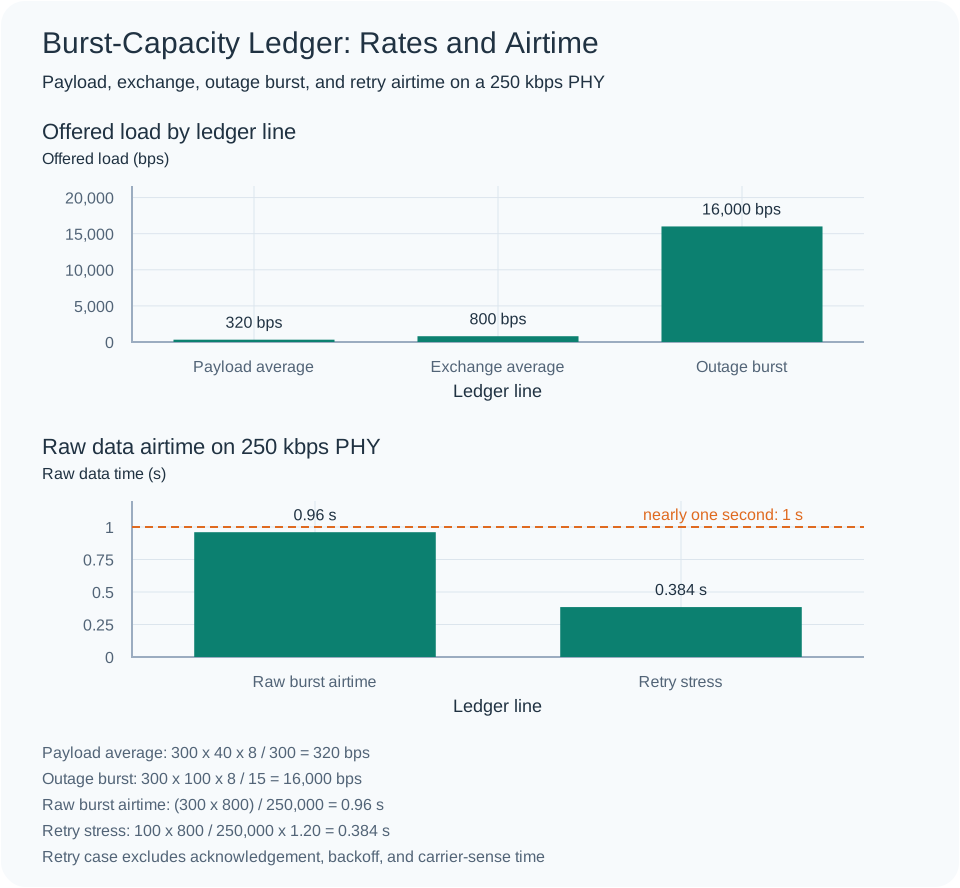
Three hundred devices each sending a 40-byte reading every 5 minutes offer a payload average of just 320 bps — small enough to look like the shared channel has room to spare. But framing and acknowledgements push the real exchange near 100 bytes, and if those same 300 devices reconnect inside a 15-second recovery window the offered load spikes to 16,000 bps, whose raw airtime alone occupies nearly one second on a 250 kbps PHY. This audit carries the ledger past the payload average — through overhead, outage timing, and retries — to ask whether the channel really has usable headroom.
Companion to the chapter Bandwidth and Channel Capacity — every number here comes from that chapter.
See the relationship before changing it
Set the input, apply the rule, then read the result with its unit.
Derive the baseline in four named moves
- 1
Name the input. The chapter baseline is 15 s.
- 2
Name the relationship. load = 300 devices x 100 bytes x 8 / window
- 3
Substitute with units. 300 x 100 x 8 / 15 = 16,000 bps
- 4
Read the result. Keep the unit beside the value. Use it only inside the technical boundary on this page.
Predict, then change recovery window
Try Predict the direction of load = 300 devices x 100 bytes x 8 / window. Test another recovery window, then compare offered burst load.
Observe Compressing the same queued bytes into less time multiplies the shared-channel load. Reset recovery window to 15 and compare offered burst load.
Explain The same recovery payload must fit inside the chosen window, so allowing more time lowers the offered burst bit rate inversely.
Check yourself
What should you do before trusting a moved-control result?
What does this small model leave out?
Ready: use the stated baseline inputs, then compare each displayed result.
The ledger, line by line
| Check | Inputs from this chapter | Arithmetic | Result |
| Payload average | 300 devices, 40 B, 5 min = 300 s | 300 x 40 x 8 / 300 | 320 bps |
| Exchange average | 300 devices, 100 B exchange, 300 s | 300 x 100 x 8 / 300 | 800 bps before retries |
| Outage burst | 300 devices, 100 B exchange, 15 s | 300 x 100 x 8 / 15 | 16,000 bps |
| Raw burst airtime | 300 exchanges, 800 bits each, 250,000 bps PHY | (300 x 800) / 250,000 | 0.96 s of raw data time |
| Retry stress | 100 devices, 100 B frame, 250,000 bps PHY, 20% retries | 100 x 800 / 250,000 x 1.20 | 0.384 s of raw data time |
The rounding happens at the end: 0.96 s is already close to the "nearly one second" warning, and the 0.384 s retry case excludes acknowledgement, backoff, and carrier-sense time. Those omitted terms are why a clean record still needs a busy-window proof.
Every number above is taken from the chapter’s own capacity worked examples and re-derived step by step.