Session Reuse, Not a Cheaper Cipher, Makes TLS Affordable
Session Reuse, Not a Cheaper Cipher, Makes TLS Affordable
Ada re-derives this chapter’s own numbers step by step, at full precision
 ADA · CALCULATION AUDIT
Session Reuse, Not a Cheaper Cipher, Makes TLS Affordable
Turning on TLS adds a one-time handshake worth 0.72 mAs every time a sensor connects, while each message it sends costs about 0.4 mAs. Hold one connection open for a day of 1440 messages and that handshake is spread almost to nothing; reconnect for every reading and it is paid in full each time. This audit amortises the same 0.72 mAs both ways to test the claim in its title: is it session reuse, not a cheaper cipher, that makes TLS affordable?
Companion to the chapter MQTT Security Fundamentals — every number here comes from that chapter.
See the relationship before changing it
Set the input, apply the rule, then read the result with its unit.
Derive the baseline in four named moves
- 1
Name the input. The chapter baseline is 1440 messages.
- 2
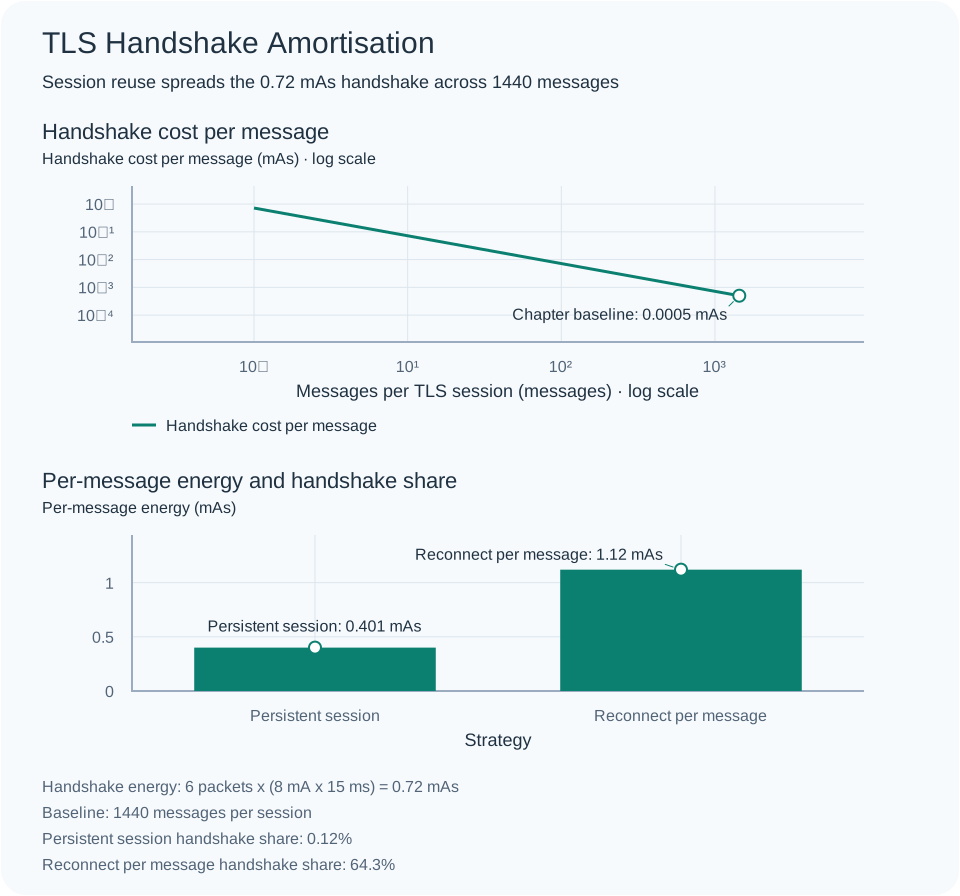
Name the relationship. cost = 0.72 mAs / messages per session
- 3
Substitute with units. 0.72 / 1,440 = 0.0005 mAs
- 4
Read the result. Keep the unit beside the value. Use it only inside the technical boundary on this page.
Predict, then change messages per tls session
Try Predict the direction of cost = 0.72 mAs / messages per session. Test another messages per tls session, then compare handshake cost per message.
Observe Session reuse spreads the same handshake charge across many readings. Reset messages per tls session to 1440 and compare handshake cost per message.
Explain A secure session pays its handshake charge once, so sending more messages through that session divides the setup charge among more messages and lowers per-message cost inversely.
Check yourself
What should you do before trusting a moved-control result?
What does this small model leave out?
Ready: use the stated baseline inputs, then compare each displayed result.
Ada: The callout and calculator both say the TLS handshake energy “falls away” over a session. Let me make that precise, because the same 0.72 mAs is either negligible or dominant depending entirely on how often you reconnect.
The handshake energy is a fixed, one-time cost per connection:
E_handshake = 6 packets x (8 mA x 15 ms) = 6 x 120 mA-ms = 720 mA-ms = 0.72 mAs
Amortise it over a one-day session of N = 1440 messages, each costing about 0.4 mAs to send:
- Handshake share per message:
0.72 / 1440 = 0.0005 mAs - Total per message:
0.0005 + 0.4 = 0.4005 mAs - Handshake as a fraction of energy:
0.0005 / 0.4005 = 0.12%
Now reconnect for every single message instead, and each message pays the full handshake:
- Per message:
0.72 + 0.4 = 1.12 mAs, of which the handshake is0.72 / 1.12 = 64.3%
The cipher and the 0.72 mAs never changed; only the number of messages sharing one handshake did. Keeping the connection persistent drives the handshake from 64% of per-message energy down to 0.12%, so the design lever that makes TLS practical on a battery is session reuse, not a lighter TLS version, and the one-time 100 ms (TLS 1.3) or 200 ms (TLS 1.2) latency is paid once rather than on every reading.
Every number above is taken from the chapter’s own material and re-derived step by step.