For a 10-Byte Payload, the Topic Is the Message
For a 10-Byte Payload, the Topic Is the Message
Ada re-derives this chapter’s own numbers step by step, at full precision
 ADA · CALCULATION AUDIT
For a 10-Byte Payload, the Topic Is the Message
Every MQTT message here carries a 4-byte header and a 10-byte payload, plus its full topic string. Swap a 42-byte verbose topic for an 8-byte short one and each message drops by 34 bytes — larger than the payload itself — which across 1000 sensors at 100 messages a day adds up to 1.16 GB a year. This audit follows the per-message formula to show why, for a 10-byte payload, the topic is the message.
Companion to the chapter MQTT Packet and Broker Features — every number here comes from that chapter.
See the relationship before changing it
Set the input, apply the rule, then read the result with its unit.
Derive the baseline in four named moves
- 1
Name the input. The chapter baseline is 34 bytes/message.
- 2
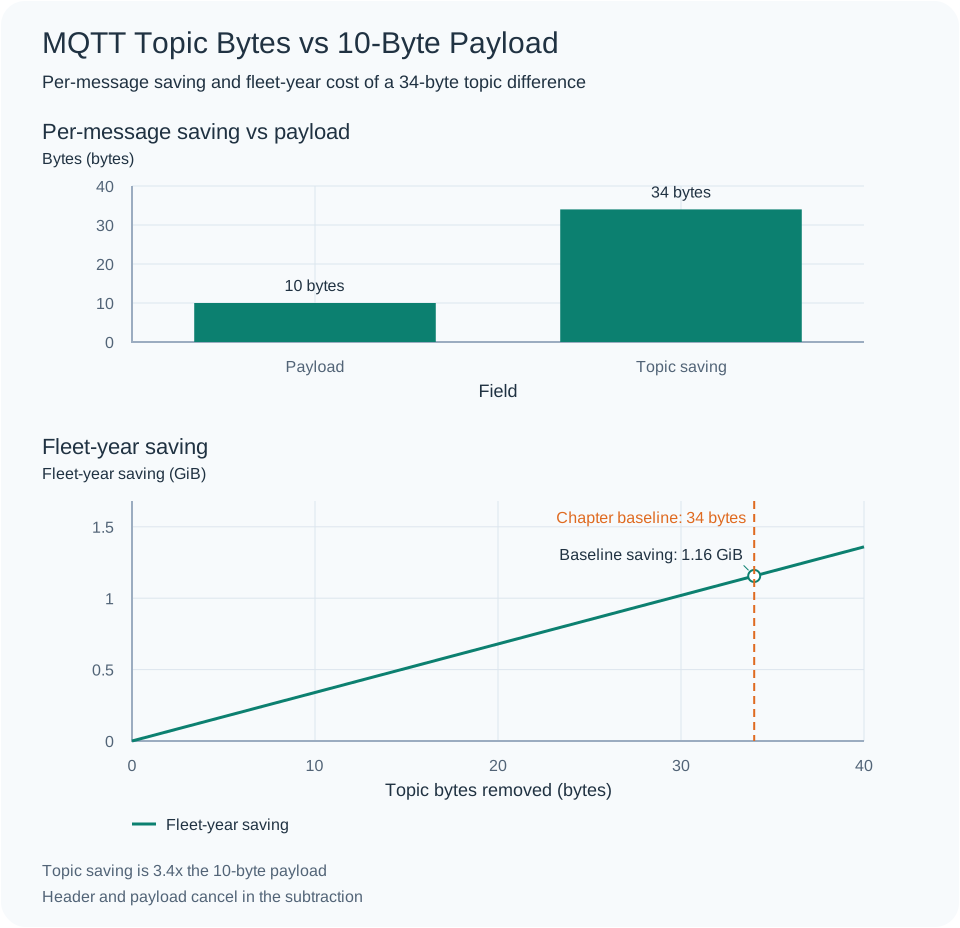
Name the relationship. saving = 1,000 x 100 x 365 x bytes / 1,073,741,824
- 3
Substitute with units. 1,000 x 100 x 365 x 34 / 1,073,741,824 = 1.16 GiB
- 4
Read the result. Keep the unit beside the value. Use it only inside the technical boundary on this page.
Predict, then change topic bytes removed
Try Predict the direction of saving = 1,000 x 100 x 365 x bytes / 1,073,741,824. Test another topic bytes removed, then compare fleet-year saving.
Observe A naming choice repeats across every device and every message in the fleet. Reset topic bytes removed to 34 and compare fleet-year saving.
Explain Topic text repeats in every publication, so removing another byte saves that byte across all devices and messages, making annual fleet savings proportional to bytes removed.
Check yourself
What should you do before trusting a moved-control result?
What does this small model leave out?
Ready: use the stated baseline inputs, then compare each displayed result.
Ada: The callout above prices topic length in bandwidth. I want to show why the saving is so large by looking at what the per-message formula keeps and what it cancels. Every message costs S_msg = S_fixed + S_topic + S_payload, with S_fixed = 4 bytes and S_payload = 10 bytes fixed on both the long and short designs.
Because the header and payload are identical on both sides, they cancel exactly when you subtract, and the entire per-message saving is the difference in topic length. The chapter’s verbose and abbreviated topics differ by 34 bytes, so:
- Saving per message:
S_long - S_short = (4 + T_long + 10) - (4 + T_short + 10) = T_long - T_short = 34 bytes - Across a fleet-year:
1000 devices x 100 msgs/day x 365 days x 34 bytes = 1,241,000,000 bytes - In binary units:
1,241,000,000 / (1024 x 1024 x 1024) = 1.156 GiB, matching the chapter’s 1.16 GB
Here is the part worth keeping: that 34-byte topic difference is 34 / 10 = 3.4x the entire 10-byte payload. For small telemetry the topic string is the largest single field on the wire, so a naming convention is not cosmetic. It is a bandwidth, energy, and airtime decision that scales linearly with every device and every message the fleet will ever send.
Every number above is taken from the chapter’s own material and re-derived step by step.