The Link-Budget Margin
The Link-Budget Margin
Ada re-derives this chapter’s own numbers step by step, at full precision
 ADA · CALCULATION AUDIT
The Link-Budget Margin
Four arithmetic checks, ~3 minutes
The physics question is whether enough signal power still reaches the receiver after distance, frequency, enclosure loss, obstacles, and fade reserve have spent the budget.
The chapter puts a 2.4 GHz gateway 100 m from a sensor in a clear yard and asks whether the link really closes. Free-space loss comes to about 80 dB, so a 14 dBm transmitter with two 2 dBi antennas and 3 dB of feed loss lands near −65 dBm — a comfortable 27 dB above a −92 dBm receiver. But add 14 dB of obstruction and 8 dB of fade reserve and only 5 dB is left. This audit re-runs that budget to ask how much link-budget margin actually survives a real installation.
Companion to the chapter Propagation and Link Budgets — every number here comes from that chapter.
See the relationship before changing it
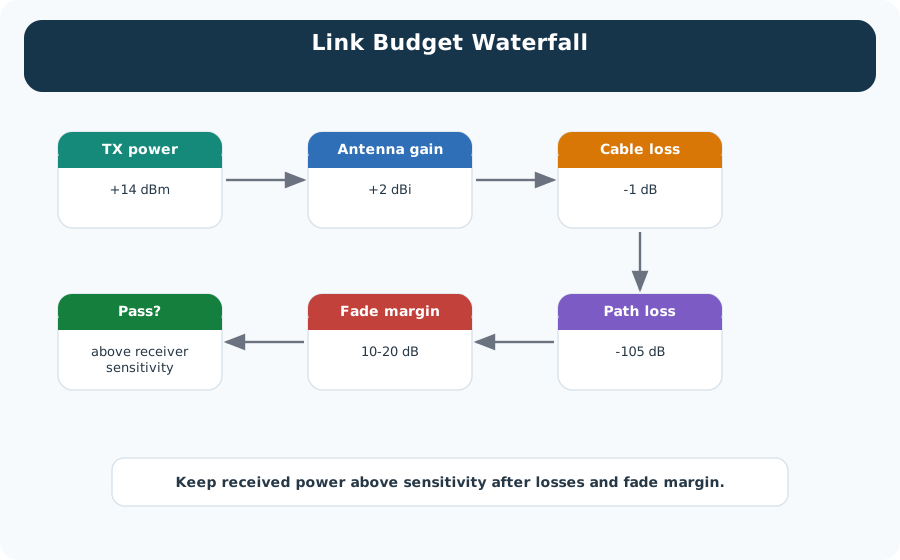
The chapter figure below shows: A link budget is a waterfall: add gains, subtract losses, and confirm the received power stays above receiver sensitivity after a reserved fade margin.
The retained audit below checks several chapter fixtures. This model keeps those stated values fixed and changes only fade reserve, so the numeric fixture does not switch without explanation.
Derive the baseline in four named moves
- 1
Name the input. The chapter baseline is 8 dB.
- 2
Name the relationship. installed margin = 26.96 dB clean margin - 14 dB obstruction - fade reserve
- 3
Substitute with units. 26.96 - 14 - 8 = 4.96 dB
- 4
Read the result. Keep the unit beside the value. Use it only inside the technical boundary on this page.
Predict, then change fade reserve
Try Predict the direction of installed margin = 26.96 dB clean margin - 14 dB obstruction - fade reserve. Test another fade reserve, then compare installed link margin.
Observe A larger fade reserve consumes more of the nominal link margin after obstruction loss. Reset fade reserve to 8 and compare installed link margin.
Explain Reserving more margin for fading leaves less of the clean link budget available after obstruction, so each reserved decibel reduces installed headroom by one decibel.
Check yourself
What should you do before trusting a moved-control result?
What does this small model leave out?
Ready: use the stated baseline inputs, then compare each displayed result.
The worked-example values
Use only the worked-example values above: a 100 m path, 2.4 GHz carrier, 14 dBm transmitter, two 2 dBi antennas, 3 dB enclosure/feed loss, -92 dBm receiver sensitivity, 14 dB obstruction loss, and 8 dB fade/interference reserve.
The four checks
| Check | Calculation | Result |
| Free-space loss | 20 log10(0.1) + 20 log10(2400) + 32.44 = -20.00 + 67.60 + 32.44 | 80.04 dB, rounded to 80 dB |
| Received power | 14 + 2 + 2 - 3 - 80.04 | -65.04 dBm, about -65 dBm |
| Clean-path margin | -65.04 - (-92) | 26.96 dB, about 27 dB |
| Installed reserve left | 26.96 - 14 - 8 | 4.96 dB, about 5 dB |
Review implication: the link still closes on paper, but the final 5 dB is small enough that a field RSSI/SNR and packet-success record should decide release. The calculation explains what must be measured; it does not replace measurement.
Every number above is taken from the chapter’s own worked link-budget example and re-derived step by step.