Wavelength, Loss, and Margin
Wavelength, Loss, and Margin
Ada re-derives this chapter’s own numbers step by step, at full precision
 ADA · CALCULATION AUDIT
Wavelength, Loss, and Margin
Every wireless decision begins with a wave leaving an antenna and losing strength as it travels, and the chapter keeps three things apart. Wavelength sets antenna scale — its shortcut λ ≈ 30 / f(GHz) puts a 2.4 GHz signal near 12.5 cm; the frequency term of free-space path loss spends link budget; and only the remaining margin says whether the installed link still has room for real obstacles. This audit keeps the physics and the dB ledger separate to ask what wavelength, loss, and margin each actually decide.
Companion to the chapter Electromagnetic Waves and Antennas — every number here comes from that chapter.
See the relationship before changing it
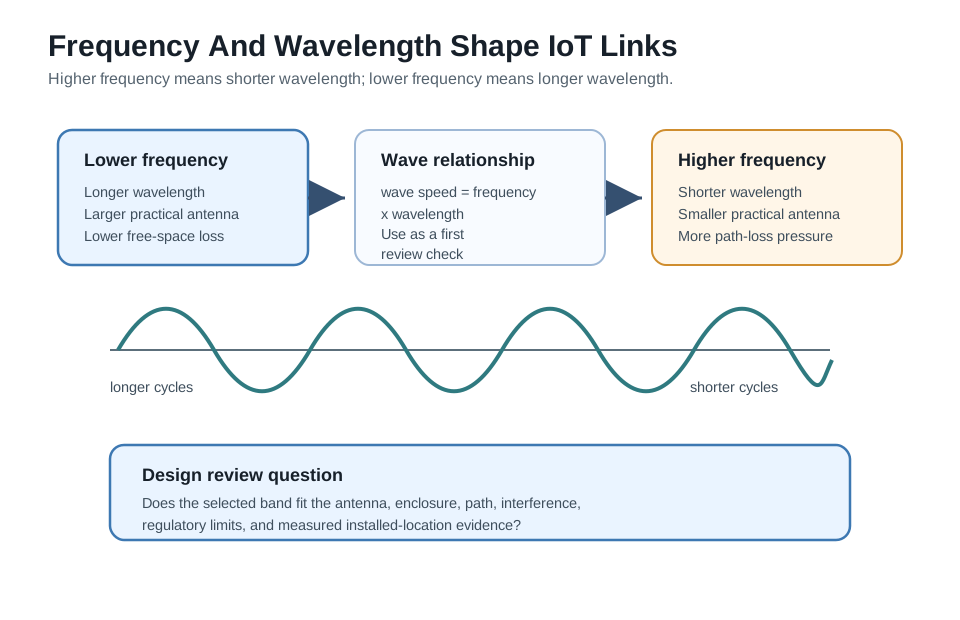
The chapter figure below shows: Frequency, wavelength, antenna, and path-loss relationships for IoT radio review.
Derive the baseline in four named moves
- 1
Name the input. The chapter baseline is 2.4 GHz.
- 2
Name the relationship. quarter wave = (30 / frequency) / 4
- 3
Substitute with units. (30 / 2.4) / 4 = 3.13 cm
- 4
Read the result. Keep the unit beside the value. Use it only inside the technical boundary on this page.
Predict, then change carrier frequency
Try Predict the direction of quarter wave = (30 / frequency) / 4. Test another carrier frequency, then compare quarter-wave length.
Observe Higher frequency shrinks the antenna but also spends more free-space link margin. Reset carrier frequency to 2.4 and compare quarter-wave length.
Explain Higher-frequency radio waves complete more cycles over the same propagation distance, so wavelength and the quarter-wave antenna length shrink inversely with frequency.
Check yourself
What should you do before trusting a moved-control result?
What does this small model leave out?
Ready: use the stated baseline inputs, then compare each displayed result.
Ada: Keep the physics and the dB ledger separate. Wavelength sets antenna scale; the frequency term spends link budget; only the remaining margin tells you whether the installed link still has room for real obstacles. Let me re-derive every number the chapter uses.
- 900 MHz wavelength. The chapter’s shortcut is
lambda(cm) = 30 / f(GHz):30 / 0.9 = 33.333... cm, so a quarter-wave element is33.333... / 4 = 8.333... cm. - 2.4 GHz wavelength.
30 / 2.4 = 12.5 cmexactly, with a quarter-wave of12.5 / 4 = 3.125 cm– matching both the “12.5 cm” headline and the small-antenna packaging claim. - Free-space path loss at 100 m, 2.4 GHz.
4 pi d / lambda = 4 pi (100) / 0.125 = 10053; in dB,20 log10(10053) = 80.0 dB. The split form the chapter also quotes,20 log10(d) + 20 log10(f) - 147.55with d in metres and f in Hz, gives40 + 187.60 - 147.55 = 80.05 dB– the same number to the precision shown. - Same-distance frequency penalty, 900 MHz to 2.4 GHz.
20 log10(2400 / 900) = 8.519... dB, rounding to 8.5 dB. A14 dBfade margin at the lower band becomes14 - 8.519... = 5.480... dBat 2.4 GHz, before walls, hands, or detuning are even counted. - 5 GHz versus 2.4 GHz.
20 log10(5000 / 2400) = 6.375... dB, about 6.4 dB, which is10^(6.375.../10) = 4.34xmore power lost to free-space spreading alone – roughly halving usable range for the same link budget. - 6 GHz versus 2.4 GHz.
20 log10(6000 / 2400) = 7.959... dB, about 8.0 dB, which is why 6 GHz needs closer cell planning than 2.4 GHz. - Installed margin worked example. Start from
-72 dBmmeasured against a-92 dBmsensitivity floor:-72 - (-92) = 20 dBof nominal margin. A closed metal door removes12 dB:20 - 12 = 8 dBleft. A polarization or antenna-match mismatch removes another6 dB:8 - 6 = 2 dBremaining – nearly out of margin even though the free-space estimate alone looked comfortable.
Every value reproduces the chapter’s own table to the digit. The lesson the arithmetic enforces is the one in the header: wavelength decides how small the antenna can be, the 20 log10(f) term is a fixed toll the higher band always pays, and only the margin ledger – after every dB loss is subtracted in order – says whether the link actually closes in the field.
Every number above is taken from the chapter’s own material and re-derived step by step.