The Margin Gate: Raw Budget, Reserved Margin, and Path-Loss Physics
The Margin Gate: Raw Budget, Reserved Margin, and Path-Loss Physics
Ada re-derives the chapter’s raw link budget, the margins it reserves, and the free-space penalty of distance
 ADA · CALCULATION AUDIT
The Margin Gate: Raw Budget, Reserved Margin, and Path-Loss Physics
A link budget is just arithmetic tied to physics: add the radio gains, subtract the real losses, reserve margin, then challenge the distance model with field measurements.
A farm water-monitoring project wants one gateway to reach hill tanks, buried meter pits, and a shed-mounted sensor, so the chapter turns the radio into a ledger. Adding 14 dBm transmit, 2 dBi device and 6 dBi gateway antennas, less 3 dB of cable loss against −130 dBm sensitivity gives a 149 dB raw budget; reserving 10 dB fading, 12 dB obstruction, and 4 dB installation leaves 123 dB of allowable path loss. This audit re-runs that ledger to ask what the margin gate actually lets you spend, and why a 128 dB estimate is a design gap rather than a maybe.
Companion to the chapter LPWAN Link Budget and Range — every number here comes from that chapter.
See the relationship before changing it
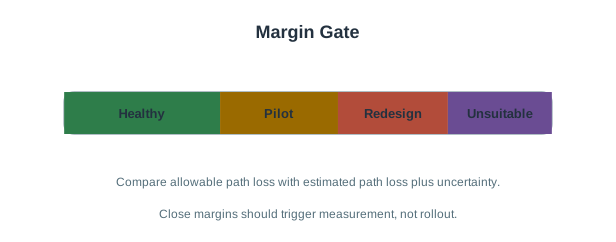
The chapter figure below shows: The margin gate turns a calculation into an engineering decision.
The retained audit below checks several chapter fixtures. This model keeps those stated values fixed and changes only estimated path loss, so the numeric fixture does not switch without explanation.
Derive the baseline in four named moves
- 1
Name the input. The chapter baseline is 128 dB.
- 2
Name the relationship. spare margin = 123 dB allowable loss - estimated path loss
- 3
Substitute with units. 123 - 128 = -5.0 dB
- 4
Read the result. Keep the unit beside the value. Use it only inside the technical boundary on this page.
Predict, then change estimated path loss
Try Predict the direction of spare margin = 123 dB allowable loss - estimated path loss. Test another estimated path loss, then compare spare reserved margin.
Observe A larger path-loss estimate spends the reserved budget and can turn spare margin into a shortfall. Reset estimated path loss to 128 and compare spare reserved margin.
Explain Path attenuation spends the link budget available after reservations, so each additional decibel of estimated loss removes one decibel of spare margin.
Check yourself
What should you do before trusting a moved-control result?
What does this small model leave out?
Ready: use the stated baseline inputs, then compare each displayed result.
Raw Ledger Arithmetic
1. Raw ledger arithmetic. Use the numbers already in the practitioner record: 14 dBm transmit power, 2 dBi device antenna gain, 6 dBi gateway antenna gain, 3 dB total cable and connector loss, and −130 dBm receiver sensitivity.
Reserved-Margin Arithmetic
2. Reserved-margin arithmetic. The chapter reserves 10 dB for fading, 12 dB for obstruction, and 4 dB for installation uncertainty. Those numbers are not extra range; they are budget you refuse to spend during normal path loss.
Distance Physics
3. Distance physics. The free-space formula uses 20·log10(d) because received power thins with distance squared. If distance doubles and frequency stays fixed, the extra loss is 20·log10(2) = 6.02 dB. That is why a small-looking placement change can consume a large part of the margin.
| Check | Arithmetic | Result |
| Raw link budget | 14 + 2 + 6 − 3 − (−130) | 149 dB |
| Allowable path loss | 149 − 10 − 12 − 4 | 123 dB |
| Model estimate at 118 dB | 123 − 118 | +5 dB spare after reserved margins — pilot candidate |
| Model estimate at 128 dB | 123 − 128 | −5 dB shortfall — design gap |
| Distance doubling penalty | 20·log10(2) | 6.02 dB more path loss |
What the physics buys you: the budget does not say "long range"; it says which assumptions can be spent. When measurements disagree with the 118 dB or 128 dB model estimate, the correct response is to reopen antenna placement, gateway density, radio setting, or installation evidence instead of rounding the range claim upward.
Terrain, stochastic fading, interference, antenna mismatch, retries, and gateway diversity are outside this fixed additive link-budget ledger; deployments still require measured path loss.
Every number above is taken from the chapter’s own link-budget example and re-derived step by step.