Where the Clock Offset Hides in the Pseudoranges
Where the Clock Offset Hides in the Pseudoranges
Ada re-derives this chapter’s own numbers step by step, at full precision
 ADA · CALCULATION AUDIT
Where the Clock Offset Hides in the Pseudoranges
GPS turns time into distance, so a receiver-clock error becomes a position error — the chapter notes that one microsecond of clock slip is 300 m off the ground. A cheap receiver clock can never match a satellite’s atomic clock, which the chapter prices near $100,000, yet a fix still needs at least four satellites, one more than the three coordinates alone would suggest. This audit follows that extra pseudorange to ask where the clock offset hides, and why the fourth satellite — not a better clock — is what solves it away.
Companion to the chapter GPS and Outdoor Positioning — every number here comes from that chapter.
See the relationship before changing it
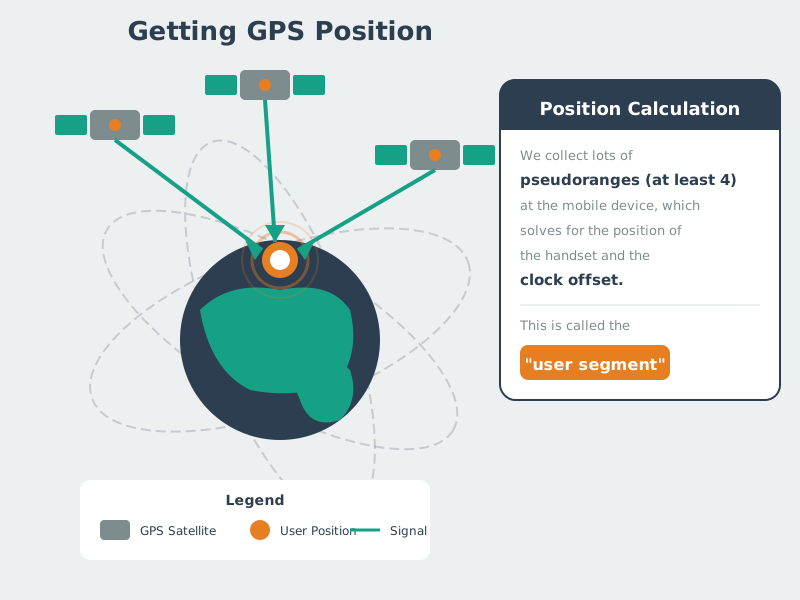
The chapter figure below shows: A GPS product should treat the coordinate as the output of satellite timing, pseudorange, and receiver clock-offset solving, not as an isolated latitude and longitude value.
Derive the baseline in four named moves
- 1
Name the input. The chapter baseline is 50 ns.
- 2
Name the relationship. range error = 299,792,458 m/s x clock slip in seconds
- 3
Substitute with units. 299,792,458 x 50 x 10^-9 = 14.99 m
- 4
Read the result. Keep the unit beside the value. Use it only inside the technical boundary on this page.
Predict, then change receiver clock slip
Try Predict the direction of range error = 299,792,458 m/s x clock slip in seconds. Test another receiver clock slip, then compare common range error.
Observe The same clock slip lengthens every pseudorange, so the fourth satellite can solve it. Reset receiver clock slip to 50 and compare common range error.
Explain Receiver-clock slip shifts every measured signal travel time together, so multiplying the slip multiplies the common apparent range error by the same factor.
Check yourself
What should you do before trusting a moved-control result?
What does this small model leave out?
Ready: use the stated baseline inputs, then compare each displayed result.
Ada: The chapter’s headline is that timing is position – a clock slip becomes a distance. Let me push the chapter’s own numbers through and show why the fourth satellite, not a better clock, closes the gap. The speed of light is c = 299,792,458 m/s.
First the sensitivity the chapter quotes:
- One microsecond of receiver-clock offset:
299,792,458 x 1e-6 = 299.792458 m, which rounds to the chapter’s300 m. - The 50-nanosecond slip in Step 2:
299,792,458 x 50e-9 = 14.98962 m, which rounds to the15 mthe chapter says every pseudorange runs long.
The word every is the whole trick. A receiver clock 50 ns fast does not spoil one range; it adds the same ~15 m to all of them at once. That common shift is separable, because a pure travel-time difference cannot carry it. Taking Sat A at 67.33 ms and Sat D at 67.40 ms with c = 299,792 km/s:
299,792 x (0.06740 - 0.06733) = 299,792 x 0.00007 = 20.98544 km, so the two ranges genuinely differ by~21.0 km.
So the four pseudoranges are four true geometric distances plus one shared clock offset – four equations for four unknowns (x, y, z, and the offset), which is exactly why four satellites are the minimum. The design meaning is the chapter’s quiet triumph: instead of fitting every device with a ~$100,000 atomic clock, GPS makes the cheap receiver clock’s error the fourth unknown and solves it away with one extra satellite.
Every number above is taken from the chapter’s own material and re-derived step by step.