Ten-Minute State Budget Calculation Audit
Ten-Minute State Budget Calculation Audit
Ada re-derives this chapter’s own numbers step by step, at full precision
 ADA · CALCULATION AUDIT
Ten-Minute State Budget Calculation Audit
The chapter’s ten-minute cycle spends 599 s asleep at 10 uA, 0.7 s of active work at 20 mA, and 0.3 s of radio at 120 mA — totalling 55.99 mA-s, an average of about 93 uA. The radio supplies 64.3% of the charge while occupying just 0.05% of the cycle. This audit works the ten-minute state budget to show short high-current states can dominate charge, yet long sleep still earns real savings.
Companion to the chapter Power Consumption Analysis — every number here comes from that chapter.
Use the chapter’s measured ten-minute cycle. Convert every state to the same unit, multiply current by time, and divide by the full cycle length only at the end.
See the relationship before changing it
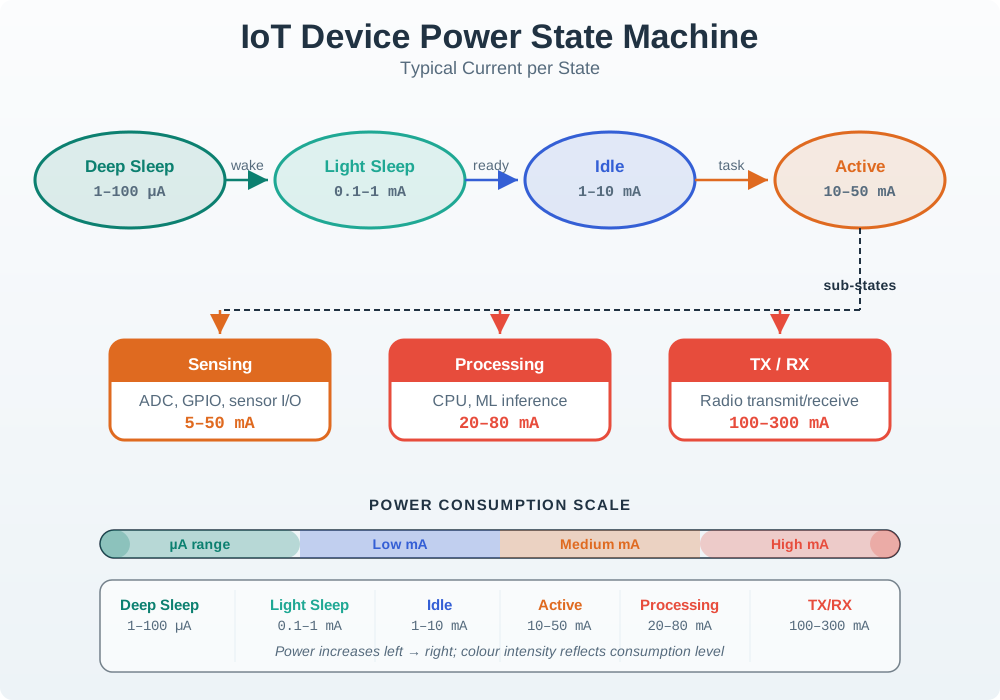
The chapter figure below shows: A defensible power budget names the states, measures each state's current and duration, and then checks which state dominates charge over the full cycle.
Derive the baseline in four named moves
- 1
Name the input. The chapter baseline is 0.3 s per 600 s.
- 2
Name the relationship. average = (5.99 + 14 + 120 x radio seconds) / 600 x 1000
- 3
Substitute with units. (5.99 + 14 + 120 x 0.3) / 600 x 1000 = 93.32 uA
- 4
Read the result. Keep the unit beside the value. Use it only inside the technical boundary on this page.
Predict, then change radio time
Try Predict the direction of average = (5.99 + 14 + 120 x radio seconds) / 600 x 1000. Test another radio time, then compare average current.
Observe A short radio burst can own most of the charge even when it owns little time. Reset radio time to 0.3 and compare average current.
Explain Longer radio operation adds charge to the same ten-minute cycle, so average current rises linearly while the other state charges stay fixed.
Check yourself
What should you do before trusting a moved-control result?
What does this small model leave out?
Formula
State charge = current x duration.
Average current = total charge / cycle time.
- Sleep: 10 uA = 0.010 mA, so 0.010 mA x 599 s = 5.99 mA-s.
- Active work: 20 mA x 0.7 s = 14.0 mA-s.
- Radio: 120 mA x 0.3 s = 36.0 mA-s.
- Total charge: 5.99 + 14.0 + 36.0 = 55.99 mA-s.
- Average current: 55.99 mA-s / 600 s = 0.0933167 mA, so the report cycle averages about 93.3 uA.
- Radio share: 36.0 / 55.99 = 0.643, so the radio contributes about 64.3% of the charge while occupying 0.3 / 600 = 0.0005, or 0.05%, of the cycle time.
- Active-current improvement: 5 mA x 0.7 s = 3.5 mA-s saved, which lowers the average by 3.5 / 600 = 0.005833 mA, or 5.83 uA.
- Sleep-baseline improvement: 3 uA = 0.003 mA, so 0.003 mA x 599 s = 1.797 mA-s saved, which lowers the average by 1.797 / 600 = 0.002995 mA, or about 3.00 uA.
The physics point is the time integral: short high-current states can dominate charge, but long sleep states still earn real savings when they span almost the whole cycle.
The ten-minute budget deliberately does not simulate boot spikes, retry traffic, regulator loss, voltage sag, cell aging, or temperature; it integrates the three stated current-duration rectangles over one fixed cycle.
Work the audit first, then check the displayed derivation.
Every number above is taken from the chapter’s own material and re-derived step by step.