Trace-to-Lifetime Calculation Audit
Trace-to-Lifetime Calculation Audit
Ada converts the measured current trace into charge, average current, and a usable cell-life estimate
 ADA · CALCULATION AUDIT
Trace-to-Lifetime Calculation Audit
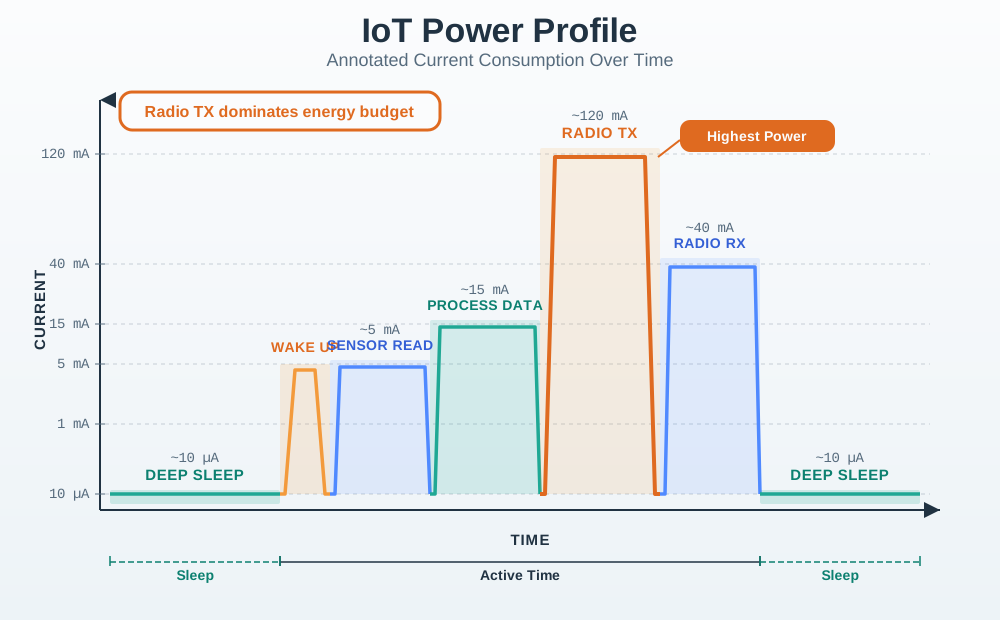
The chapter measures a ten-minute cycle where a 120 mA radio event for 1.4 s costs 46.7 uAh of a 52.2 uAh total — averaging about 313 uA, or roughly 256 days on a derated 1920 mAh cell. The radio alone is about 90% of the cycle charge. This audit converts the trace to lifetime numbers, checking each state against usable capacity rather than a headline rating.
Companion to the chapter Energy Measurement and Profiling — every number here comes from that chapter.
The current trace becomes defensible when every state is converted to charge, summed over the ten-minute cycle, and then checked against usable battery capacity instead of a headline cell rating.
See the relationship before changing it
The chapter figure below shows: Current-by-state sequence compares radio transmission charge with deep sleep charge to show how current and duration determine energy use.
The retained audit below checks several chapter fixtures. This model keeps those stated values fixed and changes only measured radio duration, so the numeric fixture does not switch without explanation.
Derive the baseline in four named moves
- 1
Name the input. The chapter baseline is 1.4 s.
- 2
Name the relationship. radio charge = 120,000 uA x duration / 3,600
- 3
Substitute with units. 120,000 x 1.4 / 3,600 = 46.67 uAh
- 4
Read the result. Keep the unit beside the value. Use it only inside the technical boundary on this page.
Predict, then change measured radio duration
Try Predict the direction of radio charge = 120,000 uA x duration / 3,600. Test another measured radio duration, then compare radio-event charge.
Observe A longer measured radio event adds charge directly and dominates the ten-minute trace. Reset measured radio duration to 1.4 and compare radio-event charge.
Explain The radio plateau draws the same current for its whole duration, so a longer measured plateau consumes proportionally more event charge.
Check yourself
What should you do before trusting a moved-control result?
What does this small model leave out?
Charge per state, average current, and cell-life estimate
| Trace row | Arithmetic shown | Audit result |
| Sleep baseline | 18 uA x 598.1 s / 3600 | 2.9905 uAh, so the table's 3.0 uAh is rounded correctly. |
| Process window | 25 mA = 25,000 uA; 25,000 x 0.1 / 3600 | 0.6944 uAh, so the table's 0.7 uAh is rounded correctly. |
| Radio event | 120 mA = 120,000 uA; 120,000 x 1.4 / 3600 | 46.6667 uAh, so the table's 46.7 uAh is rounded correctly. |
| Shutdown tail | 15 mA = 15,000 uA; 15,000 x 0.1 / 3600 | 0.4167 uAh, so the table's 0.4 uAh is rounded correctly. |
| Cycle total from listed rows | 3.0 + 1.4 + 0.7 + 46.7 + 0.4 | 52.2 uAh per ten-minute cycle, consistent with "about 52 uAh". |
| Average current | 52.2 uAh / (10 / 60 h) | 313.2 uA, which rounds to about 312-313 uA depending on the row precision used. |
| Usable cell life | 2400 mAh x 0.80 = 1920 mAh; 1920 mAh / 0.3132 mA / 24 | 255.5 days, so the chapter's roughly 256-day estimate is supported before derating. |
Engineering consequence: the radio event alone is 46.7 / 52.2 = 0.895, or about 90% of the measured cycle charge. The next fix should target radio timing, retries, and receive windows before chasing small CPU savings.
The trace conversion deliberately does not simulate probe bandwidth limits, measurement burden, unobserved startup spikes, retries, regulator loss, cell aging, or temperature; it integrates the listed current plateaus only.
Work the audit first, then check the displayed derivation.
Every number above is taken from this chapter's own worked example and re-derived step by step.