Audit the Battery-Life Ledger
Audit the Battery-Life Ledger
Ada turns each measured state into charge, then into two lifetime estimates with the rounding shown
 ADA · CALCULATION AUDIT
Audit the Battery-Life Ledger
The chapter’s worked cycle reports every 10 minutes (600 s): sleep at 0.008 mA, a 42 mA radio burst, and other states summing to 146.736 mA-s — an average of about 245 uA that a derated 1680 mAh gives about 286 days. Add two weak-signal retries and it falls to about 105 days. This audit treats the lifetime as an auditable battery-life ledger, row by row.
Companion to the chapter Energy-Aware Design Basics — every number here comes from that chapter.
Treat the lifetime number as an auditable ledger, not a guess. Every row below comes from the measured trace in the worked example, then the rounding is shown before the battery-life claim is accepted.
See the relationship before changing it
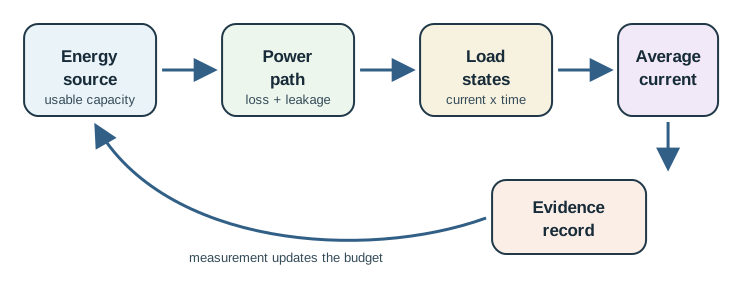
The chapter figure below shows: An energy-aware budget is a loop: usable source assumptions feed the power path and load-state ledger, while measurement evidence updates the average-current claim.
The retained audit below checks several chapter fixtures. This model keeps those stated values fixed and changes only radio-active time, so the numeric fixture does not switch without explanation.
Derive the baseline in four named moves
- 1
Name the input. The chapter baseline is 3 s.
- 2
Name the relationship. average = (20.736 mA-s fixed states + 42 mA x radio time) / 600 s
- 3
Substitute with units. (20.736 + 42 x 3) / 600 = 0.245 mA
- 4
Read the result. Keep the unit beside the value. Use it only inside the technical boundary on this page.
Predict, then change radio-active time
Try Predict the direction of average = (20.736 mA-s fixed states + 42 mA x radio time) / 600 s. Test another radio-active time, then compare cycle-average current.
Observe A longer radio state raises the cycle average far faster than the low-current sleep term. Reset radio-active time to 3 and compare cycle-average current.
Explain The active radio draws charge throughout its transmission window, so extending that window adds proportionally more charge to the unchanged reporting cycle.
Check yourself
What should you do before trusting a moved-control result?
What does this small model leave out?
1. Turn each measured state into charge
Current multiplied by duration gives charge in mA*s for one 600-second reporting cycle.
| State | Trace value | Charge arithmetic | Result |
| Sleep | 0.008 mA for 592 s | 592 x 0.008 | 4.736 mA*s |
| Sensor warm-up | 2 mA for 3 s | 3 x 2 | 6 mA*s |
| Compute | 6 mA for 1 s | 1 x 6 | 6 mA*s |
| Radio transmit/receive | 42 mA for 3 s | 3 x 42 | 126 mA*s |
| Storage plus shutdown | 4 mA for 1 s | 1 x 4 | 4 mA*s |
| Total | One cycle | 4.736 + 6 + 6 + 126 + 4 | 146.736 mA*s verified |
2. Convert cycle charge into average current
The exact division is 146.736 / 600 = 0.24456 mA. The paragraph rounds that to 0.2446 mA, which is 0.24456 x 1000 = 244.56 uA, or about 245 uA.
3. Convert usable capacity into baseline lifetime
Derating the source gives 2400 x 0.70 = 1680 mAh. Using the displayed rounded current gives 1680 / 0.2446 = 6868.4 h, and 6868.4 / 24 = 286.2 days, so the text's "about 286 days" is consistent.
4. Audit weak-signal retries
Two extra attempts at 3 seconds and 42 mA add 2 x 3 x 42 = 252 mA*s. The new cycle charge is 146.736 + 252 = 398.736 mA*s, so 398.736 / 600 = 0.66456 mA, rounded to 0.6646 mA. The lifetime becomes 1680 / 0.6646 = 2527.8 h, and 2527.8 / 24 = 105.3 days. That is 105.3 / 286.2 = 0.368 of the baseline, or about a 63 percent lifetime loss.
Review rule: accept the lifetime claim only when the state durations, usable-capacity derating, rounding choice, and retry assumption are recorded with the trace.
The battery ledger deliberately does not simulate voltage sag, regulator loss, self-discharge, temperature, capacity fade, or a distribution of retry counts; it integrates the stated cycle states and one explicit retry scenario.
Work the audit first, then check the displayed derivation.
Every number above is taken from this chapter's own worked example and re-derived step by step.