The Sweep Beats the Single Number
The Sweep Beats the Single Number
Ada re-derives this chapter’s own numbers step by step, at full precision
 ADA · CALCULATION AUDIT
The Sweep Beats the Single Number
This audit uses one fixed hourly duty-cycle example from the chapter. Predict whether its brief active burst or nearly hour-long sleep interval dominates charge, then reveal the full ledger and sensitivity sweep.
Companion to the chapter Power Management Tools — every number here comes from that chapter.
See the relationship before changing it
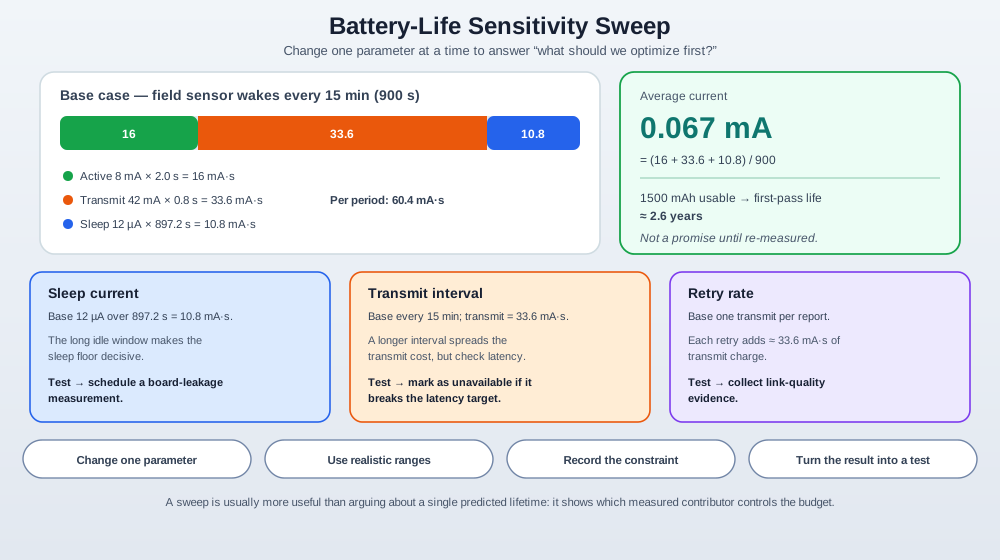
The chapter figure below shows: Battery-life sensitivity sweep: from a base ledger averaging 0.067 mA (about 2.6 years on 1500 mAh), sweeping sleep current, transmit interval, and retry rate shows which measured contributor to optimize first.
Derive the baseline in four named moves
- 1
Name the input. The chapter baseline is 20 uA.
- 2
Name the relationship. life = 1000 mAh / ((25 mA-s + sleep x 3599.5 s) / 3600 s) / 8766
- 3
Substitute with units. 1000 / ((25 + 0.020 x 3599.5) / 3600) / 8766 = 4.23 years
- 4
Read the result. Keep the unit beside the value. Use it only inside the technical boundary on this page.
Predict, then change sleep current
Try Predict the direction of life = 1000 mAh / ((25 mA-s + sleep x 3599.5 s) / 3600 s) / 8766. Test another sleep current, then compare ideal battery life.
Observe The node sleeps for almost the whole hour, so small sleep-current changes dominate life. Reset sleep current to 20 and compare ideal battery life.
Explain Sleep leakage flows through almost the entire interval, so raising sleep current increases average drain and shortens battery life inversely with that drain.
Check yourself
What should you do before trusting a moved-control result?
What does this small model leave out?
Prediction ready: press Check to reveal the worked derivation.
Ada: This chapter’s headline is a tidy 4.2-year lifetime, but the useful claim is buried in the sweep: halving sleep buys +59% while halving the far larger active current buys only +15%. That ranking is what tells you where to spend measurement effort, so let me rebuild the once-per-hour ledger from the chapter’s own inputs (50 mA for 0.5 s, 20 uA sleep, 3600 s period, 1000 mAh cell) and carry full precision to the end.
- Active charge:
50 mA x 0.5 s = 25.0 mA-s. - Sleep charge:
0.020 mA x 3599.5 s = 71.99 mA-s— sleep is71.99 / 96.99 = 74.2%of the hourly budget. - Total and average:
96.99 mA-s / 3600 s = 0.0269417 mA = 26.94 uA. - Lifetime:
1000 mAh / 0.0269417 mA = 37,117 h = 4.24 years. (The chapter’s 37,175 h divides by the 3-significant-figure 26.9 uA; carrying full precision trims it by about 58 h, roughly 0.16% — both are “about 4.2 years.”) - Halve sleep to 10 uA:
Iavg = 16.94 uA, life59,021 h = 6.74 years— a26.94 / 16.94 = +59.0%gain. - Halve active to 25 mA:
Iavg = 23.47 uA, life42,609 h = 4.86 years— only+14.8%.
The audit confirms the ranking and names why it holds: because the device sleeps for 3599.5 of every 3600 seconds, the 20 uA sleep term carries three-quarters of the average even though 50 mA is the bigger current on the trace. A lifetime figure alone would hide that — the sweep is the output that decides which input earns the careful bench measurement.
The sensitivity sweep deliberately does not simulate retry bursts, voltage-dependent current, battery derating, temperature, self-discharge, or changing cadence; each comparison changes one stated current while holding the reporting cycle fixed.
Every number in the revealed derivation comes from the chapter’s own material and is re-derived step by step.