Two Budgets a Coin Cell Must Pass
Two Budgets a Coin Cell Must Pass
Ada re-derives this chapter’s own numbers step by step, at full precision
 ADA · CALCULATION AUDIT
Two Budgets a Coin Cell Must Pass
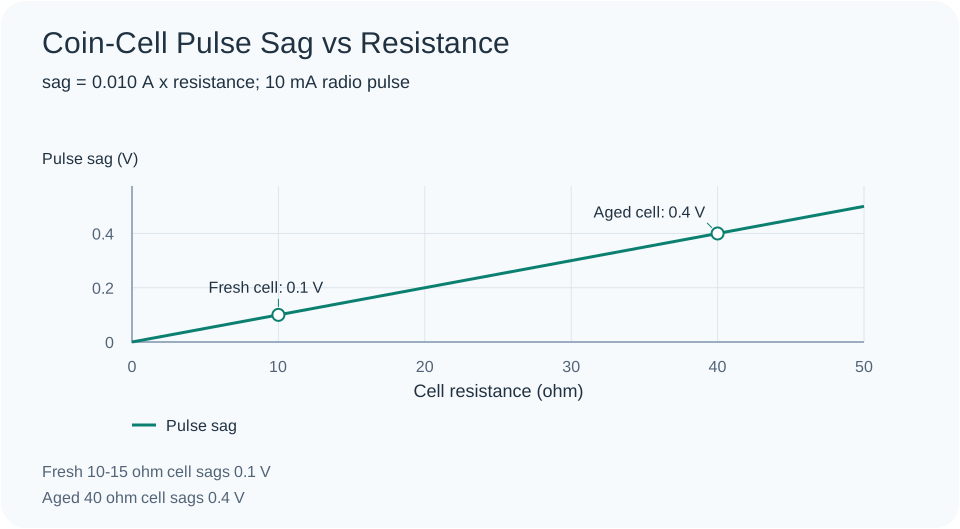
The chapter’s sharpest claim is that a CR2032’s real limit is its resistance, not its 225 mAh: a 10 mA radio pulse sags 0.1 V on a fresh 10-15 ohm cell but 0.4 V on a 40-ohm aged one, near brownout with most charge still inside. The cell easily passes a 2.6 uA energy check yet can still reset on every transmission. This audit runs both budgets a coin cell must pass, energy and pulse-sag, together.
Companion to the chapter Battery-Life Target Contracts — every number here comes from that chapter.
See the relationship before changing it
Set the input, apply the rule, then read the result with its unit.
Derive the baseline in four named moves
- 1
Name the input. The chapter baseline is 40 ohm.
- 2
Name the relationship. sag = 0.010 A x resistance
- 3
Substitute with units. 0.010 x 40 = 0.40 V
- 4
Read the result. Keep the unit beside the value. Use it only inside the technical boundary on this page.
Predict, then change cell resistance
Try Predict the direction of sag = 0.010 A x resistance. Test another cell resistance, then compare pulse sag.
Observe A cell can keep charge yet fail a radio burst because resistance, not capacity, sets sag. Reset cell resistance to 40 and compare pulse sag.
Explain The pulse current loses voltage across the cell's internal resistance, so greater resistance causes proportionally more supply sag at the fixed pulse load.
Check yourself
What should you do before trusting a moved-control result?
What does this small model leave out?
Ada: This chapter’s sharpest claim is that a CR2032’s real limit is its resistance, not its milliamp-hours. The number that proves it is a 0.4 V pulse sag on an aged cell. Let me run both budgets the chapter insists must pass together — the energy check and the pulse-sag check — using its stated values (225 mAh label, 10 mA / 5 ms radio pulse, 10-15 ohm fresh rising to 40 ohm aged).
- Energy check: a ten-year average allowance is
225 mAh / (10 x 8,760 h) = 0.00257 mA = 2.6 uA— easily met by a mostly-sleeping beacon. - Pulse sag, fresh:
V = I x R = 0.010 A x 10 ohm = 0.1 V, so a 3.0 V terminal holds 2.9 V under the burst. - Pulse sag, aged:
0.010 A x 40 ohm = 0.4 V, dropping a 2.7 V open-circuit cell to 2.3 V — near a 2.0-2.2 V brownout with most of the charge still inside. - Brownout headroom (2.6 V cell, 10 mA pulse): a 2.4 V threshold allows only
(2.6 - 2.4) / 0.010 = 20 ohm, while a 2.0 V threshold allows(2.6 - 2.0) / 0.010 = 60 ohmof internal resistance before reset. - Reservoir fix: for a 0.2 V droop,
C = I x t / dV = 0.010 A x 0.005 s / 0.2 V = 250 uF— but its leakage counts too:1 uA x 10 yr x 8,760 h/yr = 87.6 mAh, about87.6 / 225 = 39%of the cell.
The audit confirms the whole message: the cell clears the energy check by a wide margin (2.6 uA against a tiny average) yet can still reset on every transmission once resistance climbs, because 0.4 V of sag is set by Ohm’s law, not by remaining charge. Usable capacity is therefore a design variable — a lower brownout threshold triples the resistance headroom (60 ohm versus 20 ohm) and unlocks charge that a higher threshold would strand.
The coin-cell checks deliberately do not simulate electrochemical recovery, pulse-shape variation, temperature, regulator dropout, contact resistance, or aging beyond the stated internal-resistance points; energy and instantaneous sag are tested separately.
Work the audit first, then check the displayed derivation.
Every number above is taken from the chapter’s own material and re-derived step by step.