Two Budgets That Decide Cloud Versus Edge
Two Budgets That Decide Cloud Versus Edge
Ada re-derives this chapter’s own numbers step by step, at full precision
 ADA · CALCULATION AUDIT
Two Budgets That Decide Cloud Versus Edge
The chapter rests on two sizing claims: local inference shrinks a 2 Mbps uplink “more than 10,000 times” to about 20 bytes/s, and INT8 quantization takes a 5-million-weight model from 20 MB to 5 MB so it fits a 16 MB gateway. Both decide the cloud-versus-edge split. This audit carries each from the stated inputs to show they are the two budgets that decide cloud versus edge.
Companion to the chapter Edge AI Fundamentals: Why and When — every number here comes from that chapter.
See the relationship before changing it
Set the input, apply the rule, then read the result with its unit.
Derive the baseline in four named moves
- 1
Name the input. The chapter baseline is 10 s.
- 2
Name the relationship. traffic = 200 bytes / interval
- 3
Substitute with units. 200 bytes / 10 s = 20.00 bytes/s
- 4
Read the result. Keep the unit beside the value. Use it only inside the technical boundary on this page.
Predict, then change event interval
Try Predict the direction of traffic = 200 bytes / interval. Test another event interval, then compare event traffic.
Observe Longer gaps cut the event stream. They can also delay a warning. Reset event interval to 10 and compare event traffic.
Explain Each reported event has the same payload, so lengthening the gap between reports reduces the event byte rate inversely.
Check yourself
What should you do before trusting a moved-control result?
What does this small model leave out?
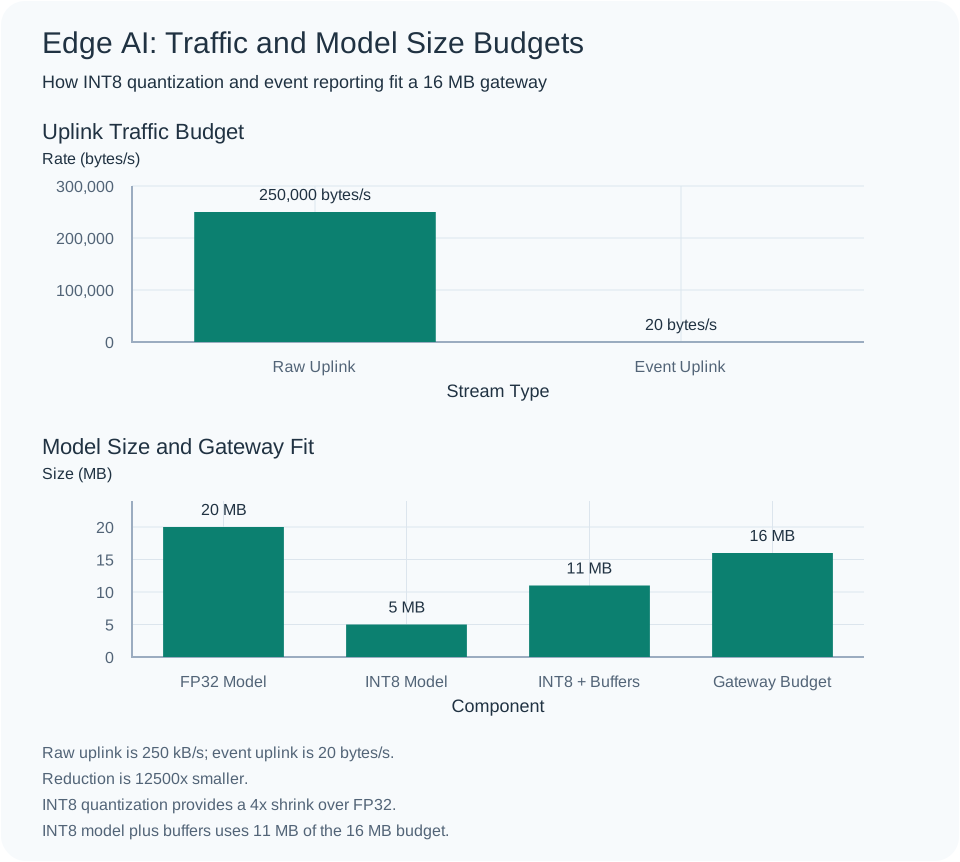
Ada: This deep dive rests on two sizing claims: local inference shrinks an uplink “more than 10,000 times,” and INT8 quantization takes a 5-million-weight model from 20 MB to 5 MB so it fits a 16 MB gateway. Both decide the cloud-versus-edge split, so let me carry each from the stated inputs.
- Raw uplink: a
2 Mbpsstream is2000000 / 8 = 250000 bytes/s = 250 kB/s. - Event uplink: a
200-byte report every10 sis200 / 10 = 20 bytes/s = 160 bits/s. - Reduction:
2000000 / 160 = 12500xsmaller – consistent with “more than 10000 times.” - FP32 model:
5,000,000 weights x 4 bytes = 20,000,000 bytes = 20 MB. - INT8 model:
5,000,000 x 1 byte = 5 MB, a20 / 5 = 4xshrink. - Gateway fit: the INT8 artifact plus a
4 MBtensor arena and2 MBinput buffer is5 + 4 + 2 = 11 MB, leaving16 - 11 = 5 MBheadroom; the20 MBFP32 version overflows the16 MBbudget before any buffers.
The audit conclusion is that quantization is what makes the whole placement legal: at FP32 the model does not fit, so “run it at the edge” is not an option; at INT8 it fits with 5 MB to spare. The design meaning is that both budgets point the same way – the model must be small enough to load and the traffic small enough to send – and a 4x weight shrink plus a 12,500x traffic shrink is precisely what turns a cloud-only inspection stream into a device that reports 20 bytes a second and survives a WAN outage.
The placement budget deliberately does not simulate operator fallback, tensor-lifetime peaks, allocator fragmentation, accuracy loss, thermal throttling, or network retries; it compares stated weight, buffer, and traffic sizes only.
Work the audit first, then check the displayed derivation.
Every number above is taken from the chapter’s own material and re-derived step by step.