The Duty-Cycle Formulas
The Duty-Cycle Formulas
Ada re-checks this chapter’s own formulas step by step, with no invented constants
 ADA · CALCULATION AUDIT
The Duty-Cycle Formulas
This chapter defines duty cycle as the active part of a repeating schedule, where the cycle splits into an active window and a sleep window that is not optional bookkeeping. Because the chapter gives no measured currents or exact cycle windows, the arithmetic here stays symbolic rather than inventing values. This audit lays out the duty-cycle formulas — cycle time, average current, and the schedule limits — so numbers can be added only from a real trace.
Companion to the chapter Duty Cycle Fundamentals — every number here comes from that chapter.
Active fraction, charge balance, and schedule limits, no invented constants
Duty-cycle math is a charge ledger. Current multiplied by time is charge, so the average-current estimate must account for the whole cycle, not just the convenient active state.
See the relationship before changing it
Set the input, apply the rule, then read the result with its unit.
The retained audit below checks several chapter fixtures. This model keeps those stated values fixed and changes only active duty, so the numeric fixture does not switch without explanation.
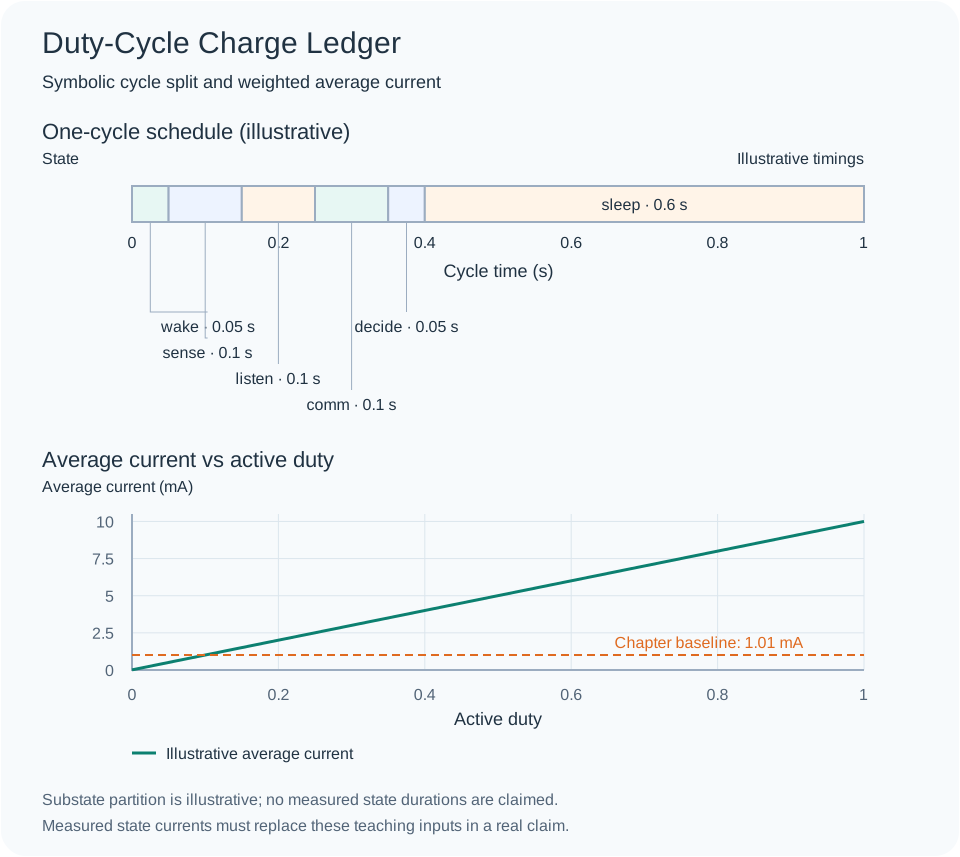
Derive the baseline in four named moves
- 1
Name the input. The chapter baseline is 10 %.
- 2
Name the relationship. average = 10 mA x duty + 0.01 mA x (1 - duty)
- 3
Substitute with units. 10 x 0.10 + 0.01 x 0.90 = 1.009 mA
- 4
Read the result. Keep the unit beside the value. Use it only inside the technical boundary on this page.
Predict, then change active duty
Try Predict the direction of average = 10 mA x duty + 0.01 mA x (1 - duty). Test another active duty, then compare illustrative average current.
Observe More active time raises average current; measured state currents must replace these teaching inputs in a real claim. Reset active duty to 10 and compare illustrative average current.
Explain Increasing active duty replaces low-current sleep time with high-current work, so average current rises linearly with the active fraction.
Check yourself
What should you do before trusting a moved-control result?
What does this small model leave out?
1. Split the cycle before using a percentage
The chapter defines duty cycle as the active part of a repeating schedule. That means the sleep window is not optional bookkeeping.
D = Tactive / Tcycle
Tsleep = Tcycle - Tactive
2. Derive the average-current shortcut from charge balance
Substitute the active and sleep fractions into the weighted average. The units stay consistent because each current is weighted by a fraction of the same full cycle.
Iavg = (IactiveTactive + IsleepTsleep) / Tcycle
3. Expand active time when the node has real states
If wake, sense, listen, communicate, and decide states all occur, a review should not hide them inside one active-current term.
| Review term | Formula shown | Why it matters |
| Active window | Tactive = twake + tsense + tlisten + tcomm + tdecide | Every active state named in the chapter gets a time slot. |
| Cycle charge | Qcycle = Iwaketwake + Isensetsense + Ilistentlisten + Icommtcomm + Idecidetdecide + IsleepTsleep | Current times time is charge; missing states understate the cycle cost. |
| Average current | Iavg = Qcycle / Tcycle | The denominator is the full repeating cycle, including sleep. |
| Schedule limit | Detection wait and communication wait are bounded by the wake schedule, not by battery arithmetic alone. | A lower average current can still fail the latency or rendezvous requirement. |
The chapter does not provide measured currents, exact cycle windows, or exact latency limits, so this panel stays symbolic. Add numeric values only from a lab trace, datasheet-backed exercise, or the worked-examples chapter where the arithmetic record is supplied.
These symbolic equations deliberately do not simulate wake-transition charge, battery self-discharge, voltage-converter loss, temperature, or missed rendezvous windows; those terms require measured currents and timings that the chapter does not supply.
Work the audit first, then check the displayed derivation.
Every formula above is taken from the chapter’s own definitions and re-derived step by step.