Peripheral Latency Governs Both Power and Timeout
Peripheral Latency Governs Both Power and Timeout
Ada re-derives this chapter’s own numbers step by step, at full precision
 ADA · CALCULATION AUDIT
Peripheral Latency Governs Both Power and Timeout
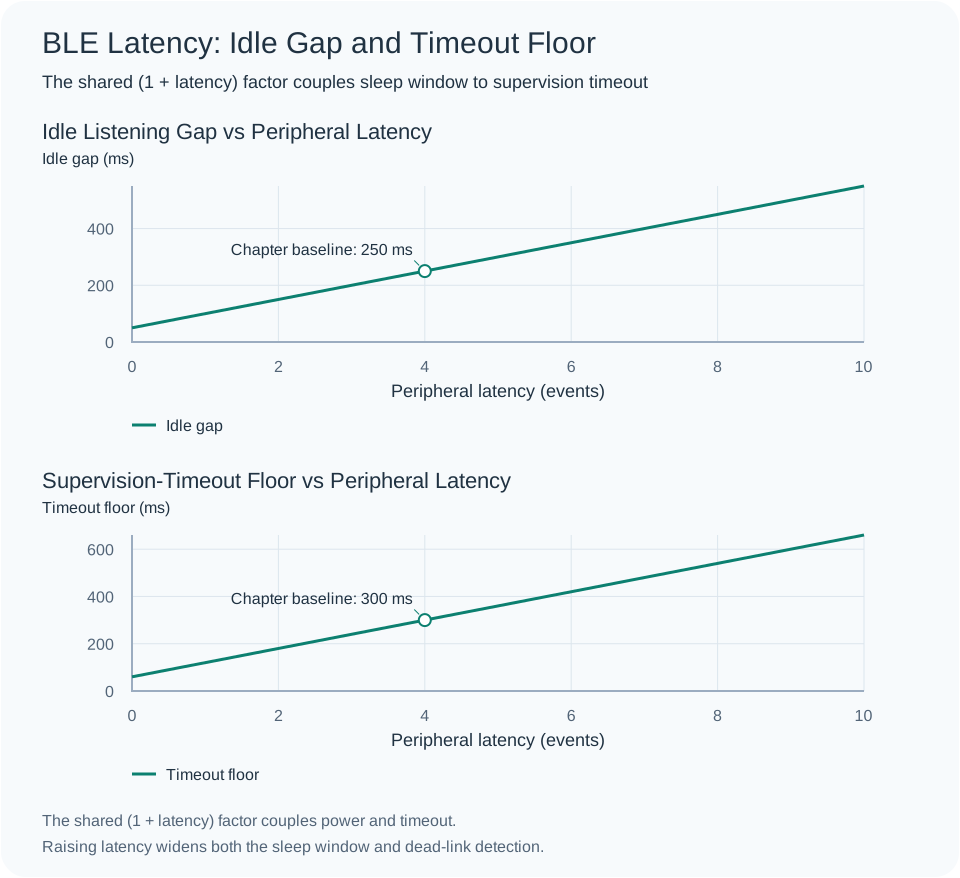
A BLE peripheral on a 30 ms connection interval with peripheral latency 4 has a supervision-timeout floor of (1 + 4) × 30 × 2 = 300 ms, so a 2 s timeout is legal but a 200 ms one is not, while the same latency stretches its idle listening gap to 250 ms. Push latency to 9 on a 1 s interval and the gap and the timeout floor jump to 10 s and 20 s. This audit re-derives each and asks whether the shared (1 + latency) factor means a power tweak that lets the radio sleep longer silently widens how long a dead link goes undetected.
Companion to the chapter BLE Field Debugging and Internals — every number here comes from that chapter.
A BLE peripheral on a 30 ms connection interval with peripheral latency 4 has a supervision-timeout floor of (1 + 4) × 30 × 2 = 300 ms , so a 2 s timeout is legal but a 200 ms one is not, while the same latency stretches its idle listening gap to 250 ms . Calculate this case.
This audit re-derives each and asks whether the shared (1 + latency) factor means a power tweak that lets the radio sleep longer silently widens how long a dead link goes undetected. Check shows this.
The design meaning is the coupling: raising latency to let the radio sleep longer multiplies the idle gap and the minimum legal supervision timeout by the identical (1 + latency) factor, so a power tweak that widens the sleep window silently widens how long a dead link goes undetected -- which is exactly why a high-latency sensor is forced into a long supervision timeout. Check confirms it.
See the relationship before changing it
Change the input, apply the rule once, then read the result with its unit.
Derive the baseline in four named moves
- 1
Name the input. The chapter baseline is 4 events.
- 2
Name the relationship. gap = (1 + latency) x 50 ms
- 3
Substitute with units. (1 + 4) x 50 ms = 250 ms
- 4
Read the result. Keep the unit beside the value, then use the result only inside the technical boundary below.
Predict, then change peripheral latency
Try Predict how idle gap responds when peripheral latency moves. Calculate peripheral latency; compare idle gap with that prediction.
Observe Return to 4 events. Recheck idle gap with peripheral latency at its chapter value.
Explain Latency lets the peripheral skip events, so the idle gap grows.
Check yourself
What should you do before trusting a moved-slider result?
What does this small model leave out?
Technical boundaries
The idle-gap calculation keeps the connection interval at 50 ms and changes only how many events the peripheral may skip. It leaves out radio collisions, retries, clock drift, operating-system delays, firmware stalls, and falling battery voltage.
Ada: The Under-the-Hood section uses the same (1 + peripheral_latency) multiplier twice – once for the idle listening gap and once for the supervision-timeout floor. Let me confirm both, because that shared factor is the reason you cannot tune one without moving the other.
Idle listening gap, (1 + latency) x interval:
50 msinterval, latency4:(1 + 4) x 50 = 250 ms.1 sinterval, latency9:(1 + 9) x 1,000 = 10,000 ms = 10 s.
Supervision-timeout floor, (1 + latency) x interval x 2:
30 msinterval, latency4:(1 + 4) x 30 x 2 = 300 ms, so a2 stimeout is valid while a200 mstimeout is below the floor and illegal.1 sinterval, latency9:(1 + 9) x 1,000 x 2 = 20,000 ms = 20 s, so a10 stimeout – half the floor – is invalid for that latency.
The design meaning is the coupling: raising latency to let the radio sleep longer multiplies the idle gap and the minimum legal supervision timeout by the identical (1 + latency) factor, so a power tweak that widens the sleep window silently widens how long a dead link goes undetected – which is exactly why a high-latency sensor is forced into a long supervision timeout.
Every number above is taken from the chapter’s own material and re-derived step by step.