Bias, RMSE, and the Variance Split
Bias, RMSE, and the Variance Split
Ada re-derives this chapter’s own numbers step by step, at full precision
 ADA · CALCULATION AUDIT
Bias, RMSE, and the Variance Split
A sensor lab logs five paired errors against a reference — +0.4, +0.6, +0.5, +0.3, +0.7 — for an RMSE of 0.52, and claims almost all of it is a 0.50 offset that a single calibration could cut to 0.14. That rests on the identity MSE = bias² + variance. This audit carries every digit through the bias, the MSE, and the variance split, and asks whether the numbers really justify removing 0.50 of the 0.52 with one zero-offset correction.
Companion to the chapter Lab: Sensor Application Workflow — every number here comes from that chapter.
A sensor lab logs five paired errors against a reference — +0.4, +0.6, +0.5, +0.3, +0.7 — for an RMSE of 0.52 , and claims almost all of it is a 0.50 offset that a single calibration could cut to 0.14 . Calculate this case.
This audit carries every digit through the bias, the MSE, and the variance split, and asks whether the numbers really justify removing 0.50 of the 0.52 with one zero-offset correction. Check shows this.
The audit shows the number that matters is the split, not the headline: because the variance (0.02) is tiny beside the squared bias (0.25), a single zero-offset calibration is justified in removing 0.50 of the 0.52 -- and the honest lab reports "0.14 residual after offset," a claim a bare "accurate enough" cannot make. Check confirms it.
See the relationship before changing it
Change the input, apply the rule once, then read the result with its unit.
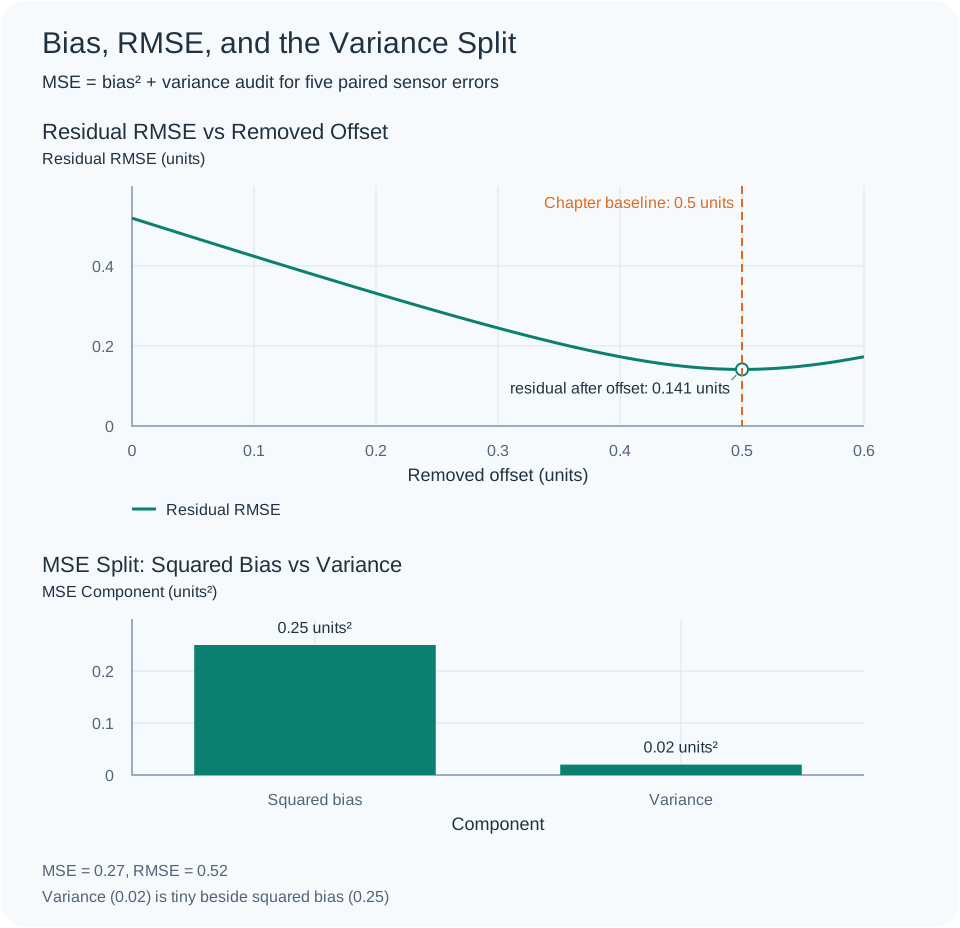
Derive the baseline in four named moves
- 1
Name the input. The chapter baseline is 0.5 units.
- 2
Name the relationship. RMSE = sqrt((0.50 - removed offset)^2 + 0.02)
- 3
Substitute with units. sqrt((0.50 - 0.50)^2 + 0.02) = 0.141 units
- 4
Read the result. Keep the unit beside the value, then use the result only inside the technical boundary below.
Predict, then change offset removed
Try Predict how residual rmse responds when offset removed moves. Calculate offset removed; compare residual rmse with that prediction.
Observe Return to 0.5 units. Recheck residual rmse with offset removed at its chapter value.
Explain Removing bias cannot remove the separate random variance.
Check yourself
What should you do before trusting a moved-slider result?
What does this small model leave out?
Technical boundaries
Removing an offset here keeps the supplied error pattern’s random variance unchanged. The calculation does not cover errors linked over time, calibration drift, errors that do not follow a bell-shaped distribution, missing samples, or changes in the reference measurements.
Ada: This chapter’s worked comparison makes a strong claim – that an RMSE of 0.52 is almost all a 0.50 offset, so calibration would cut the error to 0.14. That rests on the identity MSE = bias^2 + variance, so let me carry every digit and check it. The five paired errors (measured minus reference) are +0.4, +0.6, +0.5, +0.3, +0.7.
- Bias:
(0.4 + 0.6 + 0.5 + 0.3 + 0.7) / 5 = 2.5 / 5 = 0.50. - Squared errors:
0.16, 0.36, 0.25, 0.09, 0.49, summing to1.35. - MSE:
1.35 / 5 = 0.27, so RMSE= sqrt(0.27) = 0.519615..., which rounds to0.52. - Variance of the errors:
MSE - bias^2 = 0.27 - 0.25 = 0.02. - Residual after removing the offset:
sqrt(0.02) = 0.141421..., rounding to0.14.
The identity closes exactly: bias^2 + variance = 0.25 + 0.02 = 0.27 = MSE, so the split loses nothing.
The audit shows the number that matters is the split, not the headline: because the variance (0.02) is tiny beside the squared bias (0.25), a single zero-offset calibration is justified in removing 0.50 of the 0.52 – and the honest lab reports “0.14 residual after offset,” a claim a bare “accurate enough” cannot make.
Every number above is taken from the chapter’s own material and re-derived step by step.