A 24-Point Drop Is Not a 24% Saving
A 24-Point Drop Is Not a 24% Saving
Ada re-runs the frost-protection saving and keeps percentage points and proportional reduction apart
 ADA · CALCULATION AUDIT
A 24-Point Drop Is Not a 24% Saving
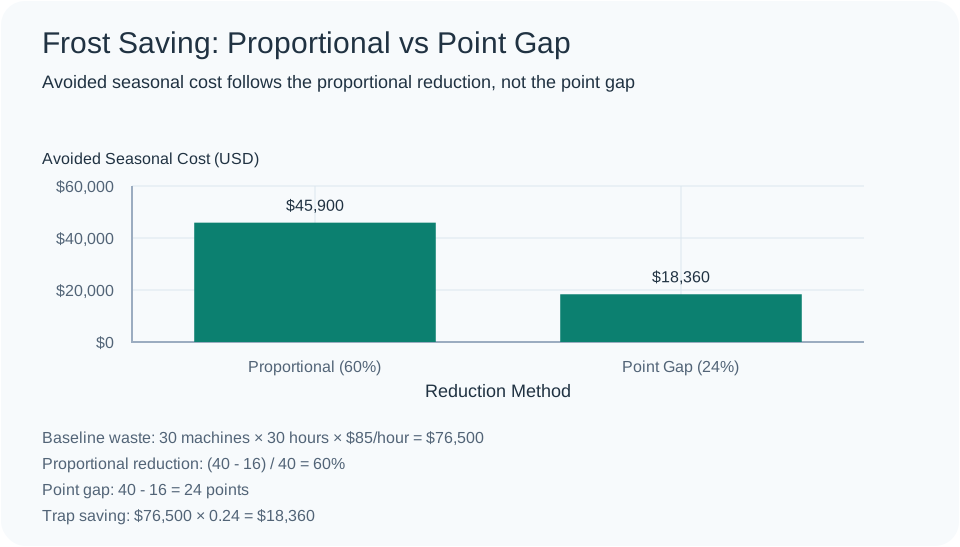
A citrus grower’s frost-protection system cut false wind-machine activations from 40% to 16% of frost events, and with 30 machines burning 30 needless hours a season at $85 per hour the baseline waste is $76,500. The tempting read is to subtract the rates — 40 minus 16 — and bank a 24% saving. This audit re-runs the figure and asks whether the value tracks the 24-point gap or the 60% proportional reduction, a difference of $27,540.
Companion to the chapter Smart Agriculture and Livestock — every number here comes from that chapter.
The frost example says false wind-machine activations fell “from 40% to 16% of frost events,” then asks for the fuel saving. The trap is to subtract — 40 minus 16 is 24 points, so surely you save 24% of the cost. Let me keep the percentage-point drop and the proportional saving apart, because only one of them scales the money.
See the relationship before changing it
Set the input, apply the rule, then read the result with its unit.
The retained audit below checks several chapter fixtures. This model keeps those stated values fixed and changes only false-activation reduction, so the numeric fixture does not switch without explanation.
Derive the baseline in four named moves
- 1
Name the input. The chapter baseline is 60 %.
- 2
Name the relationship. avoided cost = 76,500 USD x reduction / 100
- 3
Substitute with units. 76,500 USD x 60 / 100 = 45,900 USD
- 4
Read the result. Keep the unit beside the value. Use it only inside the technical boundary on this page.
Predict, then change false-activation reduction
Try Predict the direction of avoided cost = 76,500 USD x reduction / 100. Test another false-activation reduction, then compare avoided seasonal cost.
Observe The proportional reduction, not the percentage-point gap alone, sets the avoided seasonal cost. Reset false-activation reduction to 60 and compare avoided seasonal cost.
Explain Preventing unnecessary frost-machine operation avoids its running cost, so the seasonal saving grows directly with the fraction of false activations eliminated.
Check yourself
What should you do before trusting a moved-control result?
What does this small model leave out?
Press Calculate with 30 machines, 30 needless hours, $85 per hour, and false activations falling from 40% to 16%.
Check shows a 24-point change but a 60% proportional reduction, applying $45,900 of savings to the $76,500 baseline.
The monetary saving scales by (40 - 16) / 40 = 60%, because the 24-point gap is measured relative to the original false-activation rate.
Technical boundaries
For the frost case, excluded from this fixed arithmetic are weather forecast error, crop microclimates, wind-machine fuel curves, maintenance cost, or the number and severity of future frost events.
The baseline waste
30 wind machines running 30 unnecessary hours a season at $85 per hour:
The reduction — two different numbers
From 40% to 16% is a drop of 24 percentage points:
But as a fraction of the original false-alarm rate it is a 60% proportional reduction:
The saving follows the proportion, not the point gap:
What the trap would have paid
Subtracting the points instead would pay out:
— barely 40% of the real figure, and short by:
Design meaning: when a rate improves from one percentage to another, the value it unlocks tracks the relative reduction between them, not the difference in points — conflating the two is how an IoT business case quietly mis-states its own payback.
Every number above is taken from the chapter’s own frost-protection example and re-derived step by step.