Backoff Timing and Retry Budget
Backoff Timing and Retry Budget
Ada re-derives this chapter’s own numbers step by step, at full precision
 ADA · CALCULATION AUDIT
Backoff Timing and Retry Budget
On the default 2.4 GHz CSMA/CA ladder a node’s first attempt uses BE = 3 and waits up to 2.24 ms before a single CCA; each busy result widens the window until the default ceiling caps one wait at 9.92 ms. With macMaxCSMABackoffs = 4, a worst-case channel-access failure stacks four busy waits into 26.88 ms, while macMaxFrameRetries = 3 permits 4 transmit attempts when ACKs go missing. This audit rebuilds every window from the 20-symbol backoff unit and asks whether those figures promise delivery, or only bound the timing-and-energy budget until measured CCA counts and ACK failures are captured.
Companion to the chapter 802.15.4 MAC Operation — every number here comes from that chapter.
See the relationship before changing it
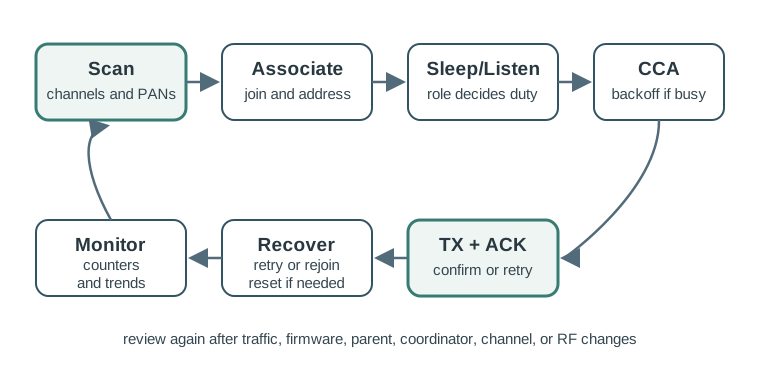
The chapter figure below shows: IEEE 802.15.4 operation state flow from scan and associate through sleep or listen, CCA and backoff, transmit and ACK, retry, rejoin, and monitoring.
The retained audit below checks several chapter fixtures. This model keeps those stated values fixed and changes only backoff exponent, so the numeric fixture does not switch without explanation.
Derive the baseline in four named moves
- 1
Name the input. The chapter baseline is 3 BE.
- 2
Name the relationship. maximum wait = (2^BE - 1) x 0.32 ms
- 3
Substitute with units. (2^3 - 1) x 0.32 ms = 2.24 ms
- 4
Read the result. Keep the unit beside the value. Use it only inside the technical boundary on this page.
Predict, then change backoff exponent
Try Predict the direction of maximum wait = (2^BE - 1) x 0.32 ms. Test another backoff exponent, then compare maximum first wait.
Observe A larger exponent widens the random wait and spends more latency before CCA. Reset backoff exponent to 3 and compare maximum first wait.
Explain Increasing the backoff exponent doubles the number of possible waiting slots, so the longest random wait grows exponentially before channel sensing.
Check yourself
What should you do before trusting a moved-control result?
What does this small model leave out?
Ada: 802.15.4 operation claims are timing physics plus a failure ledger. The chapter already gives enough numbers to check the default CSMA/CA wait windows without inventing traffic rates, current draw, or packet sizes.
- The backoff unit is
20symbols, and each 2.4 GHz symbol is16 us, so20 x 16 us = 320 us. - The first attempt uses
BE = 3, giving2^3 = 8choices:0through7backoff periods. - The first-attempt maximum wait is
7 x 320 us = 2240 us = 2.24 ms; the mean random wait is(0 + 7) / 2 x 320 us = 1120 us = 1.12 ms. - After one busy CCA,
BE = 4, so the maximum wait is(2^4 - 1) x 320 us = 15 x 320 us = 4800 us = 4.8 ms. - Once
BEreaches the default ceiling5, the maximum wait is(2^5 - 1) x 320 us = 31 x 320 us = 9920 us = 9.92 ms. - With
macMaxCSMABackoffs = 4, a worst-case channel-access failure can draw four busy-CCA waits atBE = 3, 4, 5, 5:(7 + 15 + 31 + 31) x 320 us = 84 x 320 us = 26880 us = 26.88 ms, before counting CCA time and firmware overhead. macMaxFrameRetries = 3is a different budget: one original transmission plus3retransmissions gives1 + 3 = 4possible transmit attempts when ACKs are missing.
The audit conclusion is bounded: the default 2.4 GHz backoff ladder can add tens of milliseconds during repeated busy-channel decisions, and ACK loss can spend up to four transmit attempts. Those numbers support the timing-and-energy review question, not a delivery guarantee, until measured CCA counts, ACK failures, queue delays, and current traces are captured on the real device.
Every number above is taken from the chapter’s own material and re-derived step by step.
Audit result
The maximum busy-CCA waits at BE 3, 4, 5, 5 sum to 26.88 ms; ACK failure has a separate four-attempt budget.