The Installed-Link Margin
The Installed-Link Margin
Ada re-derives this chapter’s own numbers step by step, at full precision
 ADA · CALCULATION AUDIT
The Installed-Link Margin
A deployed 10 m, 2.44 GHz link starts with 0 dBm transmit power and a −95 dBm receiver, giving a comfortable 35 dB margin in line of sight — but routing it through three drywall partitions and one brick wall adds 24 dB of loss and cuts the margin to just 11 dB. A stronger parent recovers 7 dB, and a node reporting every five minutes turns three retries into 36 extra attempts an hour. This audit rebuilds the received-power ledger and asks whether that remaining headroom can survive walls, doors, and carts, or whether battery life stays unproven until those attempts are tied to measured radio-on time.
Companion to the chapter 802.15.4 Deployment Practices — every number here comes from that chapter.
One path-loss ledger, one retry warning, ~4 minutes
The physics is not hidden in the join result. Ada keeps the deployed link as a received-power ledger, then asks whether the remaining dB headroom can survive walls, doors, carts, and retries.
See the relationship before changing it
The chapter figure below shows: A link budget is a waterfall: add gains, subtract losses, and confirm the received power stays above receiver sensitivity after a reserved fade margin.
The retained audit below checks several chapter fixtures. This model keeps those stated values fixed and changes only wall loss, so the numeric fixture does not switch without explanation.
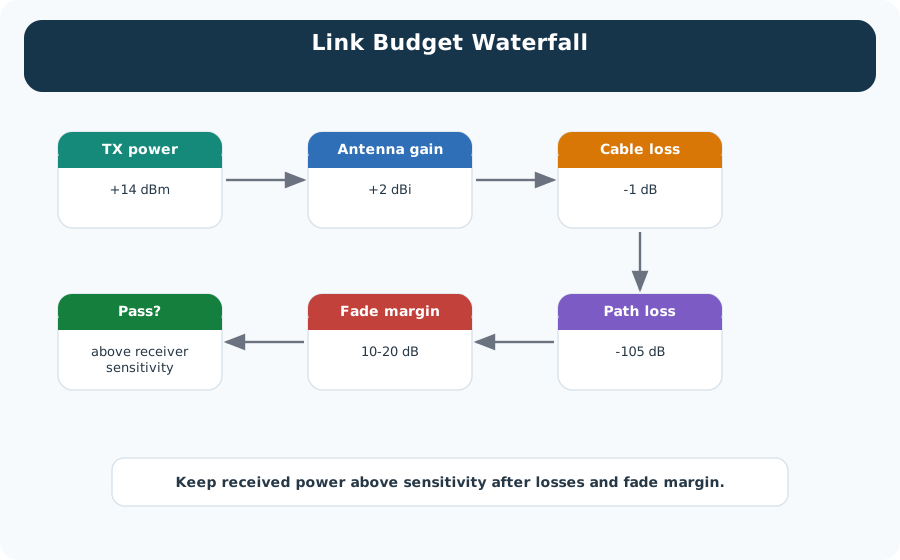
Derive the baseline in four named moves
- 1
Name the input. The chapter baseline is 24 dB.
- 2
Name the relationship. margin = 35 dB line-of-sight margin - wall loss
- 3
Substitute with units. 35 dB - 24 dB = 11.0 dB
- 4
Read the result. Keep the unit beside the value. Use it only inside the technical boundary on this page.
Predict, then change wall loss
Try Predict the direction of margin = 35 dB line-of-sight margin - wall loss. Test another wall loss, then compare installed link margin.
Observe Each measured wall-loss decibel removes one decibel of installed margin. Reset wall loss to 24 and compare installed link margin.
Explain Walls attenuate the arriving signal, so every additional decibel of wall loss removes one decibel of margin above receiver sensitivity.
Check yourself
What should you do before trusting a moved-control result?
What does this small model leave out?
Rebuild the received-power ledger
The chapter’s 10 m, 2.44 GHz example starts with 0 dBm transmit power, near-0 dBi antennas, about 60 dB path loss, and −95 dBm receiver sensitivity.
line_of_sight_margin = -60 - (-95) = 35 dB
wall_loss = 3 x 4 dB + 12 dB = 24 dB
through_walls_rx = -60 - 24 = -84 dBm
through_walls_margin = -84 - (-95) = 11 dB
Compare parents before accepting
The parent comparison uses the same sensitivity, so the stronger parent can be checked without inventing a new radio model.
parent_b_margin = -77 - (-95) = 18 dB
extra_headroom = 18 - 11 = 7 dB
Parent B still needs LQI and retry evidence, but the link-budget math shows why it is the better first commissioning candidate.
Turn retries into a power gate
A node that reports every five minutes sends 12 reports per hour. Three extra retries per report become a measurable radio-on burden.
extra_retry_attempts_per_hour = 12 x 3 = 36
The chapter does not state current or airtime for each retry, so Ada stops at the count. Battery life can be claimed only after those 36 attempts/hour are tied to measured radio-on time and current.
Every number above is taken from the chapter’s own installed-link example and re-derived step by step.
Audit result
After 24 dB of partition loss, 11 dB remains. The 36 extra attempts per hour cannot be converted to battery life without measured energy per attempt.