← Back to the chapter · Previous detail · Next detail →
Technical detail · Industrial Ethernet Family Design
EtherNet/IP and CIP boundary
Use the CIP object and assembly map to check which device data crosses the gateway. Record the service purpose, source, and command authority, then test the mapped values at the network boundary. The figure places those jobs alongside the control path.
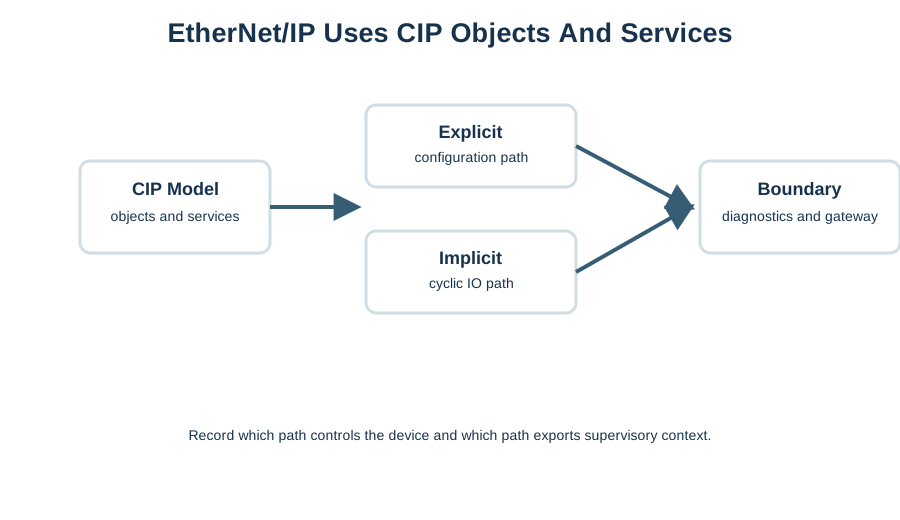
In Figure 7, start with the CIP model. Objects hold device data and offer services; assemblies group data for an exchange. Explicit messages can access services and attributes, while implicit connections can carry cyclic I/O data. At the gateway, map each selected value to its source, unit, and quality. Record which side may issue commands. This makes the supervisory view useful without giving it unplanned control of the machine. For EtherNet/IP, document CIP objects, services, assemblies, explicit or implicit messaging purpose, multicast handling, diagnostics, and gateway mappings into OPC UA, MQTT, historians, or application APIs.