← Back to the chapter · Previous detail
Technical detail · NB-IoT Power Saving (PSM/eDRX)
Fault paths and the approval loop
Failed attachment, refused timer grants, missed acknowledgements, cloud outages, SIM or profile faults and weak coverage can keep the meter active longer than the clean trace. The approved model needs a retry limit, backoff behavior, event log and support action for each case. Those records let a reviewer distinguish an expected delayed response from a defect.
Figure 2 separates the six-hour meter service target from its network timer grant and worked energy budget.
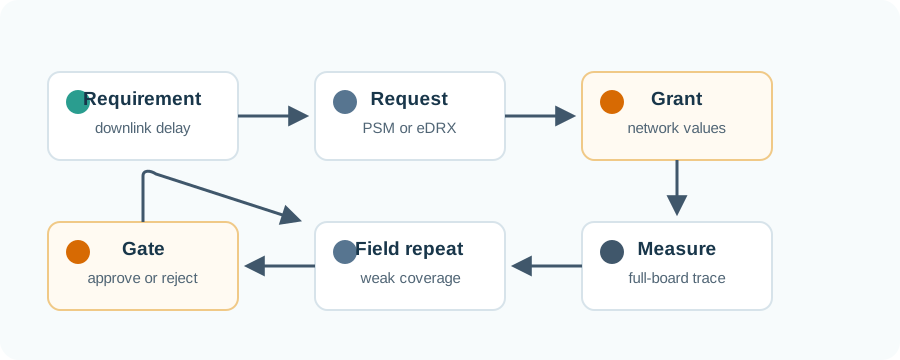
Read the six-hour water-meter example from the service target to the network grant and full-cycle model. The target is one report every 6 h with a 120 s downlink window; the numeric T3324 request is not stated. The grant boxes must be filled after attach. The model then assigns 20 s to active transfer, 100 s to reachable idle and 21,480 s to PSM. These phases yield about 1.01 mAh per cycle, or 4.04 mAh per day. The bottom gate still requires granted timers, a whole-board current trace, server receipt and weak-coverage recovery evidence.