4 Service Boundaries and Decomposition
More
Depth: Practitioner
Progress saves as you read. Mark sections complete as you go; your progress appears in the sidebar.
4.1 Begin With One Service Promise
This section: Begin With One Service Promise — Telemetry means records sent from a system so its state can be watched.
Telemetry means records sent from a system so its state can be watched. Picture a fleet app that accepts device readings and sends a high-heat alert. The first choice is not how many services to draw. It is who owns the promise from accepted reading to alert, including data, failure, and repair.
Write one clear boundary. Name its input, output, owner, store, and safe failure. Keep its data behind that owner. Then test a caller that is slow, a store that is down, a repeated event, and a partial update. Record what retries, what waits, and what a user sees. Compare this with one well-cut part in a single app before you split it across the network.
A separate service can isolate change and scale, but it adds calls, state, release work, and on-call duty. A shared store may look easy, but it ties teams and failures together. Many small boxes do not prove good design. For a service split, review capability, ownership, messages, and extraction readiness; check shared state, long call chains, repair, and run cost before accepting the result.
Try the boundary with a paper event. A device reports high heat. The intake part checks the message. The rule part decides to warn. The notice part contacts a person. Write who owns each record. Write what happens if the next part is down. Keep the first accepted fact safe. Let later work retry without making the same alert many times.
Now change one rule. If three teams and four stores must change at once, the cut may be weak. If one team can change it with a clear message and no shared table, the cut may be sound. This is a clue, not final proof.
Start with the fewest moving parts that protect the needed boundary. Split only when ownership, scale, release, or failure gives a clear gain. Keep a way back. A good plan can explain why a new part exists and who wakes up when it breaks.
4.2 Start With the Service That Owns a Promise
This section: Start With the Service That Owns a Promise — A service boundary earns its place when one capability has a promise it can own.
A service boundary earns its place when one capability has a promise it can own. Telemetry ingest promises to accept readings, command dispatch promises to track actions, and alerting promises to explain when thresholds became incidents.
Follow one device service from a vague boundary to an owned promise.
-

A device service needs one clear promise it can own.
-
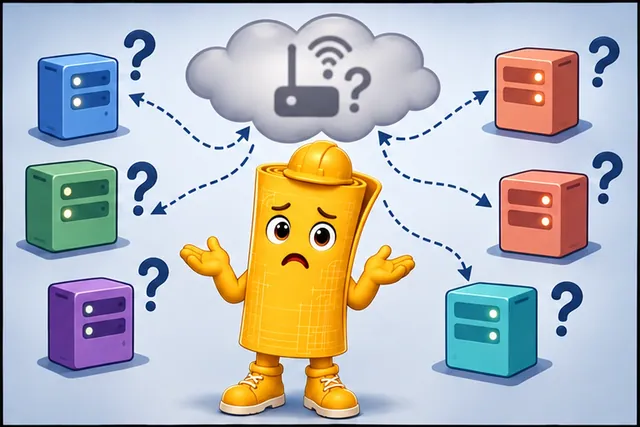
A vague promise spreads confusion across more services.
-
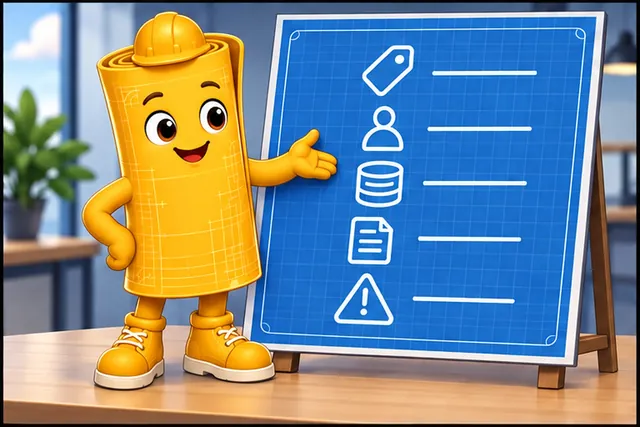
Name the promise, owner, data, contract, and failure behavior.
-
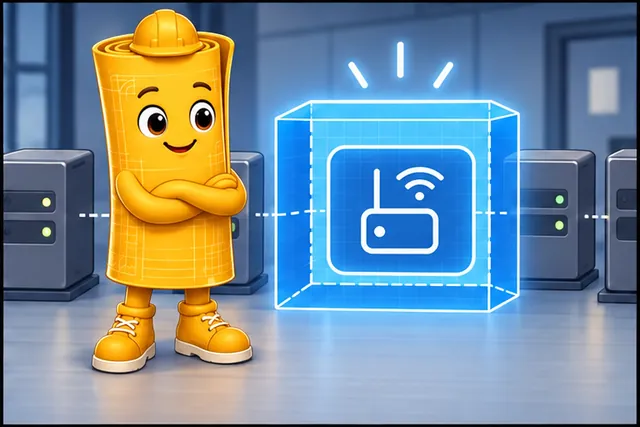
Keep the boundary only when that service can own the full promise.
Start by naming the promise, owner, data, contract, and failure behavior. If those are vague, more services only spread the confusion across more deployables.

Blueprint Bina
“An architecture is a set of decisions you can point to — if you can’t name the boundary, you haven’t drawn it yet.”
Through this chapter, Bina keeps one sheet per service line: the capability boundary, the extraction decision, and the contract you can point to.
4.3 Boundaries Come Before Services
This section: Boundaries Come Before Services — The first design question is not whether to use microservices.
The first design question is not whether to use microservices. It is where the system has real boundaries: device lifecycle, telemetry ingest, command dispatch, alert rules, user accounts, billing, support, or integration with external systems. A service boundary is useful only when it protects a capability that has its own vocabulary, data, owner, runtime needs, and failure behavior. If the team cannot name those things, a new service mostly adds network calls and coordination.
Consider a cold-room monitoring product. The device registry owns device identity, model, provisioning state, certificate status, site assignment, and ownership transfer. Telemetry ingestion owns MQTT or HTTPS message intake, payload validation, timestamp normalization, duplicate handling, queueing, and publication of telemetry.received events. A command service owns requested actions, dispatch state, acknowledgement timeouts, retry budgets, and audit history. Alerting owns threshold rules, suppression windows, escalation policy, and notification outcomes. These are capability boundaries; “API layer” and “database layer” are not.
The simplest deployable shape may still be one application. A modular monolith can keep registry, telemetry, commands, alerts, and dashboards in separate packages while the product team learns how often each capability changes. SOA becomes valuable when the platform must connect to existing ERP, MES, SCADA, billing, support, or warehouse systems through stable contracts. Microservices become valuable when one capability has a distinct owner, release cadence, scaling profile, data model, or failure-isolation need that is strong enough to justify operating another production service.
The mistake is treating service count as architecture maturity. A fleet with 200 devices and one team may be safer with a modular monolith, PostgreSQL tables hidden behind clean modules, and one deploy pipeline. A fleet with millions of readings per hour, a dedicated telemetry team, Kafka or MQTT broker lag to watch, TimescaleDB or ClickHouse retention policy, and separate alerting incidents may need telemetry ingestion extracted. The boundary decision follows evidence, not fashion.
- Modular monolith: best when the domain is still being learned.
- SOA: best when stable contracts connect existing enterprise capabilities.
- Microservices: best when ownership, scaling, release, or failure isolation evidence justifies the operational cost.
Bina’s Boundary Sheet
- Boundary: capability lines in the cold-room product — device registry, telemetry ingestion, commands, alerting.
- Decision: split by capability, not by layer — “API layer” and “database layer” are ruled out as boundaries.
- Point to it: each capability’s owned surface — registry holds identity and provisioning state; ingestion publishes
telemetry.received.
4.4 Test a Service Boundary
This section: Test a Service Boundary — A service boundary is ready only when the team can describe ownership, data, contracts, runtime behavior, and failure handling.
A service boundary is ready only when the team can describe ownership, data, contracts, runtime behavior, and failure handling. For an IoT alerting capability, that means knowing who owns alert rules, which telemetry it consumes, what event contract it accepts, how notifications are retried, how duplicate events are ignored, and how operators diagnose failures when SMS, email, push, or webhook delivery slows down.
Start with a boundary review before drawing Kubernetes boxes. Write one capability statement: “alerting evaluates customer rules against normalized telemetry and records notification outcomes.” Then list the inputs and outputs. Inputs might be telemetry.received, device.status.changed, and customer rule changes from an admin API. Outputs might be alert.triggered, alert.suppressed, ticket webhooks, and a query API for alert history. If alerting also edits device identity, writes raw telemetry rows, owns billing entitlements, and renders the dashboard, the boundary is too wide.
Next test whether extraction buys something measurable. If alert evaluation consumes bursty telemetry while the registry is stable, an independent worker pool or service may reduce incident scope. If alert rules change weekly while provisioning code changes rarely, a separate release path may reduce coordination. If notification outages should not block telemetry ingestion, an event boundary and retry queue are useful. If none of those pressures exist, keep alerting as an internal module and strengthen contracts inside the monolith.
- Ownership: One team can change and support the capability without coordinating every release.
- Data: The service owns its writes and exposes data through contracts, not a shared table free-for-all.
- Operations: Logs, metrics, traces, dashboards, and runbooks exist before the split becomes production-critical.
- Failure mode: A timeout, replay, duplicate event, or downstream outage has a designed response.
For a real review, capture the current coupling. Count how many repositories must change for one alert-rule feature. Check whether dashboards read alert tables directly or use an API. Confirm whether device firmware, gateways, or mobile apps depend on a contract version that cannot be changed quickly. Review metrics such as queue depth, event lag, p95 evaluation latency, notification retry count, dead-letter volume, and incident ownership. These signals tell the team whether it has a service candidate, a module-cleanup task, or a missing operations practice.
4.5 Distributed Costs You Must Pay
This section: Distributed Costs You Must Pay — Extracting a service converts local code problems into distributed-systems problems.
Extracting a service converts local code problems into distributed-systems problems. Calls can be slow, duplicated, reordered, partially applied, or unavailable. Data can become eventually consistent. Contract changes can break old devices, field gateways, mobile apps, dashboards, or partner integrations that stay online for years. The service boundary therefore needs contracts, versioning, failure rules, and observability before it becomes production-critical. Inspect Figure 4.4 to see which collaborations can be delayed without stopping telemetry acceptance and which data remains under one service’s control.
flowchart LR
  Device[Device or gateway] -->|MQTT/HTTPS telemetry| Ingest[Telemetry ingestion]
  Device -->|command ack/event| Command[Command service]
  Ingest -->|telemetry.received event| Rules[Rule evaluation]
  Rules -->|alert.triggered event| Notify[Notification service]
  Registry[Device registry] -->|device identity API| Ingest
  Registry -->|ownership/site API| Command
  Ingest -->|owned write model| TSDB[(Time-series store)]
Notify -->|delivery outcome API| Support[Support and operations]
Read Figure 4.4 from Device or gateway into Telemetry ingestion, then separate the owned write to Time-series store from the telemetry.received event sent to Rule evaluation. The event path continues to Notification, while Device registry supplies identity and ownership through named APIs rather than shared tables. This arrangement explains the distributed cost in operational terms: ingestion can keep accepting data when notification slows, but every API and event edge now needs versioning, retry, idempotency, and observability.
- Idempotency keeps repeated commands, alerts, or webhook deliveries from causing duplicate side effects.
- Versioned contracts let device firmware, gateways, and apps move at different speeds.
- Event design separates facts that happened from commands that ask another service to act.
- Backpressure protects ingest and alerting when telemetry spikes or downstream services slow down.
Bina’s Boundary Sheet
- Boundary: telemetry ingest’s downstream edge — events out, no waiting on rules, notifications, or dashboards.
- Decision: acknowledge readings before fan-out, ruling out a downstream slowdown becoming a data-loss incident.
- Point to it: the flow diagram —
telemetry.receivedevents, an owned write model, contracts that are versioned, observed, tested.
Data ownership is the part teams most often underbuild. A telemetry service can publish events and expose read APIs, but other services should not depend on its private table names, partitioning scheme, retention jobs, or compression choices. A command service can emit command-state events, but it should not let alerting update command rows to force a workflow forward. A registry can expose device identity, certificate state, and ownership, but it should protect certificate rotation and provisioning internals from consumers.
Failure semantics must be part of the boundary. If a notification provider is down, telemetry should still be accepted and alerts should enter a retryable state. If the registry API is unavailable, ingestion may reject unknown devices, use a bounded identity cache, or mark messages for quarantine depending on the product risk. If a device reconnects and repeats a command acknowledgement, idempotency keys and sequence numbers should prevent duplicate side effects. If a schema changes, contract tests and versioned payloads should catch consumers before deployment.
The deeper architecture skill is deciding which complexity belongs in a service boundary and which complexity should stay inside a simpler deployable unit. Use service extraction when it turns a real operating pressure into a cleaner ownership and failure model. Avoid extraction when it only spreads one uncertain model across more deployables, repositories, credentials, queues, dashboards, and incidents.
4.6 Learning Objectives
This section: Learning Objectives
By the end of this chapter, you will be able to:
- Compare modular monoliths, SOA integration, and microservices without treating any of them as a default.
- Identify IoT service boundaries from business capabilities, bounded contexts, data ownership, and runtime behavior.
- Recognize distributed monolith, shared database, synchronous chain, and nano-service anti-patterns.
- Explain why database ownership and event-driven collaboration matter in microservice systems.
- Decide when an IoT capability should stay inside a modular monolith or be extracted into a separate service.
- Review a service architecture for team ownership, deployment independence, failure isolation, and operational readiness.
Microservices are not a badge of maturity. They are a trade: you gain independent ownership and runtime control only if you can pay for service contracts, automation, observability, data ownership, versioning, and failure handling. Without those, a modular monolith is often the more professional design.
4.7 Prerequisites
This section: Prerequisites
- IoT Reference Models and Patterns: Understand layers, viewpoints, and architecture tradeoffs.
- Architecture Choice Map: Review the broader service-architecture context.
- SOA API Design and Discovery: Understand service contracts, versioning, discovery, and idempotency.
- SOA Container Orchestration: Understand what it takes to deploy and operate services.
- MQTT Fundamentals: Know why IoT systems often combine APIs with message streams.
4.8 Architecture Choice Map
This section: Architecture Choice Map — Inspect Figure 4.1 before naming an architecture.
The question is not “monolith or microservices?” The better question is “which architecture matches the current evidence?”
Inspect Figure 4.1 before naming an architecture. It frames the choice around learning rate, integration pressure, independent ownership, scaling, and failure isolation, keeping the chapter’s running decision grounded in evidence rather than fashion or service count.
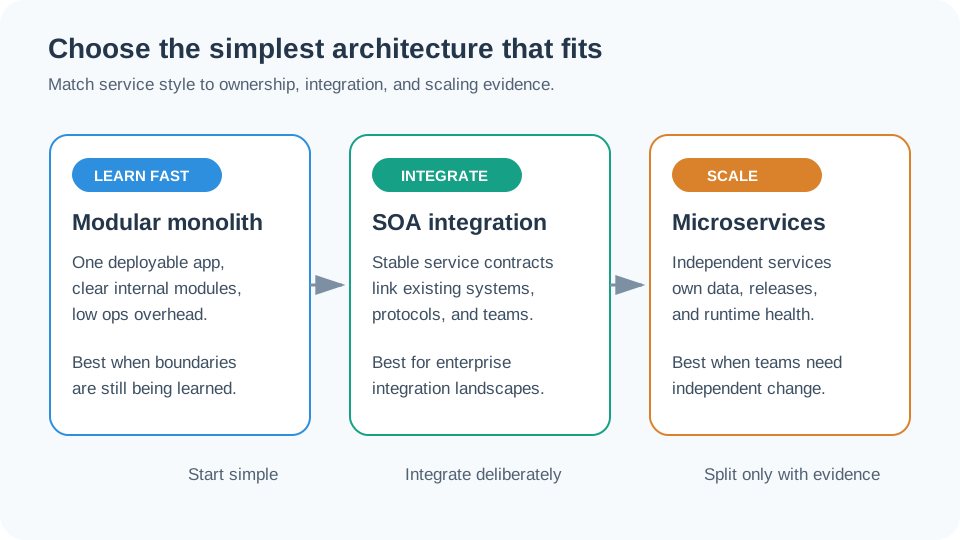
Read Figure 4.1 from left to right as increasing operational separation. A modular monolith preserves strong internal boundaries with one deployment; SOA connects established capabilities through contracts; microservices add independent ownership, deployment, scaling, and failure handling. That progression connects the visual to the review question: choose the least distributed option that satisfies the proved organizational and runtime needs.
4.8.1 Modular Monolith
One deployable application with strong internal module boundaries. Use it when the domain is still changing, the team is small, or operational simplicity matters more than independent deployment.
4.8.2 SOA Integration
Stable service contracts connect existing systems, protocols, and departments. Use it when the problem is interoperability across enterprise capabilities rather than rebuilding every system.
4.8.3 Microservices
Independently deployable services own their data, contracts, and runtime health. Use them when several teams need independent change or components have different scaling and failure profiles.
4.9 SOA and Microservices
This section: SOA and Microservices — SOA and microservices overlap, but their center of gravity is different.
SOA and microservices overlap, but their center of gravity is different.
4.9.1 SOA Focus
- Stable service contracts across systems.
- Integration among legacy, packaged, and custom applications.
- Centralized governance where consistency is important.
- Protocol mediation, routing, and enterprise interoperability.
4.9.2 Microservices Focus
- Independent deployability and ownership. A team should be able to build, run, change, and support the capability without coordinating every release with unrelated services.
- Services organized around business capabilities. Boundaries should follow the capability’s vocabulary, rules, data, and runtime needs.
- Decentralized data ownership. Each service controls its writes and exposes data through contracts, keeping private tables from becoming other services’ dependencies.
- Automated delivery, monitoring, and failure-aware design. Independent releases add operational responsibilities, including versioned contracts, observability, and designed responses to timeouts, duplicate events, and downstream outages. These costs need evidence that extraction provides a useful gain.
In IoT, SOA often appears at the enterprise edge: connecting ERP, MES, SCADA, billing, device platforms, and data warehouses. Microservices often appear inside the cloud platform: telemetry ingestion, device registry, rule evaluation, alerting, analytics, and user-facing APIs.
4.10 Service Boundary Review
This section: Service Boundary Review — Before extracting a service, test whether the boundary has enough evidence.
Before extracting a service, test whether the boundary has enough evidence.
Use Figure 4.2 to conduct that test in a repeatable order. It is worth inspecting because a service boundary must align domain language, data authority, runtime behavior, and team ownership; a diagram split alone does not establish any of those conditions.
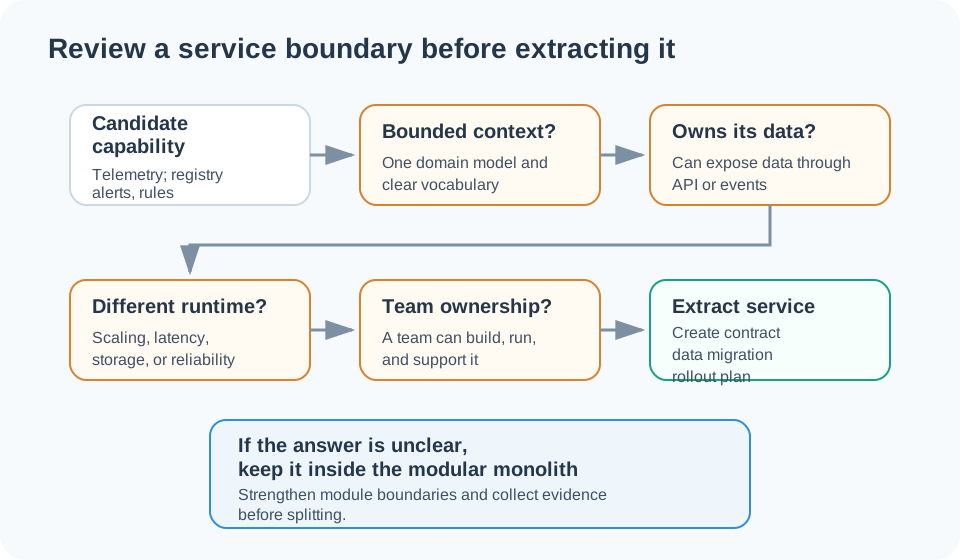
Follow Figure 4.2 from the candidate capability through bounded context and data ownership, then test runtime profile and team ownership before reaching the extraction decision. A weak answer at any step argues for keeping a clear internal module instead. This returns to the chapter’s narrative: distribution is justified by an independently governable capability, not by making more network calls.
4.10.1 Good Boundary Signals
- The capability has its own vocabulary and rules.
- A team can own the full lifecycle.
- Data can be owned behind an API or event stream.
- The component has distinct scaling, reliability, or change needs.
- The service can be deployed without forcing unrelated services to deploy.
4.10.2 Boundary Smells
- A feature always changes several services at once.
- Services share database tables directly.
- The split follows UI, API, business logic, and database layers instead of business capabilities.
- Most service calls are synchronous chains.
- One team is responsible for too many tiny services.
4.11 IoT Capability Map
This section: IoT Capability Map — IoT platforms contain several candidate domains, but not all of them need to become services immediately.
IoT platforms contain several candidate domains, but not all of them need to become services immediately.
4.11.1 Device Registry
Owns device identity, lifecycle state, model, ownership, and provisioning metadata.
4.11.2 Telemetry Ingestion
Receives readings, validates payloads, handles buffering, and publishes events for downstream consumers.
4.11.3 Command Service
Tracks command intent, dispatch state, retries, acknowledgments, and audit history.
4.11.4 Rule Evaluation
Evaluates thresholds, windows, device groups, and customer-defined conditions.
4.11.5 Notification Service
Sends alerts through email, SMS, push, webhooks, or ticketing integrations.
4.11.6 Analytics API
Provides historical query, aggregation, anomaly, and dashboard-friendly read models.
Use capability names to discuss boundaries before drawing infrastructure. “Telemetry ingestion” and “device registry” are domain terms. “API layer” and “database layer” are implementation layers.
4.12 Data Ownership and Collaboration
This section: Data Ownership and Collaboration — Microservices become real only when data ownership is clear.
Microservices become real only when data ownership is clear. A service can publish facts and expose APIs, but other services should not depend on its internal tables.
4.12.1 Prefer
- Each service owns its schema. This gives the owner authority over its data model and supports independent evolution.
- Other services use APIs, events, or replicated read models. Consumers can obtain needed data without depending on private table names or storage choices.
- Schema changes are hidden behind contracts. Version and test those contracts with consumers so internal changes do not silently break collaboration.
- Cross-service workflows use events, sagas, or explicit orchestration. Events can decouple producers and consumers; sagas coordinate local transactions and compensation when a workflow spans services. Define retry and duplicate handling as part of the boundary.
4.12.2 Avoid
- Several services reading and writing the same tables. Shared tables make internal schema choices dependencies for other services and can force coordinated changes.
- Hidden coupling through shared database views. Review whether consumers depend on storage details that should remain behind the owning service’s contracts.
- Distributed transactions for routine service collaboration. Consider events, sagas, or explicit orchestration, with defined failure behavior and compensation where needed.
- Analytics queries that bypass service ownership without governance. Read models can support analytics and dashboard queries while respecting write ownership. Review how data reaches those models and which service remains responsible for its authoritative writes.
4.13 Communication Patterns
This section: Communication Patterns — IoT service architectures usually combine synchronous APIs and asynchronous events.
IoT service architectures usually combine synchronous APIs and asynchronous events.
4.13.1 Synchronous API
Use when the caller needs an immediate answer: device lookup, command submission, dashboard query, or configuration read.
4.13.2 Asynchronous Event
Use when producers and consumers can be decoupled: telemetry received, device registered, command completed, alert triggered, or firmware rollout state changed.
4.13.3 Saga
Use when a business workflow spans services and needs compensating actions rather than a single distributed database transaction.
4.13.4 CQRS or Read Model
Use when write-side ownership and read-side query needs differ, such as high-volume telemetry writes and dashboard-friendly aggregated reads.
Telemetry paths should avoid long synchronous chains. If ingestion waits for analytics, notifications, and dashboard updates before acknowledging a reading, a downstream slowdown can become a data-loss incident.
4.14 Extraction Workflow
This section: Extraction Workflow — Extract services deliberately.
Extract services deliberately. The first extracted service should prove the operating model, not maximize the number of services.
Name capability Describe the business capability and its vocabulary.
Draw boundary Identify data, APIs, events, dependencies, and owners.
Prove reason Document the scaling, deployment, ownership, or failure-isolation reason.
Plan migration Move data and behavior incrementally while keeping clients stable.
Measure result Check whether deployment, incident scope, or team flow actually improved.
4.15 Common Patterns
This section: Common Patterns — These patterns are useful when they solve a concrete IoT pressure.
These patterns are useful when they solve a concrete IoT pressure.
Inspect Figure 4.3 to see which responsibilities belong at the platform edge and which must remain with domain services. The distinction matters because centralizing authentication, routing, and rate policy can simplify clients without centralizing every business rule or data dependency.
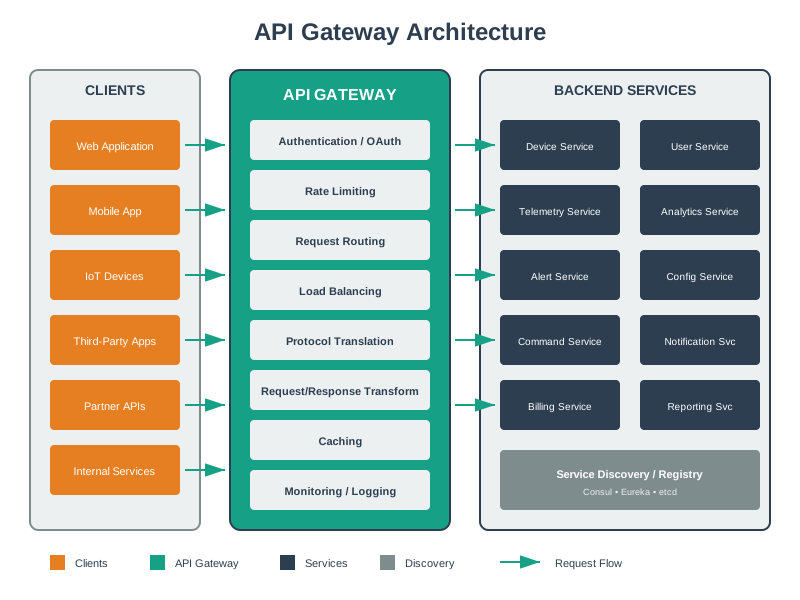
Read Figure 4.3 from clients into the gateway controls, then follow routing to the separate device, telemetry, analytics, alert, command, and user capabilities. Authentication, throttling, protocol translation, and observability can be shared at the edge; domain authorization and owned data remain behind explicit service contracts. This keeps the pattern connected to the running boundary argument rather than turning the gateway into a hidden monolith.
Bina’s Boundary Sheet
- Boundary: the platform edge — an API gateway between clients and the services behind it.
- Decision: the edge owns client contracts and cross-cutting controls, ruling out gateway-hidden domain rules.
- Point to it: the gateway figure — authentication, rate limiting, routing at the edge, while internal services evolve.
4.15.1 API Gateway
Provides a stable edge for devices, dashboards, partners, and mobile apps while internal services evolve.
4.15.2 Database per Service
Gives each service authority over its own schema and protects independent evolution.
4.15.3 Event-Driven Collaboration
Lets telemetry, rules, notifications, storage, and analytics evolve without direct call chains.
4.15.4 Read Models
Build dashboard-friendly or analytics-friendly views without forcing every query through the write service.
4.15.5 Saga
Coordinates multi-service workflows such as provisioning, billing setup, and notification enrollment through local transactions and compensation.
4.15.6 Anti-Corruption Layer
Protects a clean domain model from legacy schemas, third-party APIs, or protocol-specific details.
Before extracting an IoT capability into a network service, check whether the service can survive the failure patterns that microservices introduce:
- Circuit breaker: fail fast when a dependency is unhealthy, then use a cached result, a default response, or a clear degraded-mode error.
- Bulkhead: isolate thread pools, queues, tenants, and expensive integrations so one slow dependency does not consume the whole platform.
- Retry with jitter: retry only transient failures, bound the retry count, and add random delay so reconnecting devices do not create a synchronized retry storm.
- Buffered telemetry: store or queue measurements before fan-out so dashboards, analytics, and notification services can fall behind without blocking ingestion.
- Observable contracts: expose request rate, error rate, latency, saturation, event lag, and dead-letter counts before declaring the split successful.
Treat these checks as extraction evidence. If the team cannot name the fallback, isolation boundary, retry policy, and operator signal, the safer design is usually a modular monolith with stronger internal boundaries.
Common Pitfalls
This section: Common Pitfalls
An API service, business-logic service, and data-access service usually still need to deploy together for one business change. Split vertically by capability when a split is justified.
Shared tables make one service’s internal schema another service’s dependency. Use APIs, events, and read models instead.
Early service boundaries are guesses. Keep strong module boundaries first, then extract when the team has evidence.
Telemetry ingestion should not wait on every downstream processor. Store, buffer, publish, and let consumers process independently.
Every service needs logging, metrics, tracing, deployment automation, ownership, incident response, and versioned contracts. If the team cannot operate that surface area, do not create it yet.
4.16 Architecture Review Checklist
This section: Architecture Review Checklist
Boundary: Is the service aligned to a business capability or bounded context?
Owner: Can one team own design, code, deployment, support, and roadmap?
Data: Does the service own its data model and expose changes through contracts?
Runtime: Does it have distinct scaling, latency, storage, or reliability needs?
Contract: Are APIs and events versioned and tested with consumers?
Failure: Can the service fail without taking down unrelated capabilities?
Migration: Is there a plan for data movement, dual running, rollback, and observability?
Benefit: Will extraction reduce coordination or risk enough to justify the new operational cost?
4.17 Label the Diagram
This section: Label the Diagram
4.18 Code Challenge
This section: Code Challenge
4.19 Summary
This section: Summary
- SOA is strongest for stable service integration across existing systems.
- Microservices are strongest when teams need independent ownership, deployment, data control, and runtime scaling.
- A modular monolith is a valid starting architecture when the domain is still being learned.
- Good service boundaries follow business capabilities, bounded contexts, data ownership, and operational evidence.
- Bad service boundaries create shared databases, synchronized releases, synchronous chains, and distributed monoliths.
Extract a service only when it creates real independence: a clear owner, a clear contract, owned data, measurable runtime needs, and a migration path. Otherwise, strengthen the module boundary and keep learning.
4.20 Knowledge Check
This section: Knowledge Check
4.21 Try It Yourself
This section: Try It Yourself
Choose an IoT platform or project you know and write a short extraction rationale.
- Name one candidate capability, such as telemetry ingestion, device registry, command dispatch, or notifications.
- List the data it owns and the data it needs from other domains.
- Identify its consumers: devices, dashboards, analytics, partners, or other services.
- Decide whether collaboration should be synchronous API, asynchronous event, or both.
- Write the reason to extract it, or write why it should stay inside the modular monolith.
- Define one metric that would prove the extraction helped.
4.22 References
This section: References
4.23 What’s Next
This section: What’s Next
4.23.1 Design the Service Contract
SOA API Design and Discovery explains API resources, versions, rate limits, idempotency, and service discovery.
4.23.2 Add Runtime Resilience
SOA Resilience Patterns covers retries, timeouts, circuit breakers, and bulkheads.
4.23.3 Deploy the Service
SOA Container Orchestration shows how to package, probe, scale, and roll out services.
4.23.4 Model Device State
State Machine Patterns helps keep device lifecycle and command state explicit.
Find help
3 reviewed answers.
Where should I start in a module?
Open the module page from the sidebar to see its chapters in order. Use the module map to return to a topic you need.
Modules and pathsReviewed
What can I try when a project does not work?
Check the symptom, then work through the diagnostic steps. Keep the error message and the smallest example that reproduces it.
When you are stuckReviewed
How do interactive examples work?
Use the interactive guide to check how examples and simulations work before changing your project.
Interactive examples guideReviewed