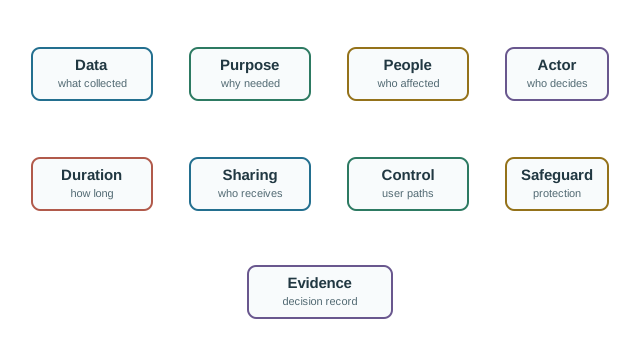
Consent should behave like connected-product state: visible, specific, changeable, and enforceable. Start with the data path, the purpose, the role affected, the withdrawal path, and the system behavior that proves the consent choice actually controls sensing, storage, sharing, and automation.
In 60 Seconds
IoT privacy consent must be explicit, informed, granular, and as easy to withdraw as it was to grant. GDPR requires freely given consent that is not bundled with service access, and IoT devices face unique challenges because they collect data continuously, often without screens for consent dialogs. Apply data minimization (collect only what is needed), edge processing (process locally before transmitting), and Privacy by Design principles (embed privacy into architecture from the start, not as an afterthought).
Chapter Roadmap
First, treat consent as a maintained product state, not a one-time setup screen.
Then, connect GDPR requirements to IoT roles, data paths, lawful bases, and user rights.
Next, reduce what the product collects through minimization, edge processing, and retention controls.
Finally, test Privacy by Design with realistic multi-party scenarios, common pitfalls, and interactive checks.
Checkpoint callouts pause after major design decisions; Deep dive sections hold optional reference material, calculators, or long review examples.
38.2 Learning Objectives
By the end of this chapter, you should be able to:
Explain GDPR and other privacy regulations as they apply to IoT systems
Design effective consent mechanisms for IoT devices and applications
Apply data minimization principles to IoT data collection
Implement user rights including access, deletion, and data portability
Integrate Privacy by Design principles into IoT development
Identify and address IoT-specific privacy challenges
Key Concepts
Privacy by Design: Framework requiring privacy protections embedded in system architecture from the start, not added afterward.
Informed Consent: User agreement that is specific, freely given, and based on a clear explanation of data collection purposes.
GDPR: EU General Data Protection Regulation setting standards for personal data collection, processing, and user rights.
Data Minimisation: Principle requiring only the minimum data necessary for a stated purpose to be collected.
Right to Erasure: GDPR right allowing users to request deletion of all personal data held by a service.
Consent Fatigue: User tendency to click ‘accept all’ on privacy dialogs without reading them, caused by excessive or poorly designed consent requests.
Purpose Limitation: GDPR principle requiring data collected for one purpose not to be used for a different, incompatible purpose.
Related Chapters, Products, and Tools
Privacy Foundations - Review Privacy by Design Schemes for comprehensive coverage of the 7 foundational principles.
Security Context - See Introduction to Privacy for regulatory framework context (GDPR, CCPA).
Human-Centered Design - Connect to UX Design Fundamentals for designing privacy-respecting interfaces.
Interactive Tools - Try the Privacy Trust Calculator to assess privacy impacts.
Privacy and Consent in IoT
What is Privacy Consent? Privacy consent is permission that users give to allow IoT systems to collect, process, and use their personal data. Unlike website cookies where you click “Accept,” IoT consent is more complex because devices collect data continuously, often without screens to display consent dialogs.
Why is IoT Privacy Different?
Smart speakers listen 24/7 for wake words
Fitness trackers monitor your body continuously
Smart home devices know when you’re home or away
Cameras capture everyone in range, not just users
Key Regulations:
Regulation
Region
Key Requirement
GDPR
EU/UK
Explicit, informed consent for personal data
CCPA/CPRA
California
Right to know, delete, opt-out
POPIA
South Africa
Purpose specification and data minimization
LGPD
Brazil
Consent must be free, informed, unambiguous
Key Takeaway
In one sentence: IoT privacy consent must be explicit, informed, granular, and as easy to withdraw as it was to grant.
Remember this rule: Users cannot consent to what they don’t understand - clear communication of data practices is a prerequisite for valid consent.
38.3 Consent as Product State
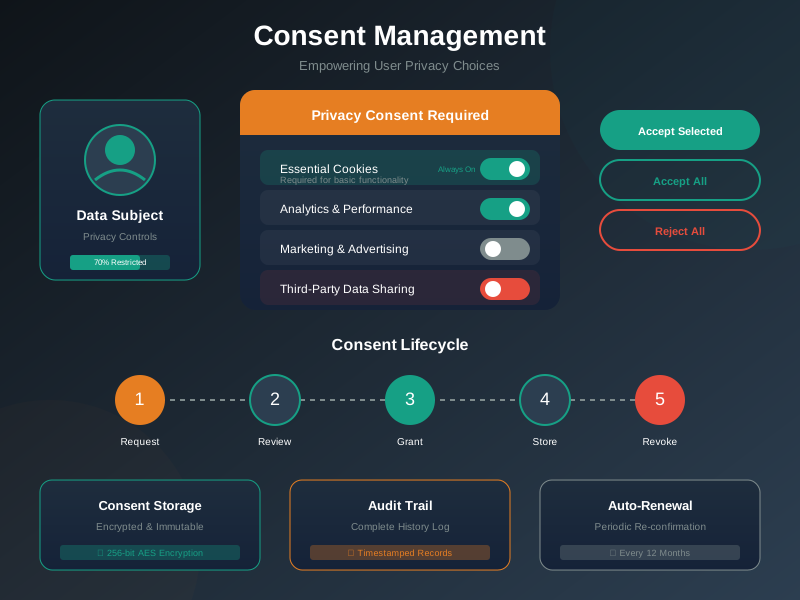
IoT consent has to survive beyond setup. A connected device may keep sensing after the app is closed, after a guest leaves, after a caregiver changes, after a tenancy changes, or after a firmware update adds a new feature. The user experience should make consent visible as a state that can be granted, limited, paused, withdrawn, exported, or deleted.
Start by separating core operation from optional data use. A thermostat may need temperature readings to control heating, but not detailed occupancy history for advertising. A smart speaker may need local wake-word detection for voice control, but not indefinite retention of raw audio. A camera doorbell may need event recording for security, but should still explain capture, retention, sharing, and bystander impact.
Consent is useful only when the user-facing choice is connected to enforcement gates and records that change collection, sharing, retention, and deletion behavior.
Purpose: name the feature enabled by each data type, such as comfort control, safety alert, diagnostics, personalization, research, or third-party sharing.
Visibility: show active, paused, local-only, cloud-sync, shared, expired, revoked, and deletion-pending states where they affect user trust.
Withdrawal: make disabling optional collection as reachable as enabling it, and explain what stops immediately versus what expires later.
A useful consent design therefore starts with a data-purpose inventory rather than a legal screen. Write down each signal the product can collect: audio, video, location, motion, presence, heart rate, power draw, access events, diagnostics, crash logs, and derived inferences. For each signal, ask whether it is required for the core function, optional for a user-visible enhancement, needed for security or troubleshooting, or intended for analytics, research, model training, advertising, or a partner integration. Those categories should not be bundled into one “accept” decision.
The product should also distinguish who is affected. An account owner can consent for account features, but a visitor, child, tenant, employee, delivery driver, neighbor, or household guest may also be captured by a camera, microphone, presence sensor, access log, or occupancy inference. The interface may need signage, a guest mode, household-member invitations, administrator controls, worker notices, or limits on where sensors can be placed. Consent is weaker when it assumes only the purchaser exists.
The design record should state the default. Privacy-preserving defaults usually mean local processing where practical, short retention, optional cloud backup, separate third-party sharing choices, visible recording indicators, and no pre-selected optional consent. If a feature stops working when optional data is denied, the user should see the real tradeoff in plain language rather than discovering it after setup. That is how consent becomes a maintained product state instead of a one-time legal ritual.
38.4 Consent by Roles and Data Paths
Map the consent experience across the people who touch the system. The account owner may grant cloud backup, a guest may need a short explanation before being recorded, a worker may need to understand an occupancy sensor, a caregiver may need delegated access, and a support agent may need temporary diagnostics without becoming a permanent data recipient. One “accept all” screen cannot carry those different responsibilities.
Then map the data path from device to gateway, companion app, cloud service, analytics system, integration partner, and support console. For each path, decide whether the product can use local processing, aggregation, coarse location, short retention, encrypted storage, or role-limited access before collecting a more sensitive stream. The best consent flow is usually paired with data minimization so the product does not ask users to accept avoidable risk.
Split required from optional: keep core device operation separate from personalization, marketing analytics, research contribution, and partner sharing.
Explain by signal: say whether the product uses audio, video, location, motion, presence, health, energy, access logs, diagnostics, or derived inferences.
Close the loop: provide a privacy dashboard, export, deletion, access history, consent change log, guest or bystander notice, and support path for corrections.
Design the consent UI as a set of task cards, not as a single policy link. A strong card names the data category, purpose, benefit, retention period, recipient, default state, consequence of refusal, and where the user can change the choice later. For example, “Store voice command history for 90 days to improve recognition” is more reviewable than “improve services.” “Share anonymized monthly energy totals with the utility for grid planning” is different from “share one-second appliance signatures with partners.” If the language cannot name the data and purpose in one sentence, the processing is probably not ready for consent.
Use real product routes in the review. During onboarding, the user might grant required permissions and decline optional analytics. In settings, they should be able to pause microphone upload, disable precise location, revoke a partner integration, export access logs, and delete history. In a household or workplace, an administrator may invite users, but each person may need their own notice and control for personal data. In support, a temporary diagnostics grant should expire automatically and appear in the access history.
Test comprehension and reversibility. After the user sees the consent flow, ask what the device collects, why it collects it, who can see it, how long it is kept, and how to turn it off. Then observe whether they can actually find the dashboard, withdraw a choice, export data, and request deletion without help. Those tasks are stronger evidence than a screenshot because they show whether consent is understandable, actionable, and maintained after setup.
The practitioner should leave the review with a consent matrix: purpose id, screen or notice, legal basis to confirm with counsel, default state, data fields, retention rule, processor or partner, user role, withdrawal path, deletion behavior, owner, and test evidence. That matrix gives engineering, legal, support, and design teams the same source of truth.
38.5 Enforceable Consent Flags
Implementation should not rely on copy alone. Model consent with fields such as user id, device id, household or organization id, role, purpose id, consent version, granted_at, withdrawn_at, retention_until, data category, collection gate, processor or integration id, and source of the user’s action. Services can then block collection, upload, analysis, sharing, support access, or model training when the consent state does not allow it.
Use real enforcement points. Firmware can disable raw microphone upload when only local wake-word detection is allowed. A gateway can aggregate occupancy before publishing an MQTT topic. A mobile app can respect Android or iOS permission state before starting background location. A cloud job can apply TTL deletion, revoke OAuth scopes, remove APNs/FCM notification tokens, delete device-shadow history, and mark export or erasure requests complete only after downstream processors respond.
Device gate: firmware config, local processing mode, recording indicator, mute switch, sampling rate, and upload queue policy.
Cloud gate: API authorization, role-based access control, retention job, export job, deletion job, support-console permission, and access log.
Consent flags should be evaluated where data is created and where it is reused. If firmware records audio while a cloud service later discards it, collection still happened. If an MQTT broker publishes presence data to a retained topic after consent is withdrawn, the dashboard and downstream subscribers may continue seeing stale personal data. If a machine-learning pipeline has already copied events into a feature store, deleting the account record is not enough. The architecture needs collection gates, storage gates, processing gates, sharing gates, and retention gates.
Versioning matters because consent language and features change. Store the policy or notice version shown to the user, the UI path used to grant it, and the exact purpose ids enabled. When a firmware update adds person detection, a new analytics partner, or a longer retention period, the system should know whether existing consent covers the change or whether the user must make a new choice. Auditors and support teams should be able to reconstruct why data existed at a given time.
Withdrawal should propagate as a workflow, not a boolean flip. The app can mark the purpose withdrawn immediately, firmware can receive a new config, upload queues can be purged, API scopes can be revoked, processors can receive deletion callbacks, scheduled jobs can remove retained records, and the user can see pending versus completed deletion states. If backups or legal holds delay deletion, the dashboard should explain the timeline and limit restore paths so old data is not reintroduced silently.
Finally, privacy telemetry should avoid becoming another privacy risk. Log consent changes, enforcement denials, export requests, deletion jobs, and support access, but keep those logs minimal, access-controlled, and retention-limited. The implementation goal is a provable chain from user choice to system behavior: what was allowed, what was blocked, what was deleted, and which evidence shows the product followed the user’s decision.
Checkpoint: Consent State
You now know how to separate required operation from optional data use.
You now know why account owners, guests, workers, caregivers, support agents, and bystanders need different consent paths.
You now know how purpose ids, consent versions, withdrawal workflows, and enforcement gates make consent auditable.
We have treated consent as product state. The next question is how that state maps to legal duties when sensors collect personal data continuously.
38.6 GDPR and Privacy Regulations for IoT
The General Data Protection Regulation (GDPR) establishes strict requirements for processing personal data. IoT systems face unique challenges because they collect data continuously from sensors, often without traditional user interfaces.
38.6.1 GDPR Principles Applied to IoT
GDPR Principle
Article
IoT Application
Example
Lawfulness
Art. 6
Must have legal basis for collection
Smart meter needs consent for detailed usage patterns
Purpose Limitation
Art. 5(1)(b)
Collect only for specified purposes
Thermostat data cannot be used for advertising
Data Minimization
Art. 5(1)(c)
Collect only what’s necessary
Fitness tracker shouldn’t collect location for step counting
Accuracy
Art. 5(1)(d)
Keep data correct and updated
Medical IoT must maintain accurate readings
Storage Limitation
Art. 5(1)(e)
Don’t keep data longer than needed
Security camera footage deleted after 30 days
Integrity & Confidentiality
Art. 5(1)(f)
Protect against unauthorized access
Encryption for smart lock access logs
38.6.2 IoT-Specific GDPR Challenges
IoT systems present unique challenges for GDPR compliance that don’t exist in traditional web applications:
Use Figure 38.1 to turn abstract compliance duties into review questions that fit continuous sensing, screenless devices, household roles, and third-party data paths.
38.7 Consent Mechanisms for IoT
Designing consent mechanisms for IoT is challenging because traditional web consent patterns (cookie banners, checkboxes) don’t work for screenless devices or continuous data collection.
38.7.1 Consent Requirements Under GDPR
For consent to be valid under GDPR Article 7, it must be:
Requirement
Definition
IoT Challenge
Freely Given
Not tied to service access
Devices often require data for core function
Specific
For defined purposes
Sensors collect multipurpose data
Informed
User understands what they’re consenting to
Complex data flows hard to explain
Unambiguous
Clear affirmative action
No screen for buttons/checkboxes
Withdrawable
As easy to withdraw as to grant
How do you “un-consent” to a smart speaker?
38.7.2 IoT Consent Design Patterns
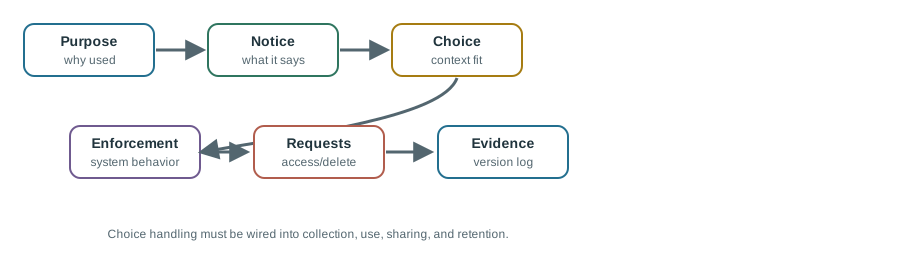
Figure 38.2: Consent choice handling flow from purpose and notice through choice, enforcement, rights requests, and evidence.
Figure 38.2 shows why consent mechanisms need both a user-facing choice and an enforcement/evidence path behind it.
38.7.3 Designing Granular Consent
Instead of all-or-nothing consent, IoT systems should offer granular choices:
Feature Category
Core Function
Optional Enhancement
Third-Party Sharing
Smart Thermostat
Temperature control (required)
Energy optimization tips
Utility company data sharing
Fitness Tracker
Step counting (required)
Social leaderboards
Research data contribution
Smart Speaker
Voice commands (required)
Personalized recommendations
Skills marketplace analytics
Checkpoint: Consent Mechanics
You now know why consent must be freely given, specific, informed, unambiguous, and withdrawable.
You now know why pre-selected choices and bundled optional sharing fail the affirmative-action test.
You now know how a consent card should name data, purpose, retention, recipient, default, refusal consequence, and change path.
The consent interface is only one control surface. The next step is to ask whether the product can collect less data before it asks for permission.
38.8 Data Minimization Principles
Data minimization is a core Privacy by Design principle requiring IoT systems to collect only the data necessary for their specified purpose.
38.8.1 The Data Minimization Hierarchy
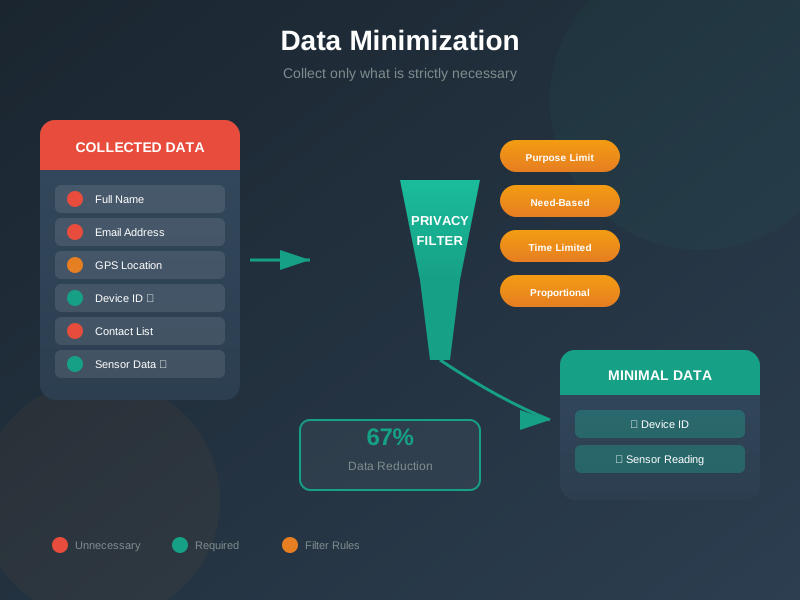
Figure 38.3: Data minimization: filtering collected fields down to only what is necessary
Use Figure 38.3 as a review loop: every new consent request should first ask whether collection, precision, transmission, access, retention, or reuse can be reduced.
38.8.2 Practical Data Minimization Examples
IoT Device
Over-Collection
Minimized Collection
Rationale
Smart Thermostat
Minute-by-minute temp + occupancy + location
Hourly temperature averages
Hourly sufficient for optimization
Fitness Tracker
GPS coordinates every second
Route summary (start/end, distance)
Full GPS reveals home/work locations
Smart Speaker
All audio recorded and uploaded
Local wake word detection, upload only commands
Most audio is ambient noise
Security Camera
24/7 cloud recording
Local storage, motion-triggered cloud backup
Continuous recording captures unnecessary footage
Deep dive: Putting Numbers to It
Storage cost of over-collection: Treat these numbers as scenario defaults to replace with your product’s bitrate, retention, and storage quote. A smart doorbell recording 1080p video 24/7 at an assumed 3 Mbps generates \(D_{daily} = \frac{3 \text{ Mbps} \times 86,400 \text{ sec}}{8 \times 1024} \approx 31.6 \text{ GB/day}\). With an assumed $0.023/GB storage price, annual cost is \(31.6 \times 365 \times 0.023 \approx \$265\) per device. With motion-triggered recording at an assumed 30 minutes active per day, cost drops to \(\frac{30}{1440} \times 265 \approx \$5.52\).
GDPR fine exposure model: Under Article 83, fines can reach up to 4% of annual global turnover or €20M, whichever is higher. For a hypothetical €500M IoT company, the upper-bound exposure is \(0.04 \times 500M = €20M\). The calculator uses a planning-budget assumption for legal, UX, and engineering work; replace it with a real estimate rather than treating it as a benchmark.
Consent adoption scenario: Use abandonment sliders as a sensitivity model. If all-or-nothing consent caused 67% abandonment in your own test and granular consent reduced it to 23%, then a company shipping 50,000 units/year at $200 margin would model \(50{,}000 \times (0.67 - 0.23) \times 200 = \$4.4M\) revenue at risk. Without product telemetry or usability data, these are assumptions, not evidence.
Re-identification risk model: Location plus timestamp can be highly identifying, especially when combined with outside information such as home, work, school, or public posts. A fitness tracker collecting GPS every 10 seconds generates \(N_{points} = \frac{86,400}{10} = 8{,}640\) points per day. Before calling that data anonymous, test whether aggregation, suppression, differential privacy, or a threshold such as \(k\)-anonymity is strong enough for the release context.
Consent withdrawal friction: If consent requires 2 clicks but withdrawal requires 8 clicks, the design conflicts with the “as easy to withdraw as to grant” principle. The calculator uses an assumed per-click completion loss to show why teams should measure withdrawal completion, not just whether a withdrawal control technically exists.
Maximum Fine: €M (4% of revenue or €20M, whichever higher)
Planning budget assumption: €M
Budget as share of upper-bound fine exposure: %
Consent Design Scenario
Assumed all-or-nothing abandonment: %
Assumed granular consent abandonment: %
Scenario revenue impact: $M/year
Withdrawal Friction Analysis
Consent completion( clicks): %
Withdrawal completion( clicks): %
Friction ratio: x
Show code
html`<div style="background: #E8F4F8; border-left: 4px solid #16A085; padding: 12px; margin: 15px 0; border-radius: 4px; font-size: 0.9em;"><strong>Key Insight:</strong> Data minimization can reduce both privacy risk and operating cost. In this scenario, motion-triggered recording saves ${savingsPercent.toFixed(0)}% on storage, and changing the consent flow changes modeled revenue by $${(revenueImpact /1000000).toFixed(2)}M. Replace the defaults with pilot, telemetry, legal, and vendor data before making a launch decision.</div>`
38.8.4 Edge Processing for Data Minimization
Processing data on the device (at the edge) before transmission is a powerful data minimization technique:
Processing Location
Data Transmitted
Privacy Level
Example
Cloud Processing
All raw sensor data
Low
Upload all audio to cloud for analysis
Edge Processing
Only results/summaries
High
Detect wake word locally, upload only command
Federated Learning
Model updates only
Very High
Train ML locally, share only gradients
Checkpoint: Minimization
You now know how to reduce collection by signal, precision, transmission, access, retention, and reuse.
You now know why high-frequency readings, raw audio, raw video, location traces, and model updates can expose behavior beyond the stated feature.
You now know how edge processing, federated learning safeguards, aggregation, suppression, and deletion windows support consent promises.
Minimization reduces avoidable collection. The next question is what happens when the user asks to inspect, move, correct, restrict, or delete data that still exists. ## User Rights in IoT Systems {#sec-user-rights .depth-l0}
GDPR and similar regulations grant users specific rights over their personal data. IoT systems must implement mechanisms to fulfill these rights.
38.8.5 The Core User Rights
Right
GDPR Article
Description
IoT Implementation Challenge
Access
Art. 15
See what data is collected
Data spread across device, gateway, cloud
Rectification
Art. 16
Correct inaccurate data
Sensor data is what it is - hard to “correct”
Erasure
Art. 17
Delete personal data
Data in backups, third parties, device caches
Portability
Art. 20
Export data in usable format
Proprietary formats, fragmented ecosystems
Restriction
Art. 18
Limit how data is processed
Continuous collection makes pausing difficult
Object
Art. 21
Refuse certain processing
Device may stop working without data
38.8.6 Implementing Right to Access
Users must be able to see what data IoT systems have collected about them:
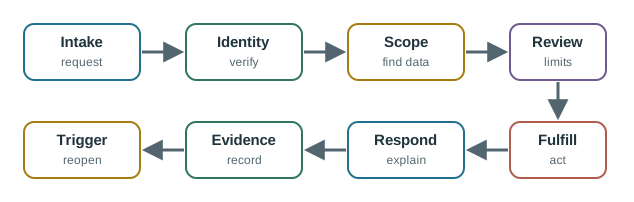
Figure 38.4: User rights request workflow showing intake, identity verification, scope, review, fulfill, respond, evidence, and follow-up trigger.
Figure 38.4 applies to access, export, correction, and deletion requests because each request needs identity proof, scoped search, fulfillment evidence, and a follow-up path when downstream data is found later.
38.8.7 Implementing Right to Data Portability
Users have the right to receive their data in a “structured, commonly used and machine-readable format”:
Format
Pros
Cons
Best For
JSON
Universal, human-readable
Verbose, no schema validation
API integrations
CSV
Spreadsheet compatible
Limited data types
Simple sensor data
XML
Schema validation
Verbose, complex
Regulated industries
Parquet
Efficient, typed
Binary, needs tools
Large datasets
Checkpoint: Rights Handling
You now know why access, erasure, portability, restriction, and objection need workflows across device, gateway, cloud, backup, and processor systems.
You now know why deletion must cover production records, backup rotation, third-party processors, device caches, and user-visible timelines.
You now know why raw observed data is usually portable while proprietary scores and algorithmic interpretations may not be.
Rights workflows prove whether privacy controls survive beyond the dashboard. The next design question is how to embed those controls before launch instead of bolting them on after complaints.
38.9 Privacy by Design for IoT
Privacy by Design requires embedding privacy into IoT systems from the beginning, not adding it as an afterthought.
38.9.1 The 7 Foundational Principles
Principle
IoT Application
Good Example
Bad Example
1. Proactive
Anticipate privacy risks during design
Privacy Impact Assessment before launch
Adding “delete data” button after breach
2. Default
Privacy-protective settings out of box
Cloud sync OFF by default
Analytics ON, buried opt-out
3. Embedded
Privacy in architecture, not bolt-on
On-device processing built into chip
Encryption added after beta
4. Full Functionality
Privacy AND features
Federated learning for personalization
“Disable tracking = limited features”
5. End-to-End
Protect entire data lifecycle
Auto-delete after retention period
Forgot to delete backups
6. Transparency
Clear about data practices
Plain-language privacy dashboard
50-page legal privacy policy
7. User-Centric
Respect user choices
Granular consent controls
All-or-nothing consent
38.9.2 Privacy Impact Assessments for IoT
Before launching an IoT product, conduct a Privacy Impact Assessment (PIA):
PIA Phase
Key Questions
IoT Considerations
1. Data Inventory
What data is collected?
Sensors may collect more than intended
2. Data Flows
Where does data go?
Device → Gateway → Cloud → Third parties
3. Necessity
Is each data element needed?
Challenge assumptions about data requirements
4. Risks
What could go wrong?
Breach, re-identification, function creep
5. Mitigations
How to reduce risks?
Minimize, anonymize, encrypt, limit access
6. Documentation
Record decisions
Required for GDPR accountability
Checkpoint: Privacy by Design
You now know how proactive design, privacy defaults, embedded controls, transparency, and user-centric choices translate into IoT architecture.
You now know why a Privacy Impact Assessment must challenge sensors, data flows, necessity, risks, mitigations, and documentation before release.
You now know why aggregate goals should use technical controls that prevent unnecessary individual tracking capability.
Privacy by Design sets the architecture. The next section stress-tests that architecture against the ambient, inferential, and multi-party realities of connected spaces.
38.10 IoT-Specific Privacy Challenges
IoT systems face privacy challenges that don’t exist in traditional computing environments.
38.10.1 Challenge 1: Ambient Data Collection
IoT sensors often capture data about people who aren’t the device owners:
Device
Primary User
Bystanders Affected
Smart doorbell
Homeowner
Visitors, delivery drivers, passersby
Voice assistant
Family member who set it up
All household members, guests
Wearable camera
Wearer
Everyone in camera view
Smart office sensors
Employer
Employees, visitors
38.10.2 Inference and Re-ID Challenge
Even “anonymous” IoT data can reveal identities:
38.10.3 Challenge 3: Multi-Party Privacy
IoT ecosystems involve multiple parties with different privacy interests:
Party
Privacy Interest
Conflict Example
Device Owner
Control over own data
vs. Manufacturer wanting usage analytics
Household Members
Privacy in shared space
vs. Owner’s security monitoring
Visitors/Guests
Not being recorded
vs. Homeowner’s smart doorbell
Manufacturer
Product improvement data
vs. User’s data minimization preference
Third-Party Services
Personalization data
vs. User’s portability rights
GDPR Consent for Baby Monitors
Scenario: A smart baby monitor startup must implement GDPR-compliant consent for their video/audio streaming product sold in the EU. The device collects video, audio, room temperature, and movement data.
Initial (Non-Compliant) Consent Flow:
Setup screen shows: > “To use BabyCam Pro, you agree to our Privacy Policy and Terms of Service. [Continue]”
Buried in 5,000-word privacy policy: - Video/audio stored in cloud for 30 days - Data shared with analytics partners for service improvement - Movement patterns used to train AI sleep algorithms - No mention of how to delete data or withdraw consent
GDPR Violations:
Not Freely Given: Consent bundled with service—can’t use monitor without agreeing to everything
Not Specific: Single “agree to all” for 4 different data uses
Not Informed: Critical info buried in legal text
Not Unambiguous: “Continue” button doesn’t constitute explicit consent for sensitive data
Not Withdrawable: No mechanism shown to revoke consent
GDPR-Compliant Redesign:
Setup Screen 1: Core Functionality Consent
BabyCam Pro streams live video to your phone and alerts you
when baby cries. This requires:

☐ Process video/audio locally on device (required for core function)
☐ Send alerts to your phone via internet (required for notifications)

[I Understand and Agree] [Cancel Setup]
Analysis: These are legitimate interest (GDPR Art. 6(1)(f)) for core product function, not requiring consent. Transparency provided, but not optional.
Setup Screen 2: Optional Features (Granular Consent)
Optional features - you can enable these now or later in settings:

Video Cloud Storage (30 days)
☐ Store video clips in cloud for playback history
  · Who sees it: Only you and users you invite
  · How long: Automatically deleted after 30 days
  · Can change: Yes, disable anytime in Settings > Cloud Storage

Sleep Pattern Analytics
☐ Use movement data to provide sleep insights
  · Who sees it: Only you (aggregated data used for product improvement)
  · How long: Stored as long as you use the feature
  · Can change: Yes, disable in Settings > Sleep Analytics

Share Data with Research Partners
☐ Help improve baby sleep research (anonymous, aggregated data only)
  · Who sees it: University research partners (no video, only stats)
  · How long: Indefinitely for research
  · Can change: Yes, revoke consent anytime

[Save Preferences] [Skip for Now]
Analysis:
Freely Given: Each optional feature has independent checkbox (not bundled)
Specific: Separate consent for cloud storage, analytics, research sharing
Informed: Plain language explains what, who, how long
Unambiguous: Explicit checkbox, not pre-ticked
Withdrawable: Clear path to disable shown
Setup Screen 3: Data Access Rights
Your Privacy Rights:

You can always:
· View your data: Settings > My Data
· Download your data: Settings > Export Data (JSON format)
· Delete your data: Settings > Delete My Data (permanent, cannot undo)
· Revoke consent: Toggle any permission off in Settings

Questions? privacy@babycampro.com
In-App Consent Management (Settings > Privacy):
Cloud Video Storage: [ON] [OFF]
  Last 30 days of video stored in encrypted cloud
  [Delete All Cloud Videos Now]

Sleep Analytics: [ON] [OFF]
  Movement data used to generate sleep insights
  [Download My Sleep Data] [Delete Sleep History]

Research Sharing: [ON] [OFF]
  Anonymous, aggregated data shared with researchers
  [Stop Sharing Immediately]
Withdrawal Process:
One-tap toggle to disable any feature
Immediate effect (within 24 hours for cloud deletion)
Confirmation dialog: “Are you sure? Sleep insights will stop. This change takes effect immediately.”
Data Retention Enforcement:
Data Type
Retention
Automatic Deletion
Live video/audio
Not stored (streamed only)
N/A
Cloud clips
30 days max
Auto-deleted after 30 days
Sleep analytics
While feature enabled
Deleted within 7 days of disabling
Research aggregates
Indefinite
User can request deletion (de-identified)
Account data
While account active
Deleted within 30 days of account deletion
User Rights Implementation:
Right to Access (GDPR Art. 15): - User clicks “Download My Data” - System generates JSON export with: cloud clips (as mp4 files), sleep analytics (CSV), device logs - Email sent with download link (expires in 7 days) - Delivered within 48 hours
Right to Erasure (GDPR Art. 17): - User clicks “Delete My Data” - Confirmation dialog warns: “This permanently deletes all your data. Account will be closed.” - System deletes: cloud videos, sleep history, account credentials - Notifies third-party processors (research partners) to delete user’s data - Sends confirmation email: “Your data has been deleted as of [timestamp]”
Right to Portability (GDPR Art. 20): - JSON export includes: - Cloud video clips (mp4 format, playable anywhere) - Sleep analytics (CSV format, importable to Excel) - Device settings (JSON format) - Structured, machine-readable format per GDPR requirement
Risk Avoided: €20M (4% of revenue) or €10M GDPR fine (whichever is higher)
User Trust: +42% in post-redesign surveys (“I trust this company with my baby’s data”)
Key Insight: GDPR compliance isn’t just legal checkbox-ticking—it’s user-centered design. Granular consent controls respect user autonomy. Clear explanations build trust. Easy withdrawal prevents lock-in resentment. The cost of compliance ($80K) is tiny compared to the cost of non-compliance (€10-20M fine + reputational damage).
Try It: Consent Withdrawal Friction Test
Pick one optional feature from the baby monitor example and audit the consent path before release:
Write the exact screen, control, and wording used to grant consent.
Write the exact screen, control, and wording used to withdraw the same consent.
Count the required actions for each path, including account login, menu navigation, confirmation, and any email step.
Record what stops after withdrawal, what data remains during the retention window, and which third parties must be notified.
Decide pass, revise, or block. Pass only if withdrawal uses the same channel, takes no more effort than granting consent, and tells the user when processing actually stops.
Deep dive: Lawful Basis for IoT Data
GDPR requires one of six lawful bases for processing personal data. Use this framework to select the appropriate basis for your IoT application:
Lawful Basis (GDPR Art. 6)
When to Use
IoT Example
Consent Required?
User Rights
1. Consent
Optional features, marketing, sharing with third parties
Smart speaker voice recordings used for AI training
YES (explicit, granular)
Full rights (access, deletion, portability)
2. Contract Performance
Necessary to deliver service user signed up for
Smart lock requires location to enable geofence auto-unlock
NO (necessary for service)
Access, rectification, portability (NOT erasure if contract active)
3. Legal Obligation
Required by law
E911 location transmission during emergency calls
NO (mandated by law)
Limited rights (legal retention)
4. Vital Interests
Life-or-death situations
Medical IoT device detects cardiac arrest, alerts emergency services
NO (life-saving)
Limited rights during emergency
5. Public Task
Government/public authority functions
Smart city traffic sensors for urban planning
NO (public interest)
Access, rectification (NOT erasure)
6. Legitimate Interest
Business need, balanced against user privacy
Smart thermostat logs errors for troubleshooting
NO (but requires balancing test)
Full rights (access, deletion, objection)
Decision Tree for IoT Data Processing:
Step 1: Is this data processing necessary for life safety? → YES: Use Vital Interests (e.g., medical alert, fall detection emergency call) → NO: Continue to Step 2
Step 2: Is this required by law? → YES: Use Legal Obligation (e.g., E911 location, tax records) → NO: Continue to Step 3
Step 3: Is this necessary to provide the service the user purchased? → YES: Use Contract Performance (e.g., smart lock needs location for geofence feature) → NO: Continue to Step 4
Step 4: Is this for business operations that benefit both company and user? → YES: Consider Legitimate Interest (requires balancing test) → NO: Continue to Step 5
Step 5: Is this optional, for marketing, or sharing with third parties? → YES: Use Consent (explicit, granular, withdrawable)
Legitimate Interest Balancing Test:
For Legitimate Interest to be valid, you must pass this three-part test:
Test
Question
IoT Example
Pass/Fail
1. Purpose Test
Is there a legitimate business/user need?
Smart thermostat logs error codes for troubleshooting
✅ PASS (prevents device failures)
2. Necessity Test
Could you achieve the same goal with less intrusive means?
Do you need full video recordings or just motion alerts?
✅ PASS if motion alerts suffice
3. Balancing Test
Does user’s privacy interest outweigh your business interest?
Recording audio in private home 24/7 for “quality assurance”
❌ FAIL (excessive surveillance)
Examples of Lawful Basis Choices:
IoT Feature
Data Collected
Correct Basis
Wrong Basis (Why)
Smart lock geofence
User location (within 500m of home)
Contract Performance (needed for auto-unlock feature user paid for)
❌ Consent (user can’t disable location and still use geofence)
Fitness tracker steps
Accelerometer data
Contract Performance (core product function)
❌ Consent (user bought device specifically for step counting)
Voice assistant recordings
Audio clips sent to human reviewers for AI training
Consent (optional quality improvement, not necessary for core function)
❌ Legitimate Interest (surveillance, not balanced against privacy)
Smart speaker voice control
Audio processing for command recognition
Legitimate Interest OR Contract Performance (necessary for core function, balanced—local processing)
❌ Consent (user can’t opt out of voice recognition and still use voice assistant)
Crash detection
Accelerometer spike triggers 911 call with location
Vital Interests (life-saving emergency response)
❌ Consent (consent invalid in unconscious emergency)
Common Mistakes:
Using Consent for Core Features: ❌ “To use smart lock, consent to location tracking”
Problem: Consent must be freely given, not bundled with service access
Fix: Use Contract Performance for necessary features
Using Legitimate Interest for Surveillance: ❌ “We have legitimate interest to record all your conversations for product improvement”
Problem: Fails balancing test—user privacy heavily outweighs business interest
Fix: Use Consent for optional analytics
Using Contract Performance for Marketing: ❌ “You bought our thermostat, so we can email you ads”
Problem: Marketing is NOT necessary to fulfill the contract
Fix: Use Consent for marketing communications
Consent vs. Legitimate Interest - Key Differences:
For Consent: - [ ] Record who consented, when, to what, how - [ ] Prove consent was freely given, specific, informed, unambiguous - [ ] Mechanism to withdraw consent easily
For Legitimate Interest: - [ ] Document balancing test (purpose, necessity, balance) - [ ] Prove less intrusive alternatives considered - [ ] Provide objection mechanism (user can opt-out)
Key Insight: Don’t default to consent for everything. Consent is appropriate for optional features and third-party sharing, but using it for core functionality creates compliance problems (bundling consent with service access violates “freely given” requirement). Use Contract Performance for necessary features and Legitimate Interest for business operations that benefit users.
Deep dive: Consent vs Privacy Policy
The Mistake: Implementing consent by showing users a 5,000-word privacy policy with “I Agree” button, assuming this satisfies GDPR’s “informed consent” requirement.
Why It Fails:
GDPR requires informed consent—users must understand what they’re agreeing to. Legal jargon buried in 20-page policies doesn’t achieve understanding.
Comprehension risks to test:
Long policies take time to read and are often skipped during device setup.
Users may not understand legal-purpose lists, processor names, retention periods, or downstream sharing.
Consent should be tested by asking users to explain the data categories, recipients, retention, and withdrawal path in their own words.
Review Scenario: Smart Home Hub
Non-Compliant “Informed Consent”:
Setup screen: > “By clicking Continue, you agree to our Privacy Policy and Terms of Service. [Continue]”
Long privacy policy excerpt: > “Company may collect, process, and store personally identifiable information including but not limited to device identifiers, usage telemetry, audio recordings, video footage, location data, biometric data, and third-party service credentials for purposes including but not limited to service provision, analytics, marketing, research, and legal compliance, and may share such data with affiliated entities, service providers, business partners, and governmental authorities as permitted by applicable law…”
What Users Think They’re Agreeing To: “This device can control my lights”
What They Actually Agreed To: Video recordings shared with marketing partners indefinitely
GDPR Perspective: This is NOT informed consent because: 1. Users may not read or understand long policies during setup 2. Legal language can be incomprehensible to average person 3. All purposes bundled (not specific) 4. No clear explanation of consequences
Compliant “Informed Consent” Redesign:
Setup Screen: Plain Language Summary
BabyHome Hub Setup - Your Privacy Choices

This device will:
✓ Control your smart home devices (lights, locks, thermostat)
✓ Respond to voice commands
✓ Process data locally on the device when possible

We need your permission for optional features:

┌─────────────────────────────────────────────────────────┐
│ Voice Recording Storage                                 │
│ ☐ Store voice commands in cloud for 90 days            │
│                                                          │
│ Why: Improve voice recognition accuracy                │
│ Who sees it: BabyHome engineers (not shared with others)│
│ Can change: Yes, disable anytime in Settings           │
│                                                          │
│ Trade-off: Disabling may reduce recognition accuracy,  │
│ but protects privacy                                   │
└─────────────────────────────────────────────────────────┘

┌─────────────────────────────────────────────────────────┐
│ Usage Analytics                                         │
│ ☐ Share anonymous usage data for product improvement   │
│                                                          │
│ Examples: "Lights turned on 5 times today" (no video)  │
│ Who sees it: BabyHome product team only                │
│ Can change: Yes, disable anytime                       │
└─────────────────────────────────────────────────────────┘

┌─────────────────────────────────────────────────────────┐
│ Marketing Communications                                │
│ ☐ Receive emails about new products and features       │
│                                                          │
│ Frequency: 1-2 emails per month                        │
│ Can change: Unsubscribe link in every email            │
└─────────────────────────────────────────────────────────┘

[Save My Choices] [Learn More]
“Learn More” expands each section with details:
Voice Recording Storage (Learn More)

What exactly is stored?
· Voice commands you say to the device ("Turn on bedroom lights")
· NOT continuous recording—only listens after wake word
· Audio stored as encrypted files

How long is it kept?
· 90 days, then automatically deleted
· You can delete sooner in Settings > Voice History

Who can access it?
· BabyHome engineers troubleshooting voice recognition issues
· NOT shared with advertisers, partners, or other companies
· NOT used to train AI sold to third parties

How to disable?
· Toggle off in Settings > Voice Recording Storage
· Changes take effect immediately
· Past recordings deleted within 24 hours

What happens if disabled?
· Voice commands processed locally only
· Voice recognition may be less accurate and may need more correction
· All smart home features still work
Why This Works:
Principle
Implementation
GDPR Compliance
Plain Language
“Store voice commands” not “process audio telemetry”
✓ Understandable
Granular
Separate checkbox per purpose
✓ Specific
Transparent
Shows who sees data, how long kept
✓ Informed
Consequences Shown
“Recognition may be less accurate if disabled”
✓ Informed trade-offs
Not Bundled
Can use device without enabling optional features
✓ Freely Given
Easy to Change
Settings > Toggle off
✓ Withdrawable
Testing Informed Consent:
After showing consent screen, ask users: 1. “What data will this device collect?” 2. “Who can see your voice recordings?” 3. “How long is data kept?” 4. “How do you disable voice recording storage?”
Good Result: Most participants can correctly answer all four questions and find the setting again without help. Bad Result: Many participants cannot explain the data use or cannot find withdrawal, so the consent flow needs redesign.
Cost of Getting This Wrong:
Users may feel deceived if they later discover a reviewer, support agent, partner, or model-training workflow had access they did not understand.
Teams may need emergency UI changes, processor reviews, deletion workflows, support scripts, and public communications.
The product may lose trust even if the original legal text mentioned the processing somewhere.
Key Insight: “Informed consent” means users genuinely understand what they’re agreeing to. A legal privacy policy that no one reads doesn’t satisfy this requirement. Use plain language, visual hierarchy, and comprehension testing to ensure consent is truly informed—not just legally defensible.
Checkpoint: Challenge Review
You now know how ambient capture affects visitors, guests, workers, household members, and passersby.
You now know why anonymized IoT datasets still need correlation and re-identification testing.
You now know how to replace legal-policy theater with understandable choices, reversible controls, and evidence that users can find.
Interactive Quiz: Match Concepts
Interactive Quiz: Sequence the Steps
Common Pitfalls
Avoid Bundled Data Consent
Presenting a single privacy policy agreement covering analytics, marketing, and third-party sharing does not constitute valid GDPR consent for each purpose. Regulators have imposed multi-million euro fines for this practice. Implement granular, purpose-specific consent controls allowing users to accept analytics but decline marketing independently.
Encrypt Rest and Transit
IoT systems that encrypt stored data but transmit readings over plain HTTP or unencrypted MQTT expose data to interception on local networks. Enforce TLS 1.2+ for all external communications and WPA2+ for local Wi-Fi, and include TLS validation in the security checklist.
Unfindable Privacy Settings
Burying data sharing controls five menus deep effectively prevents users from exercising their rights and violates GDPR Article 25 requirements for privacy by design. Surface the most important privacy control in the primary app settings screen and link to the full privacy dashboard from there.
Label the Diagram
💻 Code Challenge
38.11 Summary and Key Takeaways
38.11.1 Privacy Consent Checklist for IoT
For Kids: Meet the Sensor Squad!
The Sensor Squad learns about asking permission before collecting information!
38.11.2 Permission Slip Consent
The Sensor Squad had built an amazing classroom helper that tracked how much each student participated. But then something unexpected happened.
“Hey!” said student Maya. “I didn’t say you could watch me all day! That feels weird.”
Sammy the Sensor was confused. “But I’m helping the teacher know who needs more encouragement!”
Bella the Battery explained: “Sammy, imagine if someone followed YOU around writing down everything you did – where you went at recess, who you talked to, what you ate for lunch. Would you like that?”
“No way!” said Sammy. “That would be creepy!”
Max the Microcontroller pulled out a big piece of paper. “We need a PERMISSION SLIP – just like when you go on a field trip! It should say:
WHAT we collect: ‘We count how many times you raise your hand’ (not ‘we watch everything you do’)
WHY we collect it: ‘To help the teacher make sure everyone gets a turn’
WHO sees it: ‘Only your teacher, nobody else’
HOW to say NO: ‘You can opt out anytime by telling the teacher’
HOW to DELETE it: ‘At the end of the week, we erase everything’”
Lila the LED added the most important rule: “And ‘No’ must be a real option! If Maya says no, she should still get the same education. Consent means you have a REAL choice, not ‘agree or else!’”
Maya read the permission slip and smiled. “NOW I understand what you’re doing and why. I’m okay with counting hand-raises. But please don’t track where I sit or who I talk to – that’s none of your business!”
“Deal!” said the Squad. “That’s called DATA MINIMIZATION – only collecting what you actually need!”
38.11.3 Key Words for Kids
Word
What It Means
Consent
Giving permission after you understand what will happen with your information
Data Minimization
Only collecting the smallest amount of information you truly need
Opt Out
Being able to say “No, thanks” without being punished
Privacy by Design
Building privacy protection into a system from the very beginning
38.12 Concept Relationships
Privacy and user consent are critical foundations for trustworthy IoT systems:
Privacy by Design → This chapter applies the 7 foundational principles from Privacy by Design Schemes to consent mechanisms and data minimization
 Checkpoint: Consent State