Zigbee, Thread & Matter · Study deck

Zigbee Temperature Sensor Network

Zigbee is a low-power device network.

Radio Remi is your guide for this deck.

zigbeetemperaturesensing
Radio Remi, the module guide, in a scene from this chapter.
iotclass.org

After studying this chapter

Learning objectives

You will be able to:

  • Explain: The goal is to decide what a temperature reading can support, what context is still missing, and what must be retested before a learner or reviewer trusts the result.
  • Explain: A Zigbee temperature network is useful when its readings can be traced to a clear sensor meaning, reporting boundary, path, freshness record, and follow-up decision.
  • Explain: Sensor-meaning evidence records what the value represents, how units were interpreted, and whether the reading was raw, converted, averaged, or filtered before review.
  • Explain: Topology evidence records the parent, relay, coordinator, bridge, or gateway path that carried the report.
iotclass.org

Major section

In 60 Seconds

Zigbee is a low-power device network.

  • A gateway is a local bridge to a wider service.
  • A Zigbee temperature network is useful when its readings can be traced to a clear sensor meaning, reporting boundary, path, freshness record, and follow-up decision.
  • The goal is to decide what a temperature reading can support, what context is still missing, and what must be retested before a learner or reviewer trusts the result.
iotclass.org

Major section

Start With the Temperature Claim

A smooth line may be old data, not a true view of the room.

  • Frequent reports can show change sooner, but they spend radio time and battery.
  • Sparse reports save both, yet they can hide a fast rise.
  • The stronger claim keeps the review grounded.

Key terms

Zigbee
Zigbee is a low-power device network.
iotclass.org

Major section

Evidence Families

Reporting-scope evidence records which endpoint, room, zone, path, gateway, and review window the claim covers.

  • Sensor-meaning evidence records what the value represents, how units were interpreted, and whether the reading was raw, converted, averaged, or filtered before review.
  • Freshness evidence records whether the reading is recent enough for the decision being made and whether missing reports are explained.
  • Topology evidence records the parent, relay, coordinator, bridge, or gateway path that carried the report.
iotclass.org

Major section

Review Sensor Meaning Before Value
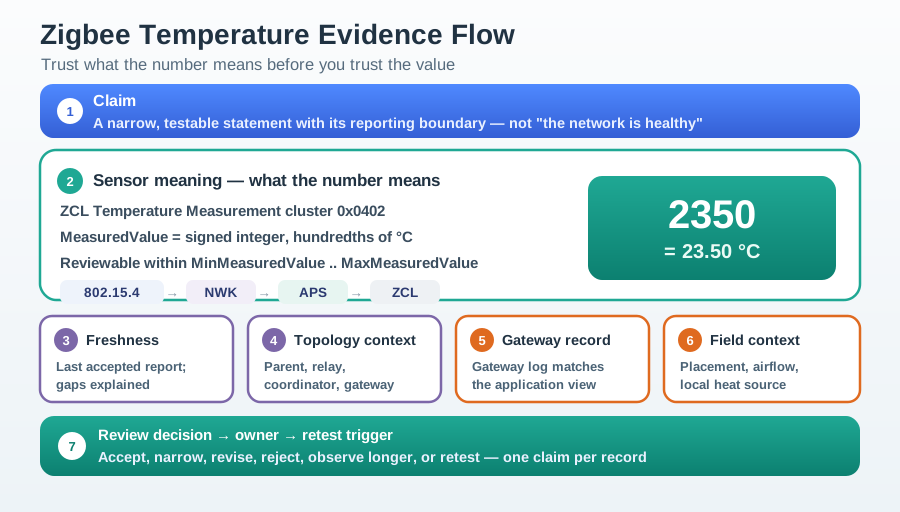
The number is not the first thing to trust.

  • The device has one or more endpoints, each endpoint hosts clusters, and the: Temperature Measurement cluster uses cluster ID 0x0402.
  • Its MeasuredValue attribute is a signed integer in hundredths of a degree Celsius, so 2350 means 23.50 degrees C.
Zigbee temperature-network evidence flow: a testable claim, a sensor-meaning decode through ZCL cluster 0x0402, and freshness, topology, gateway, and field context feeding a review decision, owner, and retest trigger.
iotclass.org

Major section

Review Freshness and Missing Reports

Freshness is not just a clock.

  • A well-designed Zigbee sensor is not normally polled for every value.
  • It uses attribute reporting configured with three parameters: a minimum reporting interval, a maximum reporting interval, and a reportable change.
  • The maximum interval creates a heartbeat even if the value has not changed.

Key terms

If the maximum interval
If the maximum interval is 300 seconds, a reading older than about 300 seconds plus reasonable slack is stale and suspect.

Why it matters

The minimum interval prevents reports from arriving too frequently.

iotclass.org

Major section

Review Freshness and Missing Reports (continued)

The minimum interval prevents reports from arriving too frequently.

  • The reportable change defines the value delta that triggers an earlier report.
  • For review work, the maximum interval is the freshness contract.
  • If the maximum interval is 300 seconds, a reading older than about 300 seconds plus reasonable slack is stale and suspect.
iotclass.org

Major section

Review Topology and Context Together

A temperature network can be healthy as a Zigbee path while still weak as room evidence.

  • Temperature evidence is stronger when the network path and field context agree.
  • Naming the layer is the difference between replacing a router and re-binding a cluster.
  • The review record should make that distinction visible.
iotclass.org

Major section

Common Temperature-Network Mistakes

Treating a reading as room proof:: A sensor reports from a location.

  • Forgetting freshness:: A retained display can be mistaken for a live report when missing-report evidence is not reviewed.
  • Ignoring unit meaning:: A transformed or rounded value can be correct for display but weak for diagnosis if the transformation is undocumented.
  • Reviewing topology without field context:: A healthy path does not prove the sensor is placed where the decision requires.
iotclass.org

Major section

Concept Relationships

Gateway and analyzer evidence: independent records strengthen or challenge the application view.

  • Temperature report and sensor meaning: the value needs unit, conversion, and transformation context before it supports a claim.
  • Freshness and missing reports: a visible value is not automatically a live value.
  • Decision and retest trigger: the review stays useful only when follow-up conditions are explicit.
iotclass.org

Deck summary

Key takeaways

Zigbee is a low-power device network.

  • A smooth line may be old data, not a true view of the room.
  • Reporting-scope evidence records which endpoint, room, zone, path, gateway, and review window the claim covers.
  • The number is not the first thing to trust.
  • Freshness is not just a clock.
iotclass.org

Retrieval practice

Recall check 1 of 6

Radio Remi says: answer from memory, then check your reasoning.

Q1A Zigbee endpoint shows a warm temperature value. What does that single reading NOT prove?

AThat placement, freshness, route, and the actual room condition are all correct
BThat the endpoint transmitted a temperature value at all
CThat the gateway received at least one report from the endpoint
DThat the endpoint currently holds a network address
Show answer

Answer: A A single reading does not prove sensor placement, freshness, route, or the actual room condition are correct.

iotclass.org

Retrieval practice

Recall check 2 of 6

Radio Remi says: answer from memory, then check your reasoning.

Q2A Zigbee Temperature Measurement cluster reports MeasuredValue = 2350. What temperature is that, and in what units is the attribute stored?

A23.50 degrees C, because MeasuredValue is stored in hundredths of a degree Celsius.
B2350 degrees C, because the cluster stores MeasuredValue directly in whole degrees Celsius.
C235.0 degrees C, because ZCL stores temperature attributes in tenths of a degree Celsius.
DIt cannot be determined, because each vendor chooses its own scale for MeasuredValue.
Show answer

Answer: A ZCL cluster 0x0402 stores MeasuredValue in 0.01 degree C units; readings live at endpoint, cluster, and attribute level.

iotclass.org

Retrieval practice

Recall check 3 of 6

Radio Remi says: answer from memory, then check your reasoning.

Q3A Zigbee temperature sensor is configured with a maximum reporting interval of 300 seconds. No report has arrived for 15 minutes. What is the correct interpretation?

AThe reading is stale, and the review should treat prolonged silence as an availability problem rather than a steady temperature.
BThe temperature has been perfectly constant, so no report was needed during the full 15-minute window.
CThe sensor switched to polling mode, so it no longer sends any upstream reports by design.
DThe reportable-change delta was set too small, so the device stopped reporting to save battery.
Show answer

Answer: A Minimum interval, maximum interval, and reportable change define reporting; the maximum interval is the freshness bound.

iotclass.org

Retrieval practice

Recall check 4 of 6

Radio Remi says: answer from memory, then check your reasoning.

Q4In the Zigbee stack, what does a binding accomplish for temperature reports?

AIt links a source endpoint and cluster to a destination so Report Attributes commands are delivered.
BIt encrypts the temperature value end to end between the sensor and whichever destination endpoint it is bound to.
CIt sets the 0.01 degree C scale that the destination uses to decode the MeasuredValue attribute.
DIt assigns the sensor its 16-bit network address so the mesh can route its reports.
Show answer

Answer: A The stack path is 802.15.4, NWK, APS endpoint delivery, then ZCL cluster and attribute; binding wires source cluster reports to destinations.

iotclass.org

Retrieval practice

Recall check 5 of 6

Radio Remi says: answer from memory, then check your reasoning.

Q5A Zigbee temperature endpoint reports a warm value, but the review has no placement note, freshness record, gateway comparison, or owner for retest. What is the strongest decision?

AApprove the room as genuinely warm, because a numeric report from the room's own sensor settles the room condition without further context.
BAccept the bounded endpoint observation, record the missing context, and require freshness, gateway, and placement evidence before a broader room claim.
CSet aside the endpoint report and require a wired probe reading first, because a wired path would reduce uncertainty about wireless delivery.
DAccept the room claim once nearby endpoints also report warmth, because agreement between sensors provides an independent check on the reported condition.
Show answer

Answer: B A temperature-network review separates a bounded endpoint observation from broader claims about room condition, control action, or deployment state.

iotclass.org

Retrieval practice

Recall check 6 of 6

Radio Remi says: answer from memory, then check your reasoning.

Q6A dashboard still shows a normal temperature after reports from that endpoint stop arriving. What should the reviewer do first?

ATreat the displayed value as fresh, because the dashboard would blank the tile if reports had stopped arriving.
BRaise the room-temperature alert first, because treating the reporting gap as a possible heating fault favors an early protective response.
CCheck the last accepted report, missing-report evidence, and topology or gateway context before using the value for a decision.
DIgnore the missing reports for now, because temperature drifts slowly enough that the old value stays safe to act on.
Show answer

Answer: C Freshness review distinguishes a live endpoint report from a retained value that may no longer describe the site condition.

iotclass.org

Print reference

Answers 1 of 2

Answer key.

  1. A · A single reading does not prove sensor placement, freshness, route, or the actual room condition are correct.
  2. A · ZCL cluster 0x0402 stores MeasuredValue in 0.01 degree C units; readings live at endpoint, cluster, and attribute level.
  3. A · Minimum interval, maximum interval, and reportable change define reporting; the maximum interval is the freshness bound.
  4. A · The stack path is 802.15.4, NWK, APS endpoint delivery, then ZCL cluster and attribute; binding wires source cluster reports to destinations.
iotclass.org

Print reference

Answers 2 of 2

Answer key.

  1. B · A temperature-network review separates a bounded endpoint observation from broader claims about room condition, control action, or deployment state.
  2. C · Freshness review distinguishes a live endpoint report from a retained value that may no longer describe the site condition.
iotclass.org