Zigbee, Thread & Matter · Study deck
Zigbee Mesh Simulation
Imagine a set of room sensors that can pass messages through nearby powered devices.
Radio Remi is your guide for this deck.

After studying this chapter
Learning objectives
You will be able to:
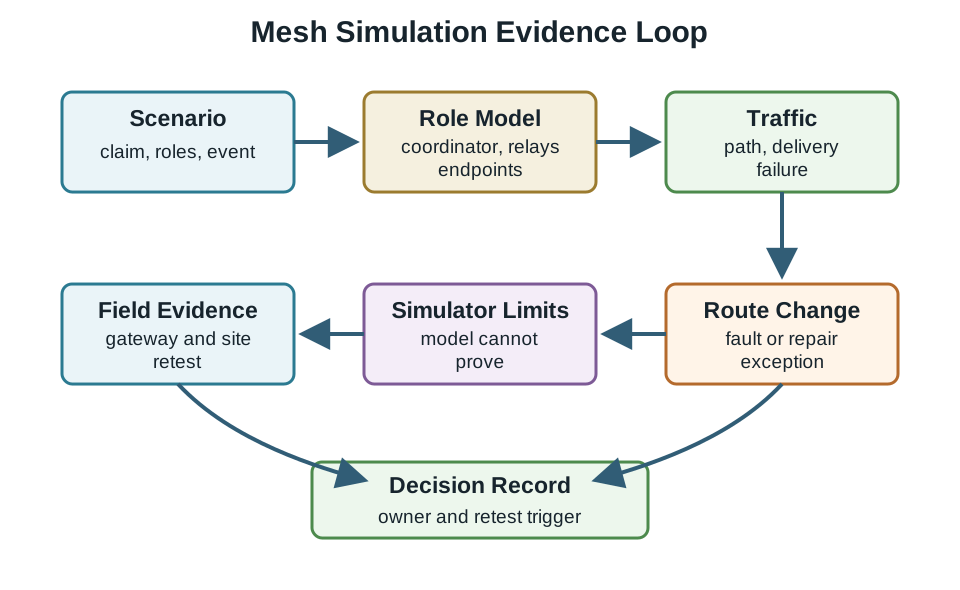
- Explain: The saved path, route-change event, routing-table next hop, hop count, simulator limits, and field evidence are shown together so the modeled result can be reviewed without treating it as deployment proof.
- Explain: The final cards keep the simulator result bounded by separating modeled roles, links, hop depth, and route-change logic from the RF, gateway, site, and retest evidence still required in the field.
- Explain: A simulation that lets battery end devices relay for each other is not modeling Zigbee mesh behavior, so its route-change conclusion should be rejected or narrowed before review.
Major section
In 60 Seconds
Zigbee is a low-power wireless system that can form this kind of mesh.
- A gateway is a bridge between the local mesh and another network.
- A changed line on the screen matters only when the record explains what changed and why.
- A gateway is the bridge from the local mesh to another system.
Major section
In 60 Seconds (continued)
A small clear run is easier to challenge than a large unexplained display.
- Include walls, uneven links, outside radio noise, real device timing, and support tools.
- The simulator does not recreate walls, radio noise, battery aging, or real gateway software.
- Its result is a bounded clue, not field approval.
- Under the Hood examines routing and model limits.
Major section
Simulation Evidence Families
Scenario-boundary evidence records the modeled site, role set, traffic path, event, and excluded conditions.
- Topology evidence records placement assumptions, neighbor assumptions, path options, and single-dependency risks.
- Role evidence records which simulated nodes act as coordinator, router, end device, gateway, or observer.
- Traffic evidence records source, destination, direction, message purpose, and visible delivery or failure.
Try it: Simulation Evidence Families in the chapter
Major section
Role and Topology Model
A Zigbee mesh simulation has to model device roles before it can make a topology claim.
- That role boundary changes how simulation evidence should be read.
- End devices are leaves attached to a parent.
- The role boundary stays explicit: the end device remains a leaf attached to the same parent, while the router backbone performs the route change.
Major section
Role and Topology Model (continued)
A simulation that lets battery end devices relay for each other is not modeling Zigbee mesh behavior, so its route-change conclusion should be rejected or narrowed before review.
- The final cards keep the simulator result bounded by separating modeled roles, links, hop depth, and route-change logic from the RF, gateway, site, and retest evidence still required in the field.
- The worked trace keeps a simulator from becoming an isolated screenshot.
- The saved path, route-change event, routing-table next hop, hop count, simulator limits, and field evidence are shown together so the modeled result can be reviewed without treating it as deployment proof.
Major section
Router Density and Failover Evidence
The strongest mesh-simulation exercise is usually a bounded self-healing test.
- Zigbee route repair can find another path only when the router backbone has an alternate path.
- An end device can rejoin only when another suitable parent is in range.
- When a simulated route heals, record the original path, the failed or removed element, the alternate path, the endpoints affected, and the evidence the simulator cannot provide.
Major section
Simulator Fidelity Limits
A mesh simulator can model device roles, logical links, hop depth from the coordinator, and route-change logic.
- Multipath fading, 2.4 GHz interference from Wi-Fi, time-varying LQI, hidden-node collisions, enclosure effects, gateway implementation details, and maintenance practice can all change the field result.
- The alternate router selected by the model may not be reachable in the real site with enough margin, or it may be reachable only under light traffic.
- It also helps to separate routing ideas the simulator may blur.
Deck summary
Key takeaways
Zigbee is a low-power wireless system that can form this kind of mesh.
- A small clear run is easier to challenge than a large unexplained display.
- Scenario-boundary evidence records the modeled site, role set, traffic path, event, and excluded conditions.
- A Zigbee mesh simulation has to model device roles before it can make a topology claim.
- A simulation that lets battery end devices relay for each other is not modeling Zigbee mesh behavior, so its route-change conclusion should be rejected or narrowed before review.
Retrieval practice
Recall check 1 of 5
Radio Remi says: answer from memory, then check your reasoning.
Q1A Zigbee mesh simulation shows traffic rerouting after one router is removed. What must still be required before deployment approval?
Show answer
Answer: A A mesh simulation is scenario evidence; deployment still needs field gateway logs, real traffic, and a retest owner.
Retrieval practice
Recall check 2 of 5
Radio Remi says: answer from memory, then check your reasoning.
Q2In a Zigbee mesh simulation, which devices form the relaying backbone?
Show answer
Answer: A Zigbee relaying is performed by routers and the coordinator.
Q3A simulation partitions the network when one router fails. What does that most directly reveal?
Show answer
Answer: A AODV-style repair and end-device rejoin help only when alternate routers and parent candidates are actually available.
Retrieval practice
Recall check 3 of 5
Radio Remi says: answer from memory, then check your reasoning.
Q4What can the team accept from this simulation before deployment?
Show answer
Answer: C Simulation evidence should be accepted only within its boundary and paired with field evidence, an owner, and a retest trigger before deployment approval.
Retrieval practice
Recall check 4 of 5
Radio Remi says: answer from memory, then check your reasoning.
Q5Why can a Zigbee mesh simulation show clean self-healing that later fails in a real deployment?
Show answer
Answer: A Mesh simulation covers logic and roles.
Retrieval practice
Recall check 5 of 5
Radio Remi says: answer from memory, then check your reasoning.
Q6A team wants to approve a real Zigbee site because a mesh simulation showed all modeled traffic reaching the gateway. Which review response best preserves quality?
Show answer
Answer: B The simulation helps shape the review, but deployment readiness needs field evidence, recorded exclusions, an owner, and a retest trigger.
Print reference
Answers 1 of 2
Answer key.
- A · A mesh simulation is scenario evidence; deployment still needs field gateway logs, real traffic, and a retest owner.
- A · Zigbee relaying is performed by routers and the coordinator.
- A · AODV-style repair and end-device rejoin help only when alternate routers and parent candidates are actually available.
- C · Simulation evidence should be accepted only within its boundary and paired with field evidence, an owner, and a retest trigger before deployment approval.
- A · Mesh simulation covers logic and roles.
Print reference
Answers 2 of 2
Answer key.
- B · The simulation helps shape the review, but deployment readiness needs field evidence, recorded exclusions, an owner, and a retest trigger.