Zigbee, Thread & Matter · Study deck
Zigbee Protocol Selection
A protocol is a shared set of rules for exchanging messages.
Radio Remi is your guide for this deck.

After studying this chapter
Learning objectives
You will be able to:
- Explain: Zigbee channels 15, 20, 25, and 26 fall in the gaps between common Wi-Fi channels 1, 6, and 11, so channel planning is selection evidence, not a late tuning task.
- Explain: BLE is phone-friendly with shorter per-hop range; Wi-Fi offers high bandwidth and direct IP at higher power and without a native low-power mesh.
- Explain: The mathematical gist: Zigbee channel 26 is 2480 MHz, so its wavelength is 0.121 m and a quarter wave is 30.2 mm.
- Explain: The common short-list choices differ on concrete axes, not marketing labels.
Major section
In 60 Seconds
A protocol is a shared set of rules for exchanging messages.
- Zigbee is a protocol for low-power devices that send small messages over a local wireless network.
- A gateway is a device that passes those messages to another network.
- Choosing Zigbee is not a popularity contest.
Major section
Phoebe's Field Notes: Why the Channel Number Barely Moves the Physics
The mathematical gist: Zigbee channel 26 is 2480 MHz, so its wavelength is 0.121 m and a quarter wave is 30.2 mm.
- Moving from channel 15 at 2425 MHz to channel 26 changes same-distance free-space loss by only 0.195 dB.
Major section
Start With the Selection Claim
The record also states which changes require a new test.
- Weak claim: Zigbee is the best protocol for the project.
- Stronger claim: Zigbee fits the workload inside this named site.
- The team can support the mesh and device behavior.
- A named owner runs the gateway.
Major section
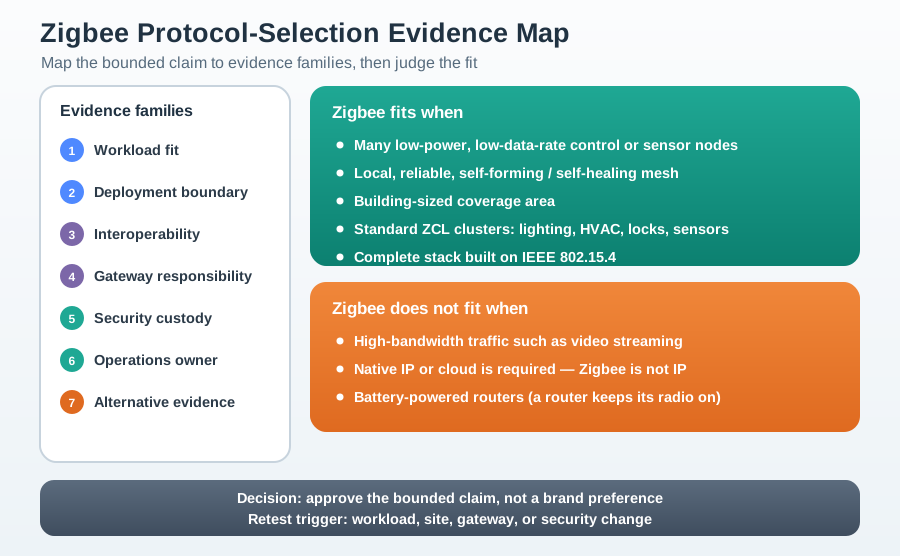
Protocol Selection Evidence Families
Workload evidence records the message pattern, endpoint behavior, energy constraints, throughput need, local control expectation, and failure tolerance.
- Deployment evidence records the site boundary, topology expectation, router availability, gateway placement, and acceptance test.
- Interoperability evidence records what the system must work with, where translation is acceptable, and which behaviors must remain native.
- Gateway evidence records whether Zigbee-to-application translation is acceptable, who owns the bridge, and what happens when the bridge changes.
Major section
Zigbee Fit Sweet Spot
A mesh lets devices pass messages for one another and find a new path after a link fails.
- The: Zigbee Cluster Library (ZCL) gives products shared commands for lights, heating, locks, and sensors.
- Zigbee fits many low-power devices that need reliable local control and send little data across a building.
- Zigbee does not fit every job.
Major section
Compare Zigbee, Thread, BLE, and Wi-Fi by Evidence
The common short-list choices differ on concrete axes, not marketing labels.
- BLE is phone-friendly with shorter per-hop range; Wi-Fi offers high bandwidth and direct IP at higher power and without a native low-power mesh.
- Zigbee's most common home-automation competitor is not Thread but Z-Wave.
- The comparison is a workload-fit question, not a brand question.
Major section
Gateway Boundary and RF Coexistence
A Zigbee network placed on a channel that overlaps a busy Wi-Fi access point will suffer retries and latency.
- When used, that gateway is a possible single point of failure and an interoperability boundary.
- The second underplanned factor is 2.4 GHz RF coexistence.
- Zigbee shares the 2.4 GHz band with Wi-Fi and BLE.
Major section
Gateway Boundary and RF Coexistence (continued)
Cross-vendor behavior depends on both sides speaking standard Zigbee 3.0 and ZCL; manufacturer-specific clusters reduce portability the moment they are used.
- Zigbee channels 15, 20, 25, and 26 fall in the gaps between common Wi-Fi channels 1, 6, and 11, so channel planning is selection evidence, not a late tuning task.
- "We chose Zigbee" is an incomplete decision.
- Because Zigbee is not IP, a Zigbee network needs a gateway when its devices must communicate with IP, MQTT, cloud, or another external application service; local Zigbee device-to-device control does not require one.
Major section
Common Selection Drift
Familiarity drift: choosing Zigbee because the team knows it without proving project fit.
- Trend drift: rejecting Zigbee because another protocol is newer without checking the deployment boundary.
- Gateway drift: ignoring the translation boundary until application behavior fails.
- Operations drift: selecting a protocol that nobody can maintain after release.
Deck summary
Key takeaways
A protocol is a shared set of rules for exchanging messages.
- The mathematical gist: Zigbee channel 26 is 2480 MHz, so its wavelength is 0.121 m and a quarter wave is 30.2 mm.
- The record also states which changes require a new test.
- Workload evidence records the message pattern, endpoint behavior, energy constraints, throughput need, local control expectation, and failure tolerance.
- A mesh lets devices pass messages for one another and find a new path after a link fails.
Retrieval practice
Recall check 1 of 6
Radio Remi says: answer from memory, then check your reasoning.
Q1A team wants Zigbee mainly because it already knows the tools. What is the strongest selection stance?
Show answer
Answer: A Zigbee should be chosen only when workload, gateway, interoperability, and operations evidence fit the claim, not from familiarity.
Retrieval practice
Recall check 2 of 6
Radio Remi says: answer from memory, then check your reasoning.
Q2Which deployment is the clearest fit for Zigbee?
Show answer
Answer: A Zigbee fits low-power 802.15.4 mesh deployments with ZCL application behavior for many small control and sensor nodes; it does not fit video, direct IP endpoint reachability, or battery router designs.
Retrieval practice
Recall check 3 of 6
Radio Remi says: answer from memory, then check your reasoning.
Q3Both Zigbee and Thread run over IEEE 802.15.4 mesh. What is the key architectural difference when choosing between them?
Show answer
Answer: A Thread is IPv6-native and commonly pairs with Matter; Zigbee is non-IP and uses a gateway plus ZCL clusters.
Retrieval practice
Recall check 4 of 6
Radio Remi says: answer from memory, then check your reasoning.
Q4A team wants to choose Zigbee because it already knows the tools and has used it before. Which review claim is strongest?
Show answer
Answer: B Protocol selection should be based on bounded evidence and owned risks — including security custody, operations ownership, and retest evidence.
Retrieval practice
Recall check 5 of 6
Radio Remi says: answer from memory, then check your reasoning.
Q5A Zigbee lighting network suffers intermittent latency and RF retries while a nearby Wi-Fi access point uses an overlapping 2.4 GHz channel. Which selection-time factor was most likely under-planned?
Show answer
Answer: A Zigbee selection needs both a gateway plan and a 2.4 GHz channel plan against local Wi-Fi, commonly using Zigbee channels such as 15, 20, 25, or 26 to reduce overlap.
Retrieval practice
Recall check 6 of 6
Radio Remi says: answer from memory, then check your reasoning.
Q6A protocol-selection record recommends Zigbee but does not document gateway ownership, interoperability evidence, or retest triggers. What should the reviewer do?
Show answer
Answer: B Protocol selection is not ready until gateway, interoperability, owner, and retest evidence are recorded.
Print reference
Answers 1 of 2
Answer key.
- A · Zigbee should be chosen only when workload, gateway, interoperability, and operations evidence fit the claim, not from familiarity.
- A · Zigbee fits low-power 802.15.4 mesh deployments with ZCL application behavior for many small control and sensor nodes; it does not fit video, direct IP endpoint reachability, or battery router designs.
- A · Thread is IPv6-native and commonly pairs with Matter; Zigbee is non-IP and uses a gateway plus ZCL clusters.
Print reference
Answers 2 of 2
Answer key.
- B · Protocol selection should be based on bounded evidence and owned risks — including security custody, operations ownership, and retest evidence.
- A · Zigbee selection needs both a gateway plan and a 2.4 GHz channel plan against local Wi-Fi, commonly using Zigbee channels such as 15, 20, 25, or 26 to reduce overlap.
- B · Protocol selection is not ready until gateway, interoperability, owner, and retest evidence are recorded.